
New Batteries - how to hold them down?

richardm47

Well-Known Member
Joined
16 Nov 2007
Messages
223
Location
Hampshire
Visit site
Here's a picture of my current battery locker. I have 2 batteries there. One, the blue engine-starting Varta, has lips on the casing of the battery, and the perforated metal strip is used as a clamp onto the lips to hold it down. The other battery (domestic, black) is held down with those yellow nylon straps, which are carefully positioned so that the black filler caps can still be accessed.
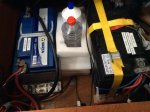
image.jpg
I'm planning to replace the black battery with 2 x Trojan T105 batteries, see below for a grainy picture. But how to fix them down securely? They don't have any such lips, and it seems to me that if I use straps they are likely to foul the filler caps.

Other ideas on how to tie batteries down would be much appreciated.
 

Attachments

  • image.jpg
    image.jpg
    5.5 KB · Views: 0
Last edited:
Do you need to hold them "down" or just stop them falling over when heeled / pitching & rolling?

If the latter, you could just make a stout 3 sided wooden box and fix that down to the floor, and put the battery inside it.
If the former, then I'm presuming everything else is capsize proofed as well...?
 
Do you need to hold them "down" or just stop them falling over when heeled / pitching & rolling?

If the latter, you could just make a stout 3 sided wooden box and fix that down to the floor, and put the battery inside it.
If the former, then I'm presuming everything else is capsize proofed as well...?

Batteries should really be properly held down to withstand an inversion - otherwise they become lethal projectiles in a >90 degree knockdown and will leave the vessel powerless upon righting, if you are alive to care!
 
Batteries should really be properly held down to withstand an inversion - otherwise they become lethal projectiles in a >90 degree knockdown and will leave the vessel powerless upon righting, if you are alive to care!

Fair enough, in which case make a wooden box with a lid, fitted with suitable vent holes in the upper sides, and stout quick-release clips (e.g. up and over type) to hold the lid on and secure the batteries down.
 
I built a solid wooden box for mine, intending to also hold them down with a wooden batten across the top though I haven't actually got round to that bit yet. I wouldn't be happy using metal bars or strapping across the top of a battery due to the potential for a short-circuit.

Pete
 
Fair enough, in which case make a wooden box with a lid, fitted with suitable vent holes in the upper sides, and stout quick-release clips (e.g. up and over type) to hold the lid on and secure the batteries down.

That would work, but might be tricky to construct such a strong box. The most common way is to make a lightish box designed only to prevent lateral movement, with straps (often web with buckles) secured to strong points at the bottom of the vessel to prevent the batteries falling out in the event of an inversion.

The reason I'm somewhat OTT on this point is that I was once on a boat which suffered a 90 degree knockdown in the Channel, where whatever dynamic forces existed sent one domestic battery on its way. This totally splintered a door it hit and the boat righted itself powerless and damaged from what should have been no more than a big Oops! moment. I reckon that battery would have broken the leg of any unfortunate crew member in its way.
 
That would work, but might be tricky to construct such a strong box. The most common way is to make a lightish box designed only to prevent lateral movement, with straps (often web with buckles) secured to strong points at the bottom of the vessel to prevent the batteries falling out in the event of an inversion.

The reason I'm somewhat OTT on this point is that I was once on a boat which suffered a 90 degree knockdown in the Channel, where whatever dynamic forces existed sent one domestic battery on its way. This totally splintered a door it hit and the boat righted itself powerless and damaged from what should have been no more than a big Oops! moment. I reckon that battery would have broken the leg of any unfortunate crew member in its way.

I have two SS threaded bars bolted through a well fixed plywood board below the batt, with a 1x 2 inch
Timber beam over the top. All clamped snugly down. Battens around the base prevent lateral movement. Has worked well so far. I found with straps only that the batts always moved a little loosening the + &- terminals. Perhaps I should use both? I guess in a box, bolted and strapped would be a belt and braces approach
 
Last edited:
I have two 110ah domestic batteries fitted on a strong shelf adjacent to a bulkhead. Fitted within a tray on the shelf and then held down by a wooden bar, hinged at the bulkhead end and a threaded SS rod with penny washers & nuts at the other. Works well and no problems even in very rough seas.

View attachment 44969
 
I don't see any problem with putting a strap across which DOES cover the filling plugs. You can undo it when checking electrolyte levels and I doubt that will be during an inversion! I certainly don't see the advantage of building a box, which probably wouldn't take the force of three batteries thumping into the lid as she rolls.

I have to say, I am lucky that my batteries are under the navigator's seat and the whole seat frame has a batten screwed across which holds them down - the frame being attached to the bulkhead... Sorry, started chuckling as the tune of "Them bones..."wouldn't leave my head.

Rob.
 
...The reason I'm somewhat OTT on this point is that I was once on a boat which suffered a 90 degree knockdown in the Channel, where whatever dynamic forces existed sent one domestic battery on its way...

You would have thought the cables to the batteries would have prevented it from travelling too far. Sounds as though something wasn't done up tight or the crimps weren't properley made.
 
You would have thought the cables to the batteries would have prevented it from travelling too far. Sounds as though something wasn't done up tight or the crimps weren't properley made.

Interesting point. I don't remember the details as I stayed on deck, but you could be right; crimping 25mm squared plus wire certainly needs a beefy crimper.

But however it happened, I was amazed at the number of items, some quite heavy, which were flung all over the place, like for example a dehumidifier which had hitherto been lodged somewhere in the back cabin. The loose battery was however by far the most chilling sight. I now secure my batteries with a lengthways web strap over the length of each one and a further strap running at right angles - to be sure to be sure as they say in Ireland!
 
... to be sure to be sure as they say in Ireland!

Or as Macbeth says, to "...make assurance double sure ...". :)

My original (now both domestic) batteries are strapped down and when I added a smaller engine start battery I used a commercial battery box, firmly affixed to a new glassed-in platform, but with a home-made wooden flat lid. The battery strap passes under the internal battens holding down the box, and the lid itself is also strapped down. Probably overkill, but it wasn't a lot of trouble to do.
 
This is the stern of a powerboat. I do like the way the batteries are bolted down and copied this idea on a rib. The frame was welded up from aluminium angle.

bbox_zpsa45a9ff5.jpg
 
I built a solid wooden box for mine, intending to also hold them down with a wooden batten across the top though I haven't actually got round to that bit yet. I wouldn't be happy using metal bars or strapping across the top of a battery due to the potential for a short-circuit.

Pete

I make an open box, but fitted D loops to the woodwork adjacent and use a small jacking strap to loop round the box and over the batteries. Easy to tighten up or release- no worry about chances of a red hot short with a metal strap!
It stayed secure after a North sea crossing last weekend, almost all off which was F5-F7, with waves to match, so I am comfortable it works! A few other things came adrift in the saloon, but nothing drastic!

Graeme
 
That would work, but might be tricky to construct such a strong box. The most common way is to make a lightish box designed only to prevent lateral movement, with straps (often web with buckles) secured to strong points at the bottom of the vessel to prevent the batteries falling out in the event of an inversion.

The reason I'm somewhat OTT on this point is that I was once on a boat which suffered a 90 degree knockdown in the Channel, where whatever dynamic forces existed sent one domestic battery on its way. This totally splintered a door it hit and the boat righted itself powerless and damaged from what should have been no more than a big Oops! moment. I reckon that battery would have broken the leg of any unfortunate crew member in its way.

I'm also OTT on securing heavy objects: in the case of the inversion and multiple knockdowns on one nasty passage the batteries were fine but it was a big steel toolbox and contents that went airborne. The toolbox contained amongst many others the one small box spanner that was essential to bleed the engine. In the same series of incidents the engine fuel line got ripped off by floating debris. It was long after we had finally sailed the engineless boat in, that the box spanner was found wedged deep under a flexible water tank under a screwed down bunk base.
 
I use ratchet straps to hold the domestic batteries in place. Easy enough to release it to fettle the batteries. I too was on a boat knocked down off Alderney. Amongst other damage, the domestic battery took flight, pinning a crew man between it and the galley, resulting in broken ribs. The length of cable between the battery and where it joined the loom was enough to allow the battery to build up enough speed to break the cables. The other problem was that the loose battery meant we lost all power in the boat: no lights, no radio, no bilge pump and no GPS. Entertaining time getting it all sorted so we could call for help as the steering was knackered too. This leads me to pay attention to making sure the damn things stay put, hence the cargo straps to hold them down.
 
As an aside if straps are used they should be made of polyester/terylene or polypropylene rather than nylon which is attacked by acid.
 
Top