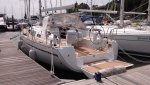
New awb's.

What I would genuinely like to see are figures showing actual use of charter boats, not just how they might be used. Accounts of charter trips in the mags are normally of a series of short hops with long stays in port. Of course, there is absolutely nothing wrong with that and it is, as you have said, what modern AWBs are designed for. But it would be very interesting to have a mean and standard deviation for hours at sea and miles covered for one of the big charter fleets.

Our boat was on a charter fleet for 6 years. It used to rent for an average of 25 weeks/year. Looking at the tracker and where people went, we used to reckon on an average of about 100nm/week and the engine hours was between 2 and 4 per day.

So over 6 years, that gives you:-

1,050 days of use
15,000 n. miles sailed
3,000 engine hours

We reckoned that was the equivilent of about 30-35 years of private use.

Boat is now 15 years old, and still looks and works fine (with a transatlantic thrown-in for good measure).

Now tell me that AWB's are only good for sitting in marinas.
 
Last edited:
There does seem to be a slightly Calvinist hair-shirt attitude prevailing amongst some of the trad yacht enthusiasts, turning their noses up at those of us who prefer pootling in the Med, or a bit of trade wind sailing to proper manly white knuckle stuff in home waters, but there's nothing new in that.

Back in the early 80s, when I was a student, I used to work sometimes in my hols for a very highly regarded British yacht builder. In particular, I worked at the boat shows atEarl's Court and Southampton.

Our sales literature generally featured a black and white shot of one of our boats, smashing to windward in a breeze in the English Channel, the crew clinging on with gritted teeth. I remember comparing it with the brochure for the Jeanneau Sun Fizz, which offered shots of the boat anchored in aquamarine mediterranean waters, with a couple of pretty girls in bikinis on board, a bottle of chilled rosé on the cockpit table and so on.

Guess which company is still in business ?
 
What I would genuinely like to see are figures showing actual use of charter boats, not just how they might be used. Accounts of charter trips in the mags are normally of a series of short hops with long stays in port. Of course, there is absolutely nothing wrong with that and it is, as you have said, what modern AWBs are designed for. But it would be very interesting to have a mean and standard deviation for hours at sea and miles covered for one of the big charter fleets.

I doubt they keep that sort of data although engine hours would be easy to find. The pattern of usage I quoted for my boat is typical of boats in the eastern Med, but the miles sailed (or motored) will vary depending on location. In the Ionian most stopping places are fairly close together and anything over 30 miles a day is unusual, whereas in the Aegean distances between islands are greater and winds are stronger so miles covered, and sailed will likely be very much higher on average.

Whichever way you look at it the basic fact that charter boats are used more intensively in their short lives than most private boats in their whole life. Wonder how many of those 30 year old engines that need replacing have done the 3500 hours mine did in the first 7 years?
 
What I would genuinely like to see are figures showing actual use of charter boats, not just how they might be used. Accounts of charter trips in the mags are normally of a series of short hops with long stays in port. Of course, there is absolutely nothing wrong with that and it is, as you have said, what modern AWBs are designed for. But it would be very interesting to have a mean and standard deviation for hours at sea and miles covered for one of the big charter fleets.

One AWB based Cornwall - not full 12 months/year chartered - ashore 3-4 months each winter. I bought it 2005 with 70 miles on the log, currently showing just over 27,000. Maintained by me (owner) not the charter agent. Actually holding up quite well in terms of condition. That probably represents about 100 miles average per weeks charter - a few go Brittany or Ireland, fair number to Scilly, some just potter about locally.
 
wully1;6305100............but I hate the twin wheel style thing which seems to me just to be a way to fill in all that space the fat arse boats have.. .[/QUOTE said:
Even worse, for a boat ostensibly designed for cruising, when they sit on top of twin rudders, saildrive and a T bulb keel.
 
Well said JumbleDuck. I wonder what the living space would be like on a tour of the western or northern isles?

As others have said they are built for the Mediterranean market, with some of them being sailed to Australia. Some are used for trips like the ARC, but as JumbleDuck said that is a three week ride on the trade winds.

I still consider the build quality as low. While I understand modern "bag and vacuum" production techniques, and visited yards to see the process in action, even more geekly followed the maths behind the strength/weigh ratios of the hull and the business case for moving to that way of production; the fact I can push the hull and it moves does not fill me with confidence. From what I've seen interior finish is appalling, OK I maybe bias as my BiL is a joiner who specialists in the quality market, but even I can see that its been built to a price.

The examples of boats that sail long distance are just that. There are many more examples, and using modern production boats is becoming the norm simply because that is what is available for many people.

We tend here to think we have a monopoly on "serious" boats and sailing, so therefore ignore what happens in the rest of the world that was not brought up on a diet of heavy boats and cold weather sailing. Never mind the often mistaken belief that all older boats are well built when even a casual reader of this forum will show that is not the case. Those of us who were involved in the boat building business in its hey day will tell you about all the dubious practices that went on. Most boats were just like today were built to a price, but today's low price buys you a far better built boat than in the past.

I suppose it is the market that determines what is acceptable and it is no surprise that the UK boat building industry collapsed as soon as it was faced with competition. I wonder if you can explain why the first and most successful Jeanneau dealer in the UK was based in Scotland? if the boats are so unsuitable for the conditions there?
 
Even worse, for a boat ostensibly designed for cruising, when they sit on top of twin rudders, saildrive and a T bulb keel.

No harm in a bit of performance features -it's easy enough to slow right down if you want to pretend to be in an old boat.

But the twin wheels are there for an entirely practical reason. The boats are designed with their entrance at the back for swimming, getting into the rib and for docking. So topsides can be as high as you like as you never step through the guard rails except onto high fuel berths, but a clear passage aft is good design and much more convenient than the big wheel we have on our older AWB.

I've started to see more UK based boats reversing into their berths but it baffles me that the majority of UK AWB owners still go in forwards and climb down onto wobbly fingers instead of stepping off onto the main pontoon.
 
There does seem to be a slightly Calvinist hair-shirt attitude prevailing amongst some of the trad yacht enthusiasts, turning their noses up at those of us who prefer pootling in the Med, or a bit of trade wind sailing to proper manly white knuckle stuff in home waters, but there's nothing new in that.

I don't think thats the case at all, certainly not from me. I am looking forward to a few years pootling around the med, and even the trip through the canals I intend to take my time and enjoy it.
I did not say awb's cannot sail, I want space and light and comfort below, I love the idea of an owners aft cabin.

I am surprised at the quality of finish and materials for the money. Even the vinyl on the cushions was cheap tat, it cant make any real difference to margins with an asking price of £365k to use high quality cushion coverings surely? (thats just one example)

I am surprised at the lack of practicality when in a rough sea given to the interior in the designs... and the med by all accts is frequently rough! No fiddles on tables, puny magnetic catches, no wet lockers. Do med sailors never use full foul weather gear? where does it go when soaking wet? I don't want it in the shower as I will prob want a nice warm shower to warm up in if the weather was crap.

(I only have my mab to compare it to, but I honestly expected to be blown away by the difference. I just wasn't. If I compared a ford mondeo say, to an entry level ford from 40 years ago, it would be night and day, from every perspective. That just doesn't appear to have happened in the yacht world. )

Most of all, I am surprised by the poor value for the amount of money asked for. It may well be that my feelings on the matter are out of kilter with everyone else's, but it doesn't change the fact I would not spend that amount of money in return for one of them. I just don't think they are worth it.

An awful lot of folk obviously do, and that's fine.
 
I've started to see more UK based boats reversing into their berths but it baffles me that the majority of UK AWB owners still go in forwards and climb down onto wobbly fingers instead of stepping off onto the main pontoon.

I often reverse in; makes it so much easier to carry gear on and off.

boat.jpg
 
Even worse, for a boat ostensibly designed for cruising, when they sit on top of twin rudders, saildrive and a T bulb keel.

You’re describing the new 34’ Rassy complete with saildrive but less chart table. Another case of a successful yacht builder knowing the market? I do hope they checked in here first :encouragement:
 
I often reverse in; makes it so much easier to carry gear on and off.

View attachment 68460

Yup - you've aligned your front door with your front path instead of carefully leaving the front door locked and climbing in and out of a high bay window.

I have to admit I'm only slowly warming to drop down sterns compared to sugar scoops despite the way they look better. That's purely because a couple of ball fenders on a sugar scoop can hold you against a wall or pontoon but it's harder to set them for the drop down stern. But in the last couple of seasons I've seen more and more of those corner fenders used on approach and that's a neat solution.
 
If any of them make it up to the West of Scotland, I'll have a look. Perhaps they are all too busy coasting down the tradewinds for three weeks.

Now you are just being silly. OK you may not like AWBs, but there are masses of AWBs cruising successfully and happily up the West Coast of Scotland, and beyond in Orkney and Shetland - probably the majority in most anchorages. I suspect you know this.
- Jeanneau, Bavaria and Hanse must make up the largest percentage of new boats sold into Scottish waters by an easy margin - certainly plenty of new Jeanneau being launched for the season at Largs earlier this year
- the vast majority of West Coast charter boats are similarly AWBs
- they take a lot of hard work - often seen us boat owners coming into a (rare) pontoon berth in the outer isles to shelter from strong winds just as 6 or 8 guys on a large Bavaria head out to hammer upwind for 60miles to keep their itinerary planned in a pub 6 months previously (“Barra or bust”). And the charter boat is back doing the same thing next week.

OK you don’t like them, and some of us pay a premium for rarer boats. But undoubtedly the AWBs do the job well, and for most are a better option than a MAB for cruising Scotland
 
Our boat was on a charter fleet for 6 years. It used to rent for an average of 25 weeks/year. Looking at the tracker and where people went, we used to reckon on an average of about 100nm/week and the engine hours was between 2 and 4 per day.

So over 6 years, that gives you:-

1,050 days of use
15,000 n. miles sailed
3,000 engine hours

We reckoned that was the equivilent of about 30-35 years of private use.

Boat is now 15 years old, and still looks and works fine (with a transatlantic thrown-in for good measure).

Now tell me that AWB's are only good for sitting in marinas.

Mine was 7 years in Charter, had 4,500 engine hours when I bought it, and instruments showing well over 40,000 NM of distance covered. It was a popular boat as proved by the number of people I have met who had previously chartered it.. Its now 19 years old and still going strong covering over 1,000 NM on average each year in my ownership. Its an AWB from 1998, built by Jeanneau, and its interior still looks better than some of the new boats, because in those days Jeanneau used good quality marine plywood with well matched veneers, and solid hardwood edgings. Whenever I see new AWB's at boat shows I am glad I bought secondhand. I don't like the modern hull shape with the beam taken right aft, and think my older boat looks much better, as well as having good sailing characteristics despite a relatively small sail plan.
 
I was also at LIBS today, and, although I didn't much care for the Beneteau/Jeanneau offerings I saw, I really liked the ~35' Dehler—not that I expect ever to afford one!

For those saying that yachts today don't look after you in a seaway—look at the '79 Fastnet report. STIX and so on are aimed at avoiding this kind of incident, and modern mass manufactured boats almost certainly have more thought given to their dynamic and static stability in different load conditions and so forth than boats of that era. Things like downflooding angles, metacentre of buoyancy etc. are likely also calculated more accurately and frequently at the design stage, thanks to CAD.
 
For those saying that yachts today don't look after you in a seaway—look at the '79 Fastnet report. STIX and so on are aimed at avoiding this kind of incident, and modern mass manufactured boats almost certainly have more thought given to their dynamic and static stability in different load conditions and so forth than boats of that era. Things like downflooding angles, metacentre of buoyancy etc. are likely also calculated more accurately and frequently at the design stage, thanks to CAD.


I am a keen student of such things but find it difficult to access any useful stability information at all about contemporary designs.
I would welcome any links to this information - the work on different load conditions sounds interesting.
 
I am a keen student of such things but find it difficult to access any useful stability information at all about contemporary designs.
I would welcome any links to this information - the work on different load conditions sounds interesting.

I'm afraid I am nothing but a fellow student in this regard—but I can recommend the oft-quoted Larsson, Eliasson and Orych "Principles of Yacht Design" (I selected it as a prize some years ago, but it's otherwise sadly rather expensive); it has a significant section on stability, specifically chapter 4. To give a vague idea, and assuming a slightly physics-y background:
They take you through the usual basic calculations of static stability to begin with; this is pretty well documented elsewhere (e.g. in the late John Teale's "How to Design a Boat", and doubtless online). Then comes longitudinal stability; after this, they consider roll damping and the effects of waves on stability. Here, and in Ch.5, they go on to discuss, for example, the moment of inertia about different axes—which is to angular acceleration what mass is to linear acceleration—in waves, there is obviously a balance to be considered. It's been some time since I looked through the book in any detail, but I seem to recall there is more on this matter later. Note that none of this (possibly aside from roll damping) cannot be done by hand, but whether it would be done without the aide of a computer package that makes it easy and quick is perhaps another question.

My point was not based on in-depth experience of yacht design, but rather from reading such books. It is my impression that many yacht designers of the 70s were not deeply numerate, and designed boats such that they "looked right"—they were designers. Modern yachts follow the thrust of car design: the bodywork may be "styled", but one gets the impression that, at the big manufacturers at least, there is a team of engineers behind it who are crunching the numbers, as indeed they must to get RCD certification. If people with more knowledge of yacht design practices from the 50s-80s are able to advise on whether such detailed sums were actually performed, this would be very interesting!

I have read that the details of stability (AVS being perhaps one of the most useful) are usually not available to the private purchaser, but only to commercial clients; either one could lean on a friendly charter firm to request them, or possibly (especially if actually looking to buy) simply put some pressure on a salesman.
 
Now you are just being silly. OK you may not like AWBs, but there are masses of AWBs cruising successfully and happily up the West Coast of Scotland, and beyond in Orkney and Shetland - probably the majority in most anchorages. I suspect you know this.

Not many. Once you're north of Ardnamuchan it's Nauticats and MABs all the way. Sure you see a few modern things in marinas, but I have rarely seen any in interesting places.
 
Not many. Once you're north of Ardnamuchan it's Nauticats and MABs all the way. Sure you see a few modern things in marinas, but I have rarely seen any in interesting places.

Maybe that's because you can buy a castle up there for the same price as an AWB.
 
Not many. Once you're north of Ardnamuchan it's Nauticats and MABs all the way..

What a ridiculous sweeping statement! My own experience is having seen a roughly even mix of MAB and AWB round the Scottish west coast I have been to over the past few years, including outer Hebrides and round north of Skye. Including being storm bound in south Rona for a day with a bav 36 and similar in loch skipport with two charter beneteaus. Both times in my MAB
 
Last edited:

Other threads that may be of interest

Top