New 6HP Tohatsu Sail Drive Stalling

Munsterfield

New Member
Joined
16 Feb 2026
Messages
5
Visit site
Hi All!
I bought a new 6HP Sail Drive Tohatsu engine last year which dies suddenly after a random amount of time from 30m to perhaps 1h30m. This has happened with both the external tank and internal tank.
There's always a subtle tell-tale before it quits, sounding like it's hesitating a little, makes me think it's starved for gas. When on the external tank, the bulb is somewhat deflated, but not quite pancaked. Once when It was on the internal tank, after it quit, I opened the gas tank and found that the liquid was all the way up to the cap (and no I did not fill it up that high) ... by the time I arrived back to my mooring ~30 minutes later the gas had dropped back to it's normal level (I'm getting the top tank had crumpled, though in my panic I didn't remove the cowling to check. And yes, I do open the EPA vent.
When hearing the telltale sound of the engine bogging down, I've been able to keep in running for a couple more minutes by pressing the priming bulb, but it still failed. Also, tried opening the gas cap completely when the telltale sound happened and it still died within a couple of minutes.
I have always been able to start the engine back up after, and it behaves like nothing happened.
I'd appreciate any insight!
 
Welcome to the forum.
I have a 2010 version of this engine, and my 1st thought for you is to take it back to the supplier and get them to check it, given that it might be within a year of purchase which (I believe) has a legal obligation of expectation that it should be OK still!
You've tried both tanks; on mine I couldn't ever get it to run reliably whilst the internal was in place, but the problem I had, which was similar, doesn't appear to have been related to either of the tanks.
With the internal tank becoming brim full would indicate that it's being pumped up, which can't happen from the engine pump, unless there's a blockage from the carb. float, perhaps sticking in the closed position, back to the pump within that short pipe, maybe becoming crimped or having a bit of crud within it.
I'd try to only run it from the internal with the external tank fully detached for simplicity, which you might have done already.
This manual might be of help to you, or this one as well. They both say that it's for the 4hp, but that's virtually the same as the 6hp.
Good luck (y) .
 
Last edited:
I see no mention of checking vents are open on tanks and working? There is a one way valve after the cock that switch’s between tank or external to stop back flow, mine had intermittent blockage, allowing petrol to flow back. Disconnect fuel line at carb and pump to check flow. Have you checked filter and water trap( if fitted)? If it’s that new , take it back to retailer.
 
I opened the gas tank and found that the liquid was all the way up to the cap (and no I did not fill it up that high) ... by the time I arrived back to my mooring ~30 minutes later the gas had dropped back to it's normal level (I'm getting the top tank had crumpled, though in my panic I didn't remove the cowling to check.

I'd agree the only way that could happen is if the tank crumpled and unless the tank is highly flexible I'd say that was unlikely. Also, that mode of failure is arguably ruled out by the fact you removed the cap and it made no difference to the running. Are you sure the angle the engine was at didn't pool the fuel higher in the tank? (Not that that seems likely, either.)

Personally, I'm flummoxed, and agree with people saying dump it on the supplier to solve.

Can't wait to hear the conclusion.
 
It's not clear (to me at least) when you refer to it being 'on the internal tank' and 'on the external tank' whether the other tank is disconnected at that time, i.e. do you get the problem (stalling, internal tank level rising..!) when running just on the internal tank, its vent open or cap loose/off, with the external tank not even attached at the quick release connector?

The deflated priming bulb and possible transfer of fuel from the external tank to the internal one would seem to indicate an issue (priming bulb valves, tank vent, etc.) with the external tank, but if you've tried it with that out of the loop and still get the problem then that debunks that theory.
 
Last edited:
I'd agree the only way that could happen is if the tank crumpled and unless the tank is highly flexible I'd say that was unlikely. Also, that mode of failure is arguably ruled out by the fact you removed the cap and it made no difference to the running. Are you sure the angle the engine was at didn't pool the fuel higher in the tank? (Not that that seems likely, either.)

Personally, I'm flummoxed, and agree with people saying dump it on the supplier to solve.

Can't wait to hear the conclusion.
Regarding the crumpled tank, it is quite rigid, it's true. But I'm unable to think of another reason why the liquid level would have changed. It's only a small tank (1.1l), and I had been running it probably for 1h by the time it stalled. Not having filled the tank up to the brim, and running it for that long, it NEVER should have been up to the top.
My problem is that when these situations happen, I don't have the presence of mind to diagnose 'on the fly', it's more of an 'oh shit, how do I get out of this one'.
In this case, I cracked the gas cap off to equalize the pressure, in case that's what the problem was (overly aggressive EPA vent), and was shocked to see the liquid at the top. I had assumed I got water in the tank because it had been raining previously.
I was able to start the engine up again, for about 15 minutes to my mooring, without incident. At the mooring, I took another look at the tank, and the liquid level had dropped to where I couldn't see it anymore.
The only explanation I have for this is the the tank 'changed shape', otherwise how could the level change.
 
Thank you all for your feedback!
It's currently winter here, and I'm planning on tinkering with the engine once the snow melts and I can bring it outside to run some tests.
Any pointers on tools/testers that would help, please let me know! I'll post whatever interesting findings I have here!
 
OK, that's quite good news really, in that the fault seems to be repeating, and then clearing itself, which will help narrowing down the fault, as well as making these 'interruptions' less of an "oh merde" event!
Where are you based; Europe or the America's?
Just for info on these engines, on YouTube there's Skinny River who knows quite a bit about these engines, albeit in their Mercury guise, and posts frequently.
 
One way that it is possible to increase the level of fuel in the internal tank is to have the external tank connected, the fuel tap for the internal tank open and then pump the external tank priming bulb; this transfers fuel from the external to the internal tank. It might also happen without pumping were the external tank higher than the internal, or pressurized by heat from the sun perhaps..
Just adding this to the mix.
 
One way that it is possible to increase the level of fuel in the internal tank is to have the external tank connected, the fuel tap for the internal tank open and then pump the external tank priming bulb; this transfers fuel from the external to the internal tank. It might also happen without pumping were the external tank higher than the internal, or pressurized by heat from the sun perhaps..
Just adding this to the mix.
This is an interesting thought! I do think the petcock is an either/or valve meaning that if I select the external tank, then the internal tank is blocked off, and likewise if I select internal, then the external tank is blocked ... however that's just been my assumption to this point. I wonder what happens in reality or what happens if it wasn't completely set to internal as I had thought. Hmmm
 
OK, that's quite good news really, in that the fault seems to be repeating, and then clearing itself, which will help narrowing down the fault, as well as making these 'interruptions' less of an "oh merde" event!
Where are you based; Europe or the America's?
Just for info on these engines, on YouTube there's Skinny River who knows quite a bit about these engines, albeit in their Mercury guise, and posts frequently.
Thanks for reminding me about Skinny River ... I just clicked the link and it shows me that I've watch a few already! :)
I'm located on the East Coast of Canada, and just waiting for the snow to melt so that I can get my boat back out on the mooring!
 
One way that it is possible to increase the level of fuel in the internal tank is to have the external tank connected, the fuel tap for the internal tank open and then pump the external tank priming bulb; this transfers fuel from the external to the internal tank. It might also happen without pumping were the external tank higher than the internal, or pressurized by heat from the sun perhaps..
Just adding this to the mix.

Genius. On my 5hp 2T the tap merely shuts off the internal tank, its not a two way diverter. So if the tap is on you can certainly push fuel into the internal tank on mine. The source of the "extra fuel" being the external tank seems more likely to me that the internal tank deforming. If there's fuel being pushed into the internal tank it would also be being forced towards the carb, perhaps pushing past the valve into the bowl flooding it. So that would explain everything, including the restarting after a while and running fine.

Wonder if someone is sitting or standing on the external tank and it's flexing squeezing fuel out. As you say, expansion from the sun is another option.Or is the external tank higher than the engine for some reason.

Like this theory a lot.
 
This is an interesting thought! I do think the petcock is an either/or valve meaning that if I select the external tank, then the internal tank is blocked off, and likewise if I select internal, then the external tank is blocked ... however that's just been my assumption to this point.

That's not how my Mercury 2T 5hp is plumbed. The Fuel tap isolates only the internal tank. Closed the External tank goes direct to the carb. Open there's essentially a T piece that allows fuel into both the tank and the carb.

If there was pressure in the external tank it's easy to imagine how you could both fill your internal tank and flood your carb at the same moment.

Can you find an exploded diagram of your OB fuel system and check if there's some kind of valve or 3 way tap?
 
This is an interesting thought! I do think the petcock is an either/or valve meaning that if I select the external tank, then the internal tank is blocked off, and likewise if I select internal, then the external tank is blocked ... however that's just been my assumption to this point. I wonder what happens in reality or what happens if it wasn't completely set to internal as I had thought. Hmmm
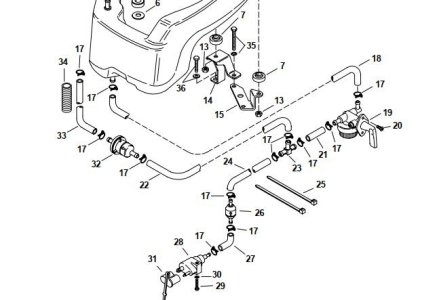
No, it's not a diverter valve, see the attached diagram (Tohatsu 4/5/6 service manual).
The fuel lines from both tanks join in a tee (#23) on the carb side of the fuel tap. With the fuel tap open both tanks are connected to each other and the carb.
There is a non-return valve (#26) in the line between the external tank connector and the tee that stops fuel flowing back into the external tank, but nothing to stop fuel flowing from the external to the internal.

fuel.JPG
 
P.S. my external tank is the old sort with an normal open vent, but if you have one of the latest 'pressurised portable tanks' (didn't even know they existed) then they run pressurised and only vent once 5psi is reached - already enough pressure to pump fuel into your vented internal tank if the tap is open.

So for correct operation:
- disconnect the external tank at the connector when using the internal tank.
- keep the internal tank's fuel tap closed when using the external tank.
 
Last edited:
Top