
Need to dry out after soda blasting before epoxy primer?

JimC

Well-Known Member
Joined
30 Aug 2001
Messages
1,570
Location
Lancashire
Visit site
I'm having the underbody my boat (a Hunter Channel 31) soda blasted to remove layers of old antifouling which is so loose and flakey in places that some came off just with pressure washing. In other places it's hard on. The advice I've had is then to apply 2 coats of high build epoxy primer followed by a tie coat followed by antifouling.
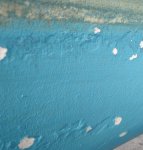
perished antifouling 2 (973x1024).jpg

I had envisaged doing all this in the space of a week or so following the blasting. but I've read suggestions that the boat will need a protracted period of drying out ashore to avoid trapping moisture under the epoxy. Is this true? if so it means no sailing this year for me.. The boat has no sign of osmosis.
 
I wouldn't dare sealing any moisture in. How long will it take to dry out of course depends on the weather.

If it rains a lot I'd use some tarpaulins too to keep the hull dry.
 
If you have gone to the expense of soda blasting I would include Copper Coat within your 'antifouling' conundrum.

I have no axe to grind, I have used conventional AF for decades, I don't use CC - but the reason I have not used CC is simply the cost of soda blasting.

CC has mixed support - but if it does not work you can apply conventional AF on top. But CC is, I believe, epoxy with copper power incorporated in the mix. The copper offers AF characteristics and you are simply going to add epoxy ........ but may lose a season - maybe use this all to your advantage ..... or otherwise..???

Jonathan
 
There is a world of differece between an epoxy primer and the epoxy in CC. One has solvents the other has not as its water based. When I did it i gave it a few days with a good breeze to dry out but more importantaly I gave the epoxy primer a full weel to degas before applying CC, I would imagine you need similiar for AF or else you run the risk of it bubbling from inside.
 
+1 for coppercoat, but not if you sit in mud regularly, when it works just as well as conventional AF - not at all!

If the gelcoat is in good condition and you have no blisters on a boat a few years old, I don't see the need for an epoxy treatment before the CC or AF. Epoxy is to try and keep the moisture out of voids in the layup so blisters don't form. Sometimes it works.
 
After several AF scrape to remove projects on boats owned I decided 'never again'.

I had mine dry-ice blasted (which leaves the boat dry, of course).

Then a new start with primer and thin film AF. At season end it takes 20 minutes to pressure wash the hull (30').
Every other year it gets a single new coat of AF.
 
I'm having the underbody my boat (a Hunter Channel 31) soda blasted to remove layers of old antifouling which is so loose and flakey in places that some came off just with pressure washing. In other places it's hard on. The advice I've had is then to apply 2 coats of high build epoxy primer followed by a tie coat followed by antifouling.

View attachment 135061

I had envisaged doing all this in the space of a week or so following the blasting. but I've read suggestions that the boat will need a protracted period of drying out ashore to avoid trapping moisture under the epoxy. Is this true? if so it means no sailing this year for me.. The boat has no sign of osmosis.
Only half true. You say no sign of osmosis but what do you mean by that? No bubbles? Low moisture meter readings? The point is that if you have high moisture in the laminate, you need to remove the gel coat and wash the laminate with warm water then dry it out over a period which DIY might take months. "drying" with the gel still on doesnt work other than short term because the nasties in the laminate which attract water into solution are still there.

But all that is if the moisture level is high enough to be an issue. Most likely it isnt. In which case coating with epoxy ( which isnt totally waterproof but simply better than poly gelcoat) will slow down any further moisture transfer from outside.

I have done both and even when drying out was in a boatyard shed , it took months . Probably quicker now with modern techniques.

If you go to the coat of blasting clean you would IMO ( but no connections with them) be daft not to coppercoat.
 
If "osmosis" is bad enough to need urgent treatment, it'll be obvious. If it isn't, but there are blisters, slap on a couple of coats of antifoul and go sailing. You can deal with the blisters when you come out for the winter some time.

I've long believed that, while there are exceptions, osmosis is only a problem when you're talking to people who sell fixes or want to buy your boat cheaper than you want to sell.
 
There are no blisters and I'm not having Coppercoat. My query is simply whether a period of drying out of the laminate is needed between blasting and applying epoxy primer. The primer suppliers, SML whom I've just phoned, say not - just thoroughly clean and rinse.
 
After spending good money on having the hull blasted you would be silly not to now fully protect the hull,
Having re-coated 5 boats over the years after hull blasting I would coat it with International Gelshield 200 osmosis protection paints 5 coats as instructed, THEN a base primer like Primocone THEN 2 coats of antifoul, I have also used the Jotun equivalents which is also very good (and cheaper).

Make sure you get the two different colors paints to ensure you fully cover over the last coat, in all cases coated after a week of then the hull was blasted but in min 10 C at night.

IF you are mixing on a nice warm day only mix what you can use in say 20 min max as it will start to go off.
During mixing allow 10 min to let air bubbles out of each mix and make sure its well stired.

Now after above treatment I only apply 1 coat antifoul and stay 'IN' for 2 years at a time as only slime on lift out as photo

Have fun11-11-2010-1[1].jpg
 
There are no blisters and I'm not having Coppercoat. My query is simply whether a period of drying out of the laminate is needed between blasting and applying epoxy primer. The primer suppliers, SML whom I've just phoned, say not - just thoroughly clean and rinse.

It needs to be at suitable moisture level. Our first boat had been epoxied a couple of years before our purchase. Another couple of years later, the epoxy started to lift and when blasted, the hull looked like craters on the moon. It hadn't been dried prior to epoxy and took many months and £s (outdoors then inside with heat) before dry enough to treat again.
 
There are no blisters and I'm not having Coppercoat. My query is simply whether a period of drying out of the laminate is needed between blasting and applying epoxy primer. The primer suppliers, SML whom I've just phoned, say not - just thoroughly clean and rinse.
There are 2 different "drying" issues. The first is dampness before you coat which I suspect is what AML is referring to. That is the hull is clean and dry after blasting and washing. The second is related to the moisture content of the laminate. If it is high moisture content then the epoxy coating may not adhere well because of the underlying moisture. However to dry such a hull needs more than just leaving for a period of time, but removing the gel coat and removing the moisture.

The first thing to do is check the moisture levels in the hull to determine whether it is dry enough to epoxy after removing just the paint down to the gel coat.
 
I don't suppose anyone has recommendation for a reasonable soda blaster in the Gosport/Portsmouth area? Sorry to hijack the post . For what it is worth I am going down the CC route.
 
I would carefully read sections 9, 10, 11 here: https://www.westsystem.com/wp-content/uploads/Fiberglass-Manual-2015.pdf
I have seen many opinions over the years here, from - you will be fine to you will sink soon, so the best solution is to gain some knowledge yourself. Personally, I wouldn't do the job just now but after shorter season and leave the hull to dry. In theory I don't believe it's necessary, but 'just in case'. In many cases osmosis is minimal and provide no danger to the boat, but if you trap the water and will get some little paint blisters you might reduce your boat value by several thousand.
 
Top