Nearly hit a Cardinal Buoy at 20 knots, how can that happen!

OP: you've said the ST600 is not connected to the Garmin Plotter. Is it connected to ANYTHING? (I mean via seatalk/nmea, to anything other than its own components and to power)

 
Thanks for your input, quite enlightening. I have emailed Raymarine asking how the AP can change and display a “MANUAL” setting and what did this mean. No response back yet, but will keep you informed of their answer. I find this "MANUAL" display quite confusing, how can it show that when there is no setting. Beyond me at the moment.
As mentioned, I was driving manually using the Garmin plotter for route guidance only, the AP being in “STANDBY” mode when it occurred, next Waypoint probrably 2 miles away.
Of interest, I had a look on the Internet to check these Buoys and found that many transmit weather and sea information and have a Flux Gate compass fitted to support this data stream enabling the supply wind and current direction. Is it possible the Buoy Flux gate had a stronger signal than the on board unit and took over from 50 metres distance? That’s what it felt like. Will be passing at 100 metres in future.

Am going to boat tomorrow, will check AP settings, reduce response if necessary and go through the motions to recalibrate the unit. Next time I have the opportunity I will take her adjacent to the same buoy at low speed to see if this situation recurs.

Is there an area within the AP setup where you can change the unit’s sensitivity to external objects, like buoys?

I really don't think the buoy would have an influence on a fluxgate compass unless you were very close to it. Like within, say, 5m. To be so sensitive to anything at a range of 50m would be bizarre. TBH, I'd even be surprised if a consumer fluxgate compass could be manufactured that would detect a buoy sized piece of metal at 50m

That link I posted suggested a possible cause that doesn't require a complex and unlikely failure. I'd definitely be investigating the wiring environment first, heading toward a replacement autopilot for a system that is used to control a boat at those sort of speeds...
 
Can a raggie butt in here?

Last year we were motoring along the Kiel Canal under autopilot. As we came alongside (about 25 m away) a jetty with big steel dolphins, the boat made a determined lunge to port to try to hit one.

Luckily I was near enough to the controls to take avoiding action. No time to disengage the auto, I just slammed it into full reverse and stopped a couple of meters short.

We have a B&G system and it has never happened before or since. At the time I put it down to the mass of steel affecting the fluxgate - it would be an amazing coincidence if that wasn't the cause.

Nearly ruined the holiday !
 
Last edited:
did you check the fluxgate compass is still secured where it was/should have been?
maybe it simply happened todrop off the bulkhead/bilges it's been mounted and whole thing went bananas?

cannot believe that a massive steel construction would affect it at that distance.

cheers

V.
 
did you check the fluxgate compass is still secured where it was/should have been?
maybe it simply happened todrop off the bulkhead/bilges it's been mounted and whole thing went bananas?

cannot believe that a massive steel construction would affect it at that distance.

cheers

V.

I don't know if this is addressed to me or the OP but my fluxgate is still securely fixed.

I can't think of any other explanation. It would be a massive co-incidence
 
There is no obvious reason for a mass of steel to affect the fluxgate like that, unless it is magnetised steel. When you went along the kiel canal you must have passed loads of steel ships. Plenty of people have been tied up alongside steel ships and their compass still points north. So it is worth thinking about other causes. Do you recall whether you were going to a waypoint or just in heading hold?
 
A dead straight bit of the canal and we using the compass heading mode.

I know it seems implausible - maybe it is a giant co-incidence but the boat made straight for it. I suppose we were about 25m away when the auto made a 30 degree course change.

As I said in my first post, it has never happened before or since.
 
Having swung many, many fluxgate compasses and worked on magnetometers (Nimrods) I have to agree I can't see how the buoy could possibly have caused the boat to home in on it. It might just be possible to design a system that would do that but it would take someone like BAe a lot of money and a fair while to do it. You'd have to analyse the normal magnetic field around the boat (not around the buoy) and then, based on the boat's heading, track and position relative to the buoy, generate an artificial magnetic field that would cause the boat to turn towards the buoy. You'd then have to recalculate and vary the magnetic field as the boat's heading and position relative to the buoy changed. Very, very difficult and, even if it happened once by chance (incredibly unlikely) for it to happen twice or more is unthinkable. You're way beyond winning the lottery jackpot twice in succession odds.

Doesn't mean you should rule out the buoy or a big lump of metal completely though, especially as some buoys contain some fairly powerful electronics. It still seems unlikely but I could just about see a scenario where the buoy caused a sudden and unrealistic change in heading (perhaps it suddenly started transmitting wave height info back to base or something - honestly no idea what and I still think it's unlikely, just not totally unimaginable). That may have been enough to trigger some code in the A/P which was supposed to be a warning or error code and would disengage the A/P. It's then easy to imagine a bug in the code such that, instead of doing what it was meant to, it throws the A/P into this undocumented MANUAL mode and puts the helm hard over.

Given that we often travel from buoy to buoy I guess the odds on a buoy being in the way aren't that high and, if the buoy actually somehow triggered the helm to go hard over, then the odds of it ending right in the way aren't so high at all. It does make me wonder about the many incidents where people have "accidentally engaged the A/P" and felt really stupid it about afterwards - maybe they weren't so stupid. It's something you'll tend not to worry about too much unless you nearly do some serious damage.
 
I don't know if this is addressed to me or the OP but my fluxgate is still securely fixed.

I can't think of any other explanation. It would be a massive co-incidence

It sounds like a coincidence but not a 'massive' one. Like any normal person you try and connect events even if their is no connection. It would be exceptional for steel to be so highly magnetised that it could affect even an ordinary compass as that distance. If it was then most of the metal ships nearby would be stuck to it permanently. Like others I suspect a fault in the electrickery.
 
Can a raggie butt in here?

Last year we were motoring along the Kiel Canal under autopilot. As we came alongside (about 25 m away) a jetty with big steel dolphins, the boat made a determined lunge to port to try to hit one.

Luckily I was near enough to the controls to take avoiding action. No time to disengage the auto, I just slammed it into full reverse and stopped a couple of meters short.

We have a B&G system and it has never happened before or since. At the time I put it down to the mass of steel affecting the fluxgate - it would be an amazing coincidence if that wasn't the cause.

Nearly ruined the holiday !


On the final approach to Carentan (northern France) a similar thing happens. You leave the River Douvre via a lock and then travel a short way up a straight canal to the marina in the town. This passes over the dual carriageway from Cherbourg to Caen and, where it does so, compasses go a bit awry. There is a warning in Reeds about not using autopilots at this point. (Not sure why anyone would want to in practice, but just in case...)

I understand that the theory is that this local "magnetic anomaly" is caused by the large quantity of steel used in constructing the aquaduct/underpass. I can believe that, since you pass directly over it, and so come within 10m of a lot of metal.

OTOH, I struggle to see how a buoy could have any discernable effect on a fluxgate at 50m, even a big one.
 
Last edited:
I've got an aeromagnetic anomaly map , shows area where anomalies occur, eg round Goonhilly Downs and out round the Manacles is pretty intense, a low of -190 nanotesla against a reference value of 47033nT.
 
Garmin Pic.jpg

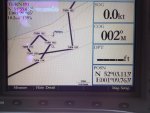
Of interest I have posted a pic from the log of the Garmin plotter, the heavy lines being the vectors and the faint line being the actua path.
Went to boat yesturday to carry out a basic check on equipment, Flux gate compass mounted under 2nd cabin bed with nothing stored in the area. Computer unit was like new and wiring felt secure. Rules out internal signal contamination.
Spoke to one of Raymarine Tech Support team who has been with them for 20 yeras+ and expalined the situation, he had never heard of a unit switching from STANDBY to MANUAL before. He said on some systemes for the unit to dispaly "MANUAL" it is normal if the vessel has a JOY stick fitted, MANUAL meaning steering by joystick operational. I dont have that fuction which indicates a gitch ocurring in the computer. I asked about weather stations on buoys to which he replied a may be possible to pick up a stray signal if the buoy has a Racon beacon fitted or if passing over power lines from a wind farms. Checked with Trinity House who confirmed the"Platters" Cardinal buoy had no electrical equipment fitted, although "Wadgate" Ledge doesm have a weather station, so I guess I was in the wrong place at the wrong time, the buoy playing no part, so I consider myself vey lucky to get away without incident. Now speaking to Raymarine about an upgrade on offer at the moment whereby you retain the hydrualic pump and return the computer unit for a total price of around £1250. The unit I am considering is the Evolution P70R, this standing me in good stead if I upgrade to the Raymarine Plotter over the winter.
 
RESULT

(Thanks JFM for suggesting inclusion of my last comment to the original thread to aid clarity. Now in process of deleting last thread, if I can work out how)
:triumphant:
I previouly outlined the event whereby our Autohelm ST6000 had switched from STANDBY to MANUAL mode of its own accord causing me to lose control of the steering whilst the boat veered hard to Port directly towards a Cardinal buoy. I managed to stop her a few metres short of direct impact. The only damage being to my nerves for couple of days.
I contacted Raymarine tech support and discussed this event with Derek a member of their support team who has been with them for 27 years and has a long memory. He was concerned and suggested Raymarine send an agent out to inspect our ST6000 installation at their expense. Two technicians arrived with a Raymarine Service bulletin covering this issue. It is a known problem with vessels built late 90's having the ST6000 Autohelm with Type 1 Computer. MANUAL can engage inadvertently from STANDBY or if guidance is activated if the system is exposed to significant radio interference from an external source.
MANUAL is a function associated with JOYSTICK control, our boat not having this function. In all instances the steering immediately applies hard to Port with loss of manual steerage.
To prevent this problem from recurring Raymarine had a Service Fix requiring a resistor to be installed bridging two contact points across the Joystick input of the computer, this isolating the joystick function and preventing this issue recurring. Apparently there had been a product recall at that time but our boat must have missed out. Interestingly they also checked the configuration of the ST6000 control unit.
There is a Joystick function, the instruction manual gives guidance that either option 1 or 2 be selected with 1 being default. This implies that this function is always ON, however when checking the options within the ST6000 there is an option 0 which is off. This is not mentioned in the configuration instructions, our boat was set to 1 but changed to 0 being OFF.
If you have ever had or experience a similar issue whereby the vessel turns hard to port of its own accord, you should check whether your system has been updated with fitment of this resistor to the circuitry, Also If you do have the ST6000 system and don't have joystick function this control setting ensure it is configured to 0.
Manual to configure the ST6000 control unit can be downloaded via Internet.
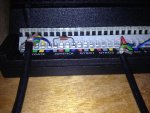
Pic shows installation of resistor bridging JOYSTICK circuitry, the coloured bands of the resistor identify the type to be installed, there are 3 red bands on the brown resistor body. If unsure, I suggest you check with Raymarine.
image.jpg

Now I know what happened if not why, and can now drive with confidence again and hope this helps others who may have had similar issues.

Many thanks to Derek and Raymarine for providing excellent after sales service even for my out of date system, much appreciated.
Thanks also to you guys for constructive comment.
 
Last edited:
Top