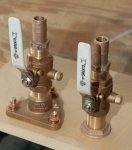
Near disaster - broken thru-hull fitting - your comments appreciated

I don't know the manufacturer of the boat in question in this thread,but why do reputable manufacturers fit brass fittings?

And how do we allow them to get away with it?

Does anyone know what windy used back in 2006?

Brass fittings have been used for many years by most of the major European builders (including Halberg Rassy) - so 100's of thousands in use. Failure is fortunately rare. Until recently the better DZR was not widely available outside the UK, although that has changed recently now that a major supplier in Italy is producing them. Bronze is 4 times the price of brass and non metallic fittings 3 times, and not widely available in Europe as suppliers are either US or NZ.
 
.............That Seabung looks very interesting. Seems a much better solution that wooden bungs.

Firstly, I'm glad the issue is resolved K, a scary moment for any boat owner to discover water entering the boat like this.

Regarding the above quote, yes it does, I remember seeing a JTB post a few months ago and thinking this item will certainly go into my damage control kit, although the wooden bungs will also stay, just in case ;)

Your comment about the plastic sheet put on the outside of the hull to stem the water ingress, of course is a good one, and a proper way to slow the inflow. I keep a suitable sized plastic tarpaulin with lengths of light line attached to each corner just in case of a hull breach.
Without the line, getting the tarp down into the water and along to the breach location and holding it in place (especially if the boat is still moving) would be very difficult, without getting into the water, and time consuming.
I was onboard during an incident many years ago when a vessel collided with a broken off pile below the water level, the long gash in the hull breached several watertight compartments (catamaran), the tarp and line concept kept the boat afloat overnight until the haul-out arrangements the next day.
 
I'm surprised no one has pointed out that the seacocks are installed directly to the stem of the mushroom fitting without a proper flange that gives most of the strength to the installation.

A proper installation is pictured here.

thru hull.jpg

Photo courtesy of Compass Marine.
 
Last edited:
As others have said I simply don't see any reason to have holes below the water line for draining or in fact for any other reason
 
Last edited:
As others have said I simply don't see any reason to have holes below the water line so draining or in fact for any other reason

You need them below the WL for water IN --- for machinery cooling
2x main engines
Geny
Anchor wash
Air con
You can fit bilge alarms + decent pumps + have seperate water tight compartments using sealed bulkheads for example - my boat has 4 .
Exit wise this can be minimised by manifolds -when several drain into a one large via pumps ( shower sump eg ) or gravity into a large sloping pipe that runs the length of the boat -passing through glands @ bulk heads -not holes to the stern
Thus minimising exsist below the WL .
Of course as JTB says when it's out for annual -do check them and really have a regular period removal /change regime .
I had 2x main engine ,+ 3 small ones changed + new cocks last Easter .
The paperwork to defend against a possible insurance attemp to refute a claim is in a file @ home -demonstrating hopefully some sort of regular maintenance -not DIY on letterhead marine engineer /yard paper .
Aside the boat is over 13 years with no previous history of this work .
How ever - they where v diff to remove -solid golden colour and the main engine had to be cut out ,the outside flange grained off and the tube left jacked out -using a hydraulic jack from the concrete floor to push em up .
Was a 2-3 day job in all -guys new what to do .Also had replaced all the black engine pipes in the E/Room this year .
Last year replaced all the fuel pipes + hydraulic G box pipes -
Gradually working through a regular replacement regime -for piece of mind really .
Here's a pic ( sorry for the clarity ) of water ingress in the stern compartment -its not sunk !
null_zpsmjimevhc.jpg

It's not me - just a pic I found on the net -
 
Last edited:
I'm surprised no one has pointed out that the seacocks are installed directly to the stem of the mushroom fitting without a proper flange that gives most of the strength to the installation.

A proper installation is pictured here.


Portofino below .....
That will kinda help if the pipe torques the flange , but it should be up to that .
De zincification will still occur if the base metal is poor .
It's the quality of the thing not the shape size , fitting , of it - corrosion will not recognise the additional flange .
Water seepage into the hull now as 4 points of entry with the LHS flanged version
We can drift into soggy hull -balsa core etc - but lets stick with corossion of the skin fitting , how to spot it , mitigate it and
deal with a breach .

View attachment 59028

.
 
You need them below the WL for water IN --- for machinery cooling
2x main engines
Geny
Anchor wash
Air con
You can fit bilge alarms + decent pumps + have seperate water tight compartments using sealed bulkheads for example - my boat has 4 .
Exit wise this can be minimised by manifolds -when several drain into a one large via pumps ( shower sump eg ) or gravity into a large sloping pipe that runs the length of the boat -passing through glands @ bulk heads -not holes to the stern
Thus minimising exsist below the WL .
Of course as JTB says when it's out for annual -do check them and really have a regular period removal /change regime .
I had 2x main engine ,+ 3 small ones changed + new cocks last Easter .
The paperwork to defend against a possible insurance attemp to refute a claim is in a file @ home -demonstrating hopefully some sort of regular maintenance -not DIY on letterhead marine engineer /yard paper .
Aside the boat is over 13 years with no previous history of this work .
How ever - they where v diff to remove -solid golden colour and the main engine had to be cut out ,the outside flange grained off and the tube left jacked out -using a hydraulic jack from the concrete floor to push em up .
Was a 2-3 day job in all -guys new what to do .Also had replaced all the black engine pipes in the E/Room this year .
Last year replaced all the fuel pipes + hydraulic G box pipes -
Gradually working through a regular replacement regime -for piece of mind really .
Here's a pic ( sorry for the clarity ) of water ingress in the stern compartment -its not sunk !
null_zpsmjimevhc.jpg

It's not me - just a pic I found on the net -

In the post above regarding paperwork you suggest that it is better for potential insurance reasons to have maintenance done by firms with paperwork (some would assume professional firms) rather than do it yourself

This is an interesting statement and in some ways suggests that the paperwork you receive might be more important than the actual quality of the job carried out. I say this because reading these forums I often see comments about poor and very poor work from what people have assumed to be good companies.

Sometimes the reality is that doing it by DIY results in a far better job than getting others to do it for you.

Less pen pushers and more doers I say......................... I earn my living by the way pen pushing....................well sitting in front of a screen in modern speech..... Cant usually find a pen these days

Regards

Dennis
 
That will kinda help if the pipe torques the flange , but it should be up to that .
De zincification will still occur if the base metal is poor .
It's the quality of the thing not the shape size , fitting , of it - corrosion will not recognise the additional flange .
Water seepage into the hull now as 4 points of entry with the LHS flanged version
We can drift into soggy hull -balsa core etc - but lets stick with corossion of the skin fitting , how to spot it , mitigate it and
deal with a breach .

I agree that from the photos, the OP's problem seemed to be much more an issue of dezincification than physical stress on the fitting, but if he's going to be repairing and replacing through hulls and seacocks why not do it right instead of half assed as apparently the builder did. Also, at least on this side of the pond, I am not aware of any maker that sells proper flanged fittings that uses any material other than good, marine grade bronze so both problems solved with one proper fix.
 
Here is a further pic of the failed part.

IMG_1014_zpszemds5ge.jpg


Color is carroty but imo not as much as on Nick's pic. Further, the broken edges are not at all brittle but in fact almost as hard as the real thing. I scratched it with a key, you can see the markings on three o'clock both on the broken surface and the on flange (is that the right word) behind it.

IMG_1015_zpshjlpevad.jpg


Still, I don't think this changes the dezincification diagnosis but just as a reference.

Regarding the cost of bronze fittings; I'm sure that is of course the driving force behind the decision of using brass but somehow the argument doesn't hold water in my view. I paid €6,90 at chandlery prices for a new, admittedly smallest on the boat, brass fitting. Even if the cost for bronze would be four times (the retail price), in the grand scheme of things the difference would appear pretty insignificant. And besides, marketing department could make full use of 'extra high quality components used'.

Everything adds up of course but for instance in this case with a bit of extra hose, the three u/w holes dedicated for draining lockers could very easily have been replaced with just one. I'm not sure what they were thinking in the first place, tbh.

As Portofino suggested, with a bit of planning the extra cost of bronze could be offset by fewer fittings.

@AndieMac; my half plan in case of a hull breach would be to use the flybridge cover to go under the hull. A dedicated tarpaulin if of course a more prudent measure.
 
Last edited:
After a five hour cruise yesterday we moored up in Hanko. Roughly fifteen minutes later the bilge pump started going and I went down to investigate. Following the alarming sound of gushing water it transpired that one of the through hull fittings had broken and we were taking on water at an uncomfortable rate.

The fitting is for draining one of the storage lockers in the cockpit and is situated on the side of a trim tab ‘tunnel’ in the aft port side.

As a first aid, I blocked the hole with a plastic bag from the outside and later replaced that with a wooden bung. After a while the bung did it’s job and the leak was reduced to a few drops so it was time to calm down...

I’m now waiting for a lift-out at around 3 pm this afternoon for replacing the fitting and to have a good look at the other fittings with an endoscope.

The fitting has sheared right from the bottom. Initial analysis of a marine services guy who visited the boat was that it might have been over tightened and due to the weight of the ball valve has slowly given in. We’ll know more once it’s removed and we can have a proper look.

20160727_103735_zpskpjcdd0b.jpg


The other fittings seem ok externally, the broken one shows signs of a prolonged leak which I had missed in the spring (white powder).

20160727_103940_zpsnxbi4954.jpg


20160727_104017_zpswn5cihos.jpg


I would really appreciate any and all comments you might have on things to take into consideration when fitting the new one, causes of the breakage, etc.

I’m just happy it didn’t happen when we were out in the middle of the sea...

Thanks in advance!

Very scary incident indeed. Really glad that nothing serious happend! I had a broken through hull fitting on my previous boat as well (Phantom 38 from 1998) however that fitting was a retrofit made for a non factory fitted black water tank. Luckily this happend during winter storage when we replaced some hoses. All other through hulls vere checked at that moment and they were all solid. The retrofitted one was of wrong material and had no bonding wire attached. It was clearly suffering from de zinkification.

My current boat, Ferretti from 2001, has numerious underwater outlets which off course gives the appreciated silet operation of the AC, genset, main engines, etc... But poses a risk of a major leak. Any comment reg. the quality of these fittings in Ferrettis of this age would be much appreciated. Some of these fittings are in places that would be very difficult to reach at sea when the engine room is hot.
 
There are two schools of thought for under water fittings:
1/ with DZR or bronze do not bond
2/ with DZR & bronze bond to an anode

I follow the lttaer I've abound all u/w fittings & do not use brass.

if you have a 240v leak brass will fizz away very quickly.
 
In the last twelve months two yachts close to me have suffered from virtually identical skin fitting failure. I saw the first one, An Oyster 53, took me three hours to pump it out. I don't know what the repair cost was but I suspect in the region of £50.000 +.
The second one an Ancona 42 ?, was in the last couple of weeks and other than skin fitting failure I have no further details, I was spending a week ashore.
Have been round all of mine with a small hammer in the last week.

j
 
There but for the grace of Go...od maintenance and checks go all of us.
After a career as a seagoing engineer, I have learned to be careful. Ok I do not lift my boat every year. Often it is 3 years or more. But when I do I remove all the valves from their skin fittings. Check the condition and thickness of the skin fittings and refit the valve. Not difficult or expensive. 7 below water hull valves normally take me 2 days and the price of new seals.
Yes there is a risk that disturbing them may create a leak when going back in the water, but so far I have been lucky.
I also have a labelled wooden bung for each size inlet, and a small painted mark on the waterline in line with each inlet/outlet.
I would like to say my safety checks have been justified by finding a problem, but I haven’t, (at least not on my own boat). But a lifetime in the industry has made good maintenance practices a habit.
The hardest bit was the first year I had this boat. Getting the right size spanners that would fit into the space available took a bit of time and effort. But at least I have them now.
Re-reading my post it makes me sound a bit holier than though, but it is only what was hammered into me as an apprentice in the sixties, to the extent that I would have sleepless nights haunted by my old mentors if I did not do this and many other maintenance things.
 
My current boat, Ferretti from 2001, has numerious underwater outlets which off course gives the appreciated silet operation of the AC, genset, main engines, etc... But poses a risk of a major leak. Any comment reg. the quality of these fittings in Ferrettis of this age would be much appreciated. Some of these fittings are in places that would be very difficult to reach at sea when the engine room is hot.

All I can say is that I've had all of the seacocks and skin fittings on all 3 of my Ferrettis inspected every year without fail by the yard during the annual winter maintenance and I have been advised to replace two of the seacocks on one occasion because the valves were stuck although I was told otherwise the seacocks themselves were in good condition. Its good practice to test the seacocks yourself occasionally by opening and closing the levers especially the big ones for the engine seawater intakes which you might need to do in an emergency.

I have to say with regard to scubaman's problem whichever engineer decided it was good idea to put the outlet for a cockpit locker drain below the waterline ought to be shot

Thanks for the post scubaman and pleased to hear that it was only a near disaster.
 
All I can say is that I've had all of the seacocks and skin fittings on all 3 of my Ferrettis inspected every year without fail by the yard during the annual winter maintenance and I have been advised to replace two of the seacocks on one occasion because the valves were stuck although I was told otherwise the seacocks themselves were in good condition. Its good practice to test the seacocks yourself occasionally by opening and closing the levers especially the big ones for the engine seawater intakes which you might need to do in an emergency.

I have to say with regard to scubaman's problem whichever engineer decided it was good idea to put the outlet for a cockpit locker drain below the waterline ought to be shot

Thanks for the post scubaman and pleased to hear that it was only a near disaster.

Thanks Deleted User! That is reassuring. Exercising the valves is key, I had one of the main engine intakes stuck last season, it could not be moved even with the extended handle-bar that comes with the boat. This was fixed last winter otherwise no issues so far.
 
A short epilogue, hopefully, to my broken fitting experience.

When the fitting broke, due to holidays/slipway repair works/etc. I had to make quite a few phone calls to get somebody to lift the boat. And when the lift came, the guy who was supposed to change the fitting was no longer available, so I had to change it myself, which was fine as the lift guy was well experienced and gave me instructions on how to do it properly.

But as the boat was on slings and I was pressed for time, I didn't have enough time to go through all the remaining fittings properly. To achieve piece of mind I today took the boat to a local yard in Helsinki (thanks baylabayla for the tip on Hopeasalmi) and asked them to check them all, which they did. Everything was ok and I can now sleep better at night.

We did also have a look at the broken fitting and I'm not entirely convinced that dezincification was the reason behind its failure. Looking closer at the sheared surfaces, it would seem that it has been at least partially broken for a longer period of time and that sikaflex has kept it from leaking any more than what it has. Also, as I mentioned earlier, there is no evidence of brittleness.

All a bit academic, main thing is that all seems sorted now.
 

Other threads that may be of interest

Top