
Nav light switch configuration

Ardenfour

Well-Known Member
Joined
7 Feb 2004
Messages
990
Location
Port Bannatyne
Visit site
I am at the final stages of fitting a new switch panel. 12 rocker switches plus fuses. One aspect has me headscratching. I have fitted adjacent to the panel a 3-position rotary switch, powered from one of the panel circuits, to select nav lights. Positions 1,2 and 3 are 'mast steaming pulpit bicolour and stern', 'bicolour pulpit and stern', and 'tri colour' respectfully. How can I isolate the mast steaming light in position 2?Switchpanel.jpg
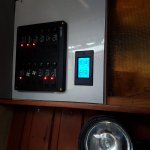
 
The obvious answer is it's on its own pole of the switch so is already 'isolated' from the others. How many poles does your switch have?
 
I am at the final stages of fitting a new switch panel. 12 rocker switches plus fuses. One aspect has me headscratching. I have fitted adjacent to the panel a 3-position rotary switch, powered from one of the panel circuits, to select nav lights. Positions 1,2 and 3 are 'mast steaming pulpit bicolour and stern', 'bicolour pulpit and stern', and 'tri colour' respectfully. How can I isolate the mast steaming light in position 2?View attachment 68735

I take it your switch is not the ancient "Yaxley" https://en.wikipedia.org/wiki/Rotary_switch pattern with as many rotors as needed for your independent circuits?

Mike.
 
Multi-pole switch, diodes or a relay. As you don’t need to worry about the voltage drop on a steaming light (assuming you have an alternator) the voltage drop on the diode should be a problem. Alternatively a relay powered by the switch. It will be an extra load, but then again you should be under engine with “free” power.
 
Diode sounds like a plan pyrojames.
Lpdsn my problem is how to have bicolour and stern in both 1 + 2 position, but with the addition of mast steaming light in position 1
 
Lpdsn my problem is how to have bicolour and stern in both 1 + 2 position, but with the addition of mast steaming light in position 1

Put bow & stern lights on one pole, for positions 1 & 2, tricolour on another, for position 3 and steaming light on a third pole for position 1.

Not sure how many poles the switch you've bought has, it doesn't seeem to say in the ad, but I reckon three is the minimum for what you're trying to achieve.
 
ok, but how do I stop steaming light coming on in position 2 if all 3 lights come on in position 1?
will need a diode I think.
Switch is 3 poles

You have three separate circuits. Bow & Stern lights all on one circuit, steaming light on another and tricolour on the third. At position 1 you are turning on two of the circuits, but they're not connected to each other except via the switch. At position 2 you are just turning on one of the circuits.

If your switch is double pole then might be easier just to sell it on eBay and buy a three pole one. Should be able to get something for a lot less than £38.
 
Not sure how many poles the switch you've bought has, it doesn't seeem to say in the ad, but I reckon three is the minimum for what you're trying to achieve.

I did this (actually a more complicated combination) with a single-pole multi-throw switch. I think I wasn't particularly aware of the multi-pole option, plus the choice was limited in IP67 rating which I wanted since it's mounted in the cockpit.

My switch goes:
[table="width: 600, class: grid"]
[tr][td]Off[/td][td]Nothing, obviously[/td][/tr]
[tr][td]Sail High[/td][td]Tricolour, wind-vane, compass[/td][/tr]
[tr][td]Sail Low[/td][td]Bow bicolour, stern, wind-vane, compass[/td][/tr]
[tr][td]Motor High[/td][td]Bow bicolour, all-round masthead white, wind-vane, compass[/td][/tr]
[tr][td]Motor Low[/td][td]Bow Bicolour, steaming light, stern light, wind-vane, compass[/td][/tr]
[tr][td]All-Round White[/td][td]All-round masthead white (I deliberately didn't call this "anchor" as I use a portable light on the forestay for that. But the masthead light was there and I thought I might as well have the option.)[/td][/tr]
[/table]

It's all done with diodes, on a bit of veroboard fitted with screw terminals and then potted in resin. This might be a bit dubious with Edwardian-style filament lamps, but since I only use LEDs that draw little current, it's no problem.

Pete
 
It's all done with diodes, on a bit of veroboard fitted with screw terminals and then potted in resin. This might be a bit dubious with Edwardian-style filament lamps, but since I only use LEDs that draw little current, it's no problem.

Pete

There's always many ways to skin a cat. I've also considered myself just keeping the existing bank of light switches and making a simple circuit that will light an LED if I've got it wrong (the advantage of that is I can feed a thin wire with the alternator output to the circuit so it'll tell me that there's a mismatch between the steaming light and the engine running).

However the OP seems to have done most of the work in producing his panel, so all I was trying to do is suggest the cheapest, easiest, quickest way to get from where he is to what he wants, which is to go on Amazon or look at some component websites and just buy a three pole rotary switch that'll fit in the hole he has in his panel.

PS Don't gamble on your bulbs always being LED. At 2am you might just want to get an Edwardian bulb out of your box of spares to replace a faulty LED so the circuit should be able to cope (wasn't a faulty LED in my case, but I definitely tried the old bulb).
 
Last edited:
I think I paid around £7 nut same switch as in link. I just need to block the current to the steaming light in position 1. Each of the 3 switches in the gang has 4 terminals, so double pole (I think!)
I've linked a 12v feed to 1 side of each switch. The load side goes to the relevent lights. Thinking about it I could feed the steaming light from a separate pole of switch 1 ?
I'll try this tomorrow
 
I can feed a thin wire with the alternator output to the circuit so it'll tell me that there's a mismatch between the steaming light and the engine running.

My previous boat only had a bicolour, a steaming light, and a stern light, so the possible options were fewer. Basically just bicolour and stern light all the time, turn the steaming light on when under power. So I just installed a single "nav lights" switch, plus a relay that turned on the steaming light automatically when the engine was running.

However the OP seems to have done most of the work in producing his panel, so all I was trying to do is suggest the cheapest, easiest, quickest way to get from where he is to what he wants, which is to go on Amazon or look at some component websites and just buy a three pole rotary switch that'll fit in the hole he has in his panel.

Yep, a multi-pole switch is definitely a good choice. I mostly just didn't think of it :)

PS Don't gamble on your bulbs always being LED. At 2am you might just want to get an Edwardian bulb out of your box of spares to replace a faulty LED

That would be tricky to do since there are no bulb holders. The LED lamps are solid blocks of resin with wire pigtails emerging, which are soldered directly to the supply cables with the joint sealed inside two layers of adhesive heatshrink. In any case there are no incandescent bulbs on board even in a spares box, although I do have a couple of spares of the LED festoons used in most of the cabin lights.

I do, however, have a spare bicolour and spare white lamp housing from the big box of random boaty junk that came with the previous boat. I've put some basic LED bulbs in those and a length of wire on each, and then stuffed the whole lot in a plastic bag in a deep locker. I have a troubleshooting cable with a lighter-socket plug on one end and croc-clips on the other, and there are sockets scattered around the boat. So if a light ever did fail, rather than dismantle it at sea I'd just gaffer-tape or cable-tie a whole new lamp unit in place nearby with its own independent supply.

Pete
 
Last edited:
This topic comes up fairly often. I have switches labelled 'port & starboard', 'stern' and 'masthead'. It does the job and I don't recall accidentally setting a wrong combination in the last 20,000 miles.
 
I built a nav light panel using a simple Maplin multi pole rotary switch, 6 way if I remember correctly. Worked a treat and I had a little yacht diagram with an LED for each light as a double check on the correct switch position having been selected.
 
Top