Nautical brass compass

Lok

New Member
Joined
21 May 2025
Messages
4
Visit site
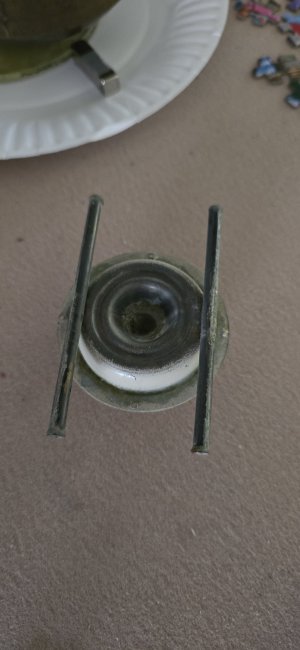
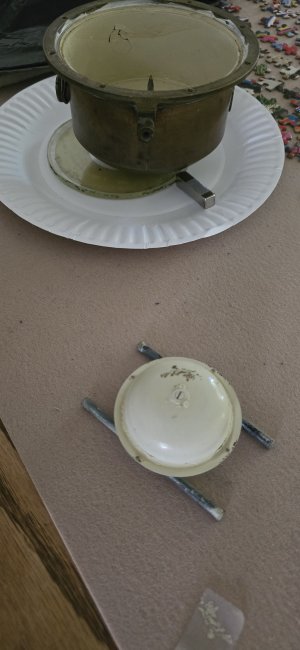
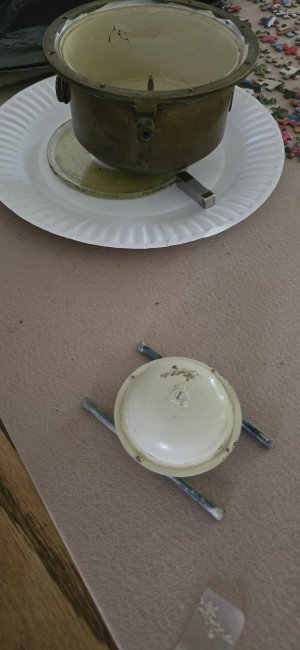
I have an old antique brass ship compass. I've taken it apart to clean it up and repair it. I'm going to remagnetize it but under the little cap are two bars I assume that run north and south. I put magnets on them and had no reaction whatsoever it's still just sits there. It doesn't even try to move . I'm using the correct magnet and I put it on the correct Pole but yet still the dial won't turn. I left them on there for a few hours and still nothing.1000006746.jpg1000006747.jpg Can anybody give me some help advice? Thanks
 
Some fifty five years ago, I did Compass Work as part of my BOT Ocean Course at Sir John Cass College. The advice given by one of the instructors was to give the instrument to a qualified adjuster so that he could make the necessary incantations while pouring alcohol into the bowl.

Is it a wet compass or a dry card one ? I can't see the filler cap. It is likely that over the years the two horizontal magnets attached to the small float have lost their coercivity, which is the 'engine' driving the card. Reviving them is a tricky business as they need to be roughly tuned for the particular part of the earth's surface on which you intend to sail. The final, more precise tuning is done with corrector magnets (Flinder's bars and Kelvin spheres fixed to the body of the compass) to 'dial out' the various coefficients , induced and permanent, which surround the compass positioning on the boat.

Another reason for the card failing to swing might be excessive pivot friction. If the jewel , either ruby or iridium/sapphire, on top of the supporting pivot needle, or in the cap of the float is missing or worn, then the magnetic forces trying to turn the card will be negated by friction.

Adjusting the card so that is as nearly 'dead beat' as possible for practical use is really best left to a skilled adjuster. Unless you want the instrument as a very neat display item, in which case replacing the two horizontal bars with their unknown magnetic strength, with different ones, is the initial option. You can induce magnetism into 'soft' iron by stroking it with a stronger permanent magnet ( e.g. a neodymium one from Amazon or an old hard drive) but you are dealing with exceptionally small and sensitive forces which need careful balancing to make the card accurate and precise when active.

It sounds like a fun DIY task, but if you want a live compass at the end, hand it over to an adjuster.
 
Last edited by a moderator:
  • Like
Reactions: Lok
Reviving them is a tricky business as they need to be roughly tuned for the particular part of the earth's surface on which you intend to sail.
I donot doubt the greater part of your post which makes sense. However, I would like some clarification on the above comment. If not you then others may come in here.
I would have thought that a compass is designed to take one around the globe. The usual magnetic adjustment for deviation being applied of course. But I cannot imagine that is what you are referring to.
But if you are right that might explain that it is my Sestral compass that has got me lost so many times over the years & it is not my poor navigation after all
 
  • Like
Reactions: Lok
I donot doubt the greater part of your post which makes sense. However, I would like some clarification on the above comment. If not you then others may come in here.
I would have thought that a compass is designed to take one around the globe. The usual magnetic adjustment for deviation being applied of course. But I cannot imagine that is what you are referring to.
But if you are right that might explain that it is my Sestral compass that has got me lost so many times over the years & it is not my poor navigation after all
It’s because there’s ‘dip’ to the earths magnetic field as well as direction. Ideally you put a compass on your boat that’s got the magnets aligned for the area of the globe that you mainly work in. In practice. It doesn’t make a huge difference when you go out of area but as I understand it,the compass isn’t quite as responsive.
 
  • Like
Reactions: Lok
The isogonals in SE Australia show a Dec of around 12E, and around 4W in the SW. The first compass and chronometer users in Antipodean waters must have had a lot of fun discovering quite rapid changes.

https://www.smithonline.id.au/images/Aust_mag_dec.gif

People who undertake RTW cruises apply DEC (sometimes called VAR) from such charts, and correct compass observations as routine practice. Goodness knows what is happening down South with rapid migration of the magnetic N pole at the moment.
 
Last edited:
  • Like
Reactions: Lok
People who undertake RTW cruises apply DEC (sometimes called VAR) from such charts, and correct compass observations as routine practice.
I thought all they do nowadays is set off with an iPad/navionics, Patreon and Instagram. Probs they stop off and pick up the Bikinis after a few thousand miles when the Patreon has fired up. I’m shocked to hear they also use compasses.
 
I thought all they do nowadays is set off with an iPad/navionics, Patreon and Instagram. Probs they stop off and pick up the Bikinis after a few thousand miles when the Patreon has fired up. I’m shocked to hear they also use compasses.
The use of ancient navigation instruments like a compass makes for a whole new episode in their YouTube blogging.
 
Some fifty five years ago, I did Compass Work as part of my BOT Ocean Course at Sir John Cass College. The advice given by one of the instructors was to give the instrument to a qualified adjuster so that he could make the necessary incantations while pouring alcohol into the bowl.

Is it a wet compass or a dry card one ? I can't see the filler cap. It is likely that over the years the two horizontal magnets attached to the small float have lost their coercivity, which is the 'engine' driving the card. Reviving them is a tricky business as they need to be roughly tuned for the particular part of the earth's surface on which you intend to sail. The final, more precise tuning is done with corrector magnets (Flinder's bars and Kelvin spheres fixed to the body of the compass) to 'dial out' the various coefficients , induced and permanent, which surround the compass positioning on the boat.

Another reason for the card failing to swing might be excessive pivot friction. If the jewel , either ruby or iridium/sapphire, on top of the supporting pivot needle, or in the cap of the float is missing or worn, then the magnetic forces trying to turn the card will be negated by friction.

Adjusting the card so that is as nearly 'dead beat' as possible for practical use is really best left to a skilled adjuster. Unless you want the instrument as a very neat display item, in which case replacing the two horizontal bars with their unknown magnetic strength, with different ones, is the initial option. You can induce magnetism into 'soft' iron by stroking it with a stronger permanent magnet ( e.g. a neodymium one from Amazon or an old hard drive) but you are dealing with exceptionally small and sensitive forces which need careful balancing to make the card accurate and precise when active.

It sounds like a fun DIY task, but if you want a live compass at the end, hand it over to an adjuster.
Thank you for your help. It is a wet compass. I have tried with the magnet but still no pull to any direction.
 
I'm pleased you all know what a compass is used for
I purchased a compass off ebay that was very corroded. Green colors .The person selling it said it was nice as it still had its camouflage. Ask another person about another compass I wanted to know what it measured. She said I think it's made to measure distance or something it's a compass. Wow. I guess if you have a tablet with gps you don't know what a compass is. LOL strange getting older.
 
So I've left a magnet on the compass for days and nothing has happened as you can see in the pictures I'm not sure where to put it or it which end. I assume both bars under the Bell are part of the magnetics. Anybody coming up with a solution for me yet? Thanks1000006747.jpg1000006746.jpg
 
Leaving a still magnet in place generally won't make a lasting change to the compass.

At a guess everything in there is brass (therefore nonmagnetisable) apart from the two long bars - or it could even be the inner cores of the two long bars - the outsides of the bars look like brass to me and the ends look sealed with solder so my guess is the (now demagnetised) magnetic parts are inside them. if this is the case, then you won't be able to fix anything with a static magnet and it might even be quite difficult to remagnetise the contents of the bars with a strong permanent magnet. You can either try stroking a strong permanent magnet along the full length of those bars about 100 times each at steady speed in the same direction, or find someone with a magnetisation coil. Or it's possible those are just iron bars and I'm not looking at the picture right, of course. Give them a bit of a polish and it might be clearer.
 

Other threads that may be of interest

Top