NASA skin fitting

If the things are installed correctly, as (tens of?) thousands are, then bits don't fall off.

Given that they are the only manufacturer that persists with this method, it begs the question why?. Nobody else has any problem making plastic skin fittings robust enough and out of a material that is impervious to sealants, so why don't NASA? After all that fitting is pennies in cost and doubt there is any significant difference in cost between their inadequate type and one that does the job properly. Not as if it is a recent discovery, the product has been in production for years and reports of failures for just as long.
 
If the things are installed correctly, as (tens of?) thousands are, then bits don't fall off.

Nonsense.

Even meticulously installed - as mine were - the wind jobs are pot luck as to longevity beyond one week, with odds heavily stacked against the owner.

I wish it was not the case, I would love to ' big up ' a British company from the rooftops.
 
Yes, even if the thing manages not to sink the boat it still looks shoddy. Rather like the underwater gear in some new continental boats, made out of plumbing fittings, how much money can it save?

I agree with you MA, a bronze item should be listed as an alternative, though they are readily available elsewhere.
 
What size bronze or DZR fitting would suit?
Yes, even if the thing manages not to sink the boat it still looks shoddy. Rather like the underwater gear in some new continental boats, made out of plumbing fittings, how much money can it save?

I agree with you MA, a bronze item should be listed as an alternative, though they are readily available elsewhere.
 
What size bronze or DZR fitting would suit?


Here it gets tricky. I may have been over optimistic.

I have never had a NASA log but I do have an Echopilot which came with a similar dodgy looking through hull in plastic. The outside diameter of that is 1 3/4in with a 16tpi thread which I think is Unified extra fine (UNEF). This is a sort of de facto standard from the old days. The I/d for the transducer is
c 36mm.

I am afraid that I assumed that the NASA one would be the same but I see it is slightly smaller in o/d, possibly 1 5/8in, in which case, if it follows the example of mine, you might expect it to have 18 threads per in - UNEF.

I was able to find a suitable bronze through hull in the old stock of a local chandlers. You could well have a job on your hands. In any case suitably glassed in position the risk with the plastic should be minimal.
Others may be able to help further or at least confirm the sizes of the NASA unit.
 
Bronze was only ever needed when fitting in traditional timber planks. Completely unnecessary in GRP and nobody uses it now.

The problem with NASA fittings is that they are too thin and made of a material that is incompatible with sealers normally used. So their solution is to suggest glassing in rather than making their bit correctly in the first place. Making it a different size from others adds insult to injury by forcing you to use their inadequate component.
 
If the thing had been made properly in the first place, bits wouldn't fall off and it wouldn't need glassing in!
"Cinderella": Scanmar 33, built in 1985
I just had a bad experienced with the NASA skin fitting :-(
We installed the NASA Clipper log/depth combo three years ago, after the trustworthy Silva gave up. Unfortunately Garmin has aquired Silva and they changed the diameter of the through hull fittings, therefore we chose NASA with the same 32 mm sensor diameter as Silva (I believe they now also offer a 43 mm OD version, which would fit the old Silva/Nexus).
The old skin fitting was replaced with the new NASA part.
The main problem for paddles in Norwegian waters are barnacles, so we usually have to remove and clean the paddle wheel a couple of times during summer. This has worked flawlessly for more than 30 years with the old Silva fitting.
When attempting to pull the unit (twist and tug, no excessive force), the fitting broke clean off above the inner tightning nut! So not due to wrong sealant on the outside! We were sailing at the time, so the water gushed in. I managed to insert one of the spare Silva blind plugs with one O-ring into the remaining plastic, and then knocked in a wooden plug and got it tight for now, but we need to get the boat out of the water for a permanent fix. Looking for a replacement fitting, preferably bronze, but composite (Trudesign) may also work. Or seal the hole permanently and go for a GPS log
 
"Cinderella": Scanmar 33, built in 1985
I just had a bad experienced with the NASA skin fitting :-(
We installed the NASA Clipper log/depth combo three years ago, after the trustworthy Silva gave up. Unfortunately Garmin has aquired Silva and they changed the diameter of the through hull fittings, therefore we chose NASA with the same 32 mm sensor diameter as Silva (I believe they now also offer a 43 mm OD version, which would fit the old Silva/Nexus).
The old skin fitting was replaced with the new NASA part.
The main problem for paddles in Norwegian waters are barnacles, so we usually have to remove and clean the paddle wheel a couple of times during summer. This has worked flawlessly for more than 30 years with the old Silva fitting.
When attempting to pull the unit (twist and tug, no excessive force), the fitting broke clean off above the inner tightning nut! So not due to wrong sealant on the outside! We were sailing at the time, so the water gushed in. I managed to insert one of the spare Silva blind plugs with one O-ring into the remaining plastic, and then knocked in a wooden plug and got it tight for now, but we need to get the boat out of the water for a permanent fix. Looking for a replacement fitting, preferably bronze, but composite (Trudesign) may also work. Or seal the hole permanently and go for a GPS log

Welcome to the forums!

Sorry to hear of your experience. There are lots of NASA fans who will tell you that the aftersales service is good. They don't seem to recognise that if the stuff was properly made it wouldn't need aftersales service!
 
From the installation manual:
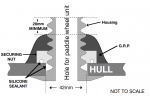
"With the vessel out of water, drill a hole of 42mm diameter through the hull to take the paddle housing and use conventional methods for sealing.
It is advisable to avoid the use of mastic materials - use a form of proprietary silicon sealant"
1623075024120.png
Figure 2 - Paddle Housing Installation (Sectioned view)
The securing nut has a groove on its underside which should also be filled with sealing compound. Take care not to overtighten this nut.
After the sealing compound has set, wipe off the excess and encapsulate the whole assembly in G.R.P. as shown on Figure 2.
Take care to ensure that a minimum of20mm of thread is clear at the top of the paddle housing"
 
From the installation manual:
"With the vessel out of water, drill a hole of 42mm diameter through the hull to take the paddle housing and use conventional methods for sealing.
It is advisable to avoid the use of mastic materials - use a form of proprietary silicon sealant"
View attachment 116908
Figure 2 - Paddle Housing Installation (Sectioned view)
The securing nut has a groove on its underside which should also be filled with sealing compound. Take care not to overtighten this nut.
After the sealing compound has set, wipe off the excess and encapsulate the whole assembly in G.R.P. as shown on Figure 2.
Take care to ensure that a minimum of20mm of thread is clear at the top of the paddle housing"
That's a novel approach, follow the instructions.
 
A speaker at our club last night described how his NASA log skin fitting became detached when crossing some turbulent water. The external flange broke off leaving a 2"dia hole in his bow and he was lucky to save his boat. That is why NASA installation instructions say glass the fitting in on the inside.
I've never done that in the past but will be checking mine today to check the installation is adequate and I urge readers to do the same.
The speaker's topic was cruising the west coast of Ireland in a 25 footer which was very entertaining.
The West coast of Ireland is not a place I would like to be caught with a 2" hole in my hull!
 
Top
