Nasa Clipper echo sounder problem

alancollins

Well-Known Member
Joined
28 Mar 2008
Messages
243
Visit site
I am still struggling to get this thing working. It is fine with the engine off or at low revs, but goes haywire when the rpm goes above 1100. I have tried 2 different types of suppressor, I have put chokes on the power and transducer cables and passed the power cables 2 or 3 times through a toroidal ferrite. I have tried running it from a dry cell battery pack with all other electrics turned off, but nothing changes. The instrument is mounted at least 6 feet away from my diesel engine alternator and the transducer is in-hull with the cable about 4 feet away from any other electrics. In short, the set-up is the same as my old Navman sounder which worked perfectly for many years. Nasa seem to have run out of ideas so can anyone else suggest some thing other than chucking it overboard?
 
I think I would confirm that the alternator is to blame by disabling it
BY
Removing the drive belt ............ but if that also drives the raw water pump limit the run time to not much more than a few seconds to avoid cooking the exhaust system.
OR
completely disconnecting the alternator.

If the alternator proves to be the culprit get it checked by an auto electrician .... you may be avoiding future problems with it.

I am surprised the E/S does not work on an independent battery. I'd check the connections to the transducer and the cable for something that might be affected by vibration.
Suspect the transducer or its installation maybe ?????
 
Last edited:
I've had these echosounders in two boats now and they have been bullet proof when it comes to engine volts, radio frequency interference, etc (mine is a similar distance from the alternator). But do you have a meter to show the battery volts with the engine running in case the alternator is generating a voltage that shuts down an overvoltage protection circuit in the echosounder? I would have thought that NASA would have mentioned that if one was fitted.

Have you tried listening to a radio with the engine running to pick up excessive rf interference. I think echosunders are low frequency, so listen on long wave or medium wave.
Are any LED devices on at the same time? They create a fair bit of rfi. Switch them off.

Taking off the alternator belt could help you isolate the problem to that device too, or voltage sensitive relays, charge controllers or anything else downstream of the alternator. Just don't take off the wire or fuse. Alternators are said to not like being run without a load (never done it to find out and don't intend to!)
 
Thanks for the suggestions. I don't understand why rf interference ( which is what Nasa seem to be sure it is) affects their unit when the previous sounder had no problem with it. I don't think it's a voltage problem as a 12 volt dry battery made no difference. I will try a radio with the engine running but if that shows interference I still have to work out what I can do about it.
 
Thanks for the suggestions. I don't understand why rf interference ( which is what Nasa seem to be sure it is) affects their unit when the previous sounder had no problem with it. I don't think it's a voltage problem as a 12 volt dry battery made no difference. I will try a radio with the engine running but if that shows interference I still have to work out what I can do about it.
My experience of sorting out electrical problems like this is ancient but I seem to remember wiring small capacitors across various terminals being much more effective than ferrite cores (you need a lot of turns around the core to resist rfi, whereas a capacitor 'drains' it away. But if the bushes on the alternator are very worn it'll cause bad rfi that no amount of capacitors and ferrite cores will get rid of.
It might have nothing to do with rfi, of course, and I might be wrong about the solution if it is. But I bought a bag of mixed capacitors for a few quid when one of my LED lights made listening to Test Match Special on Long Wave impossible. Did the job.
 
Nasa tell me I need a "low pass" capacitor. Do I simply wire this into the positive power cable?

No
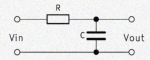
A low pass filter consists of a resistor and a capacitor.

1599732021779.png

The values of R and C determine the cutoff frequency

BUT, You have already tried running the E/S on a separate battery so any filter in the power supply is not likely to have any effect

Have you determined whether or not the alternator is the source of the interference as suggested earlier.
 
I will do this when I am next on board, but I doubt it can be anything else as I have run the echo sounder with all other electrics switched off and I still have the problem.
 
I will do this when I am next on board, but I doubt it can be anything else as I have run the echo sounder with all other electrics switched off and I still have the problem.

How about buying a new transducer. They are only about £30.
At least that narrows the margin of uncertainty .
 
I will do this when I am next on board, but I doubt it can be anything else as I have run the echo sounder with all other electrics switched off and I still have the problem.
Perhaps the effect of vibration ? confirm or eliminate the alternator from the equation and you will know for sure.
 
Th e problem seems to be radiated interference from the alternator, since I have eliminated the possibility of it coming through the power cables. This is surprising as the sounder is mounted several feet from the alternator. I very much doubt it can be anything else as vibration is not an issue and the transducer works properly at low engine revs. The sounder readings become more haywire as engine revs increase. Does anyone know how to prevent radiated EMI/RFI?
 
Since you've identified the alternator as the likely candidate, how about taking it a a local (automotive) specialist? Thinking that alternators would probably only do this when something's dying. Most towns have one, and if they're like the one I use they'll only charge you a beer or two for a test.
 
I had problems once that was eventually found to be turbulence. I repositioned the sounder head from a through hull fitting to one inside the hull but only about 20cm away, and the problem was resolved. (I filled the hole!). It's now mounted inside the hull just offset from centre, forward of centre of the boat. Reads well up to about 90m depth. (And if there's more that that depth I figure its enough).
 
The transducer is well away from anything electrical, mounted inside the hull, so I don't think that is the problem. The suggestion to have the alternator checked makes sense even though it is functioning as it should, as worn brushes may be generating the interference.
 
Top