Name in signal flags

icarusbop

Well-Known Member
Joined
14 Jan 2013
Messages
124
Visit site
Hello:

I was thinking about getting a set of signal flags to spell the name of my boat, but have found out that individual flags each have their own static meaning...
"A" for example, means "I have a diver below"

So, was wondering if I'm not allowed to fly a set of flags that spell out my boat name whilst out, otherwise other vessels might get the message...

"I have a diver below. My vessel is healthy, request clearance into port. You are running into danger. I am altering my course to port. No. I have a diver below. "

Or would other vessels take the flags as letters instead of "meanings" since I was displaying a string of them?

IcarusBop
 
I think you will be fine but do you intend to fly these flags all the time or just for a special occasion?

The original idea was for a special occasion - but looking at the cost of them, I'd want to fly them all I was out sailing, possibly from the crosstree.
Hence the question, it was just an idea really, an excuse to buy more things for the boat and make her look pretty.
 
I was thinking about getting a set of signal flags to spell the name of my boat, but have found out that individual flags each have their own static meaning...
"A" for example, means "I have a diver below"

So, was wondering if I'm not allowed to fly a set of flags that spell out my boat name whilst out, otherwise other vessels might get the message...

"I have a diver below. My vessel is healthy, request clearance into port. You are running into danger. I am altering my course to port. No. I have a diver below. "

Or would other vessels take the flags as letters instead of "meanings" since I was displaying a string of them?

Multiple flag signals have their own meanings. For example, GN3 means "I wish some persons taken off. Skeleton crew will remain on board", MS1 means "My vessel is a dangerous source of radiation; you may approach from my starboard side" and "I request you to arrange hospital admission" (all taken from https://en.wikipedia.org/wiki/International_Code_of_Signals#Examples_of_multiple-flag_signals). I haven't found a current version of the International Code of Signals online, but in the 1969 version (http://www.seasources.net/PDF/PUB102.pdf) there is nothing longer than three symbols plus possible some numbers, so unless your name is Al ("I have a doctor on board"), Bo ("We are going to jump by parachute"), Di ("I require boats"), Ed ("Your distress signals are understood"), Jo ("I am afloat") or Vi ("What is the coverage of low clouds in octants (eighths of sky covered)?") you are probably OK.

Anyway, it's quite all right to spell out words. Nelson's original signal started "England confides ..." but his flag officer explained that it woul dbe a lot easier to do "England expects ..." because there was a code for "expects" while "confides" would have to be spelled out.

We spent four weeks this summer sailing with my crew's name spelled out under the port spreaders (Not the right place? Sue me.) and nobody tried to rescue us, board us or force us to jump with a parachute.
 
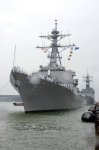
Warships often fly their callsign in flags when entering or leaving port.

800px-US_Navy_020425-N-1110A-506_USS_Cole_returns_to_homeport.jpg
USS Cole (NDDG)

Code, H on the starboard spreader.
 
Multiple flag signals have their own meanings. For example, GN3 means "I wish some persons taken off. Skeleton crew will remain on board", MS1 means "My vessel is a dangerous source of radiation; you may approach from my starboard side" and "I request you to arrange hospital admission" (all taken from https://en.wikipedia.org/wiki/International_Code_of_Signals#Examples_of_multiple-flag_signals). I haven't found a current version of the International Code of Signals online, but in the 1969 version (http://www.seasources.net/PDF/PUB102.pdf) there is nothing longer than three symbols plus possible some numbers, so unless your name is Al ("I have a doctor on board"), Bo ("We are going to jump by parachute"), Di ("I require boats"), Ed ("Your distress signals are understood"), Jo ("I am afloat") or Vi ("What is the coverage of low clouds in octants (eighths of sky covered)?") you are probably OK.

Anyway, it's quite all right to spell out words. Nelson's original signal started "England confides ..." but his flag officer explained that it woul dbe a lot easier to do "England expects ..." because there was a code for "expects" while "confides" would have to be spelled out.

We spent four weeks this summer sailing with my crew's name spelled out under the port spreaders (Not the right place? Sue me.) and nobody tried to rescue us, board us or force us to jump with a parachute.
A career sailing instructor/superyacht crew of my acquaintance, named Jo, will be very pleased with that information:)
 
Top