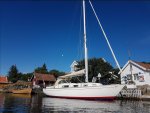
Najad 34 - 1979 Masthead sloop adding a staysail/second forstay..

Joined
14 Sep 2021
Messages
6
Location
Norway
Visit site
Hello All,

First time to use this forum so I hope I'm using the correct area from which to post this question.

I have a Najad 34 - 1979 aft cockpit version. It has a single set of spreader half way up and the mast is fairly solid looking I think. I have been sailing a couple of years now and am starting to do a bit more offshore sailing. I am starting to think about how the boat is setup with intentions of sailing from the West coast of Norway to Ireland round trip in the next 18-24 months.
As part of my plan I am considering adding a second stay so I can have more sail flexibility when sailing in a blow.
I am planning to carry out most of the work myself if possible. I am looking for advive on how best to carry this upgrade out.

1. A slutter?
2 A staysail? preferred option

Do I need running backstays? What components do I need? Installation tips etc...

I have attached some pictures of the boat which I have boat 6 months ago to show current rig setup and a few sketches to give a rough idea of what I'm thinking.

Much appreciated!

Michael
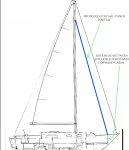
 

Attachments

  • bulkhead and staysail plan copy.jpg
    bulkhead and staysail plan copy.jpg
    171.6 KB · Views: 49
1. A slutter?
2 A staysail? preferred option
Do I need running backstays? What components do I need? Installation tips etc...

I have installed an inner forestay (for a storm jib, so not a cutter stay) on a smaller boat with similar type of rig.
To avoid the need for running backstays, the recommendation from sparmaker Seldén is that the attachment point on the mast should be placed between 3 and 6 percent of the fore triangle height (measured from the top).
 
Do a search for 'solent stay' to get some ideas. I have recently fitted a removable solent stay, which goes from just below the top of the mast, to the same point as you have illustrated in your diagram.
 
I always thought it is a great idea to have a working sail aft of the genoa for long trips, esp if it can be fitted on a furler.

A previous owner of my boat fitted a stay for a heavy weather jib, which has a robust, through bolted, bracket about 1ft from the masthead (32 ft sloop masthead, deck stepped) down to just aft of the anchor locker bulkhead. I have tried to load a photo but the file size is too large, if you are interested I will make more of an effort.

I was never very happy with the U bolt fixing which just went through the deck aft of the locker. I added an L shaped, gusseted bracket which is through bolted into the anchor locker bulkhead and is much stronger. I would suggest you bring the bottom fixing aft a bit to do the same if it suits your set up.

I have tried the boat as a cutter but there is not really enough separation between the sails. More importantly you really need properly designed sails and deck fittings to make it work and the advantages might be marginal. As a sail option for poor weather offshore I am sure it's a grand plan.

.
 
Do a search for 'solent stay' to get some ideas. I have recently fitted a removable solent stay, which goes from just below the top of the mast, to the same point as you have illustrated in your diagram.
+1 for that. I have a similar Solent stay for hank on jibs just behind my genoa furler. Came with the boat, no mast mods beyond a fitting plus halyard opening, attach to the stem head fitting (which is enormous and long). Removes via a Highfield lever when not needed. Added bonus of twin head sails for running.
 
I always thought it is a great idea to have a working sail aft of the genoa for long trips, esp if it can be fitted on a furler.

A previous owner of my boat fitted a stay for a heavy weather jib, which has a robust, through bolted, bracket about 1ft from the masthead (32 ft sloop masthead, deck stepped) down to just aft of the anchor locker bulkhead. I have tried to load a photo but the file size is too large, if you are interested I will make more of an effort.

I was never very happy with the U bolt fixing which just went through the deck aft of the locker. I added an L shaped, gusseted bracket which is through bolted into the anchor locker bulkhead and is much stronger. I would suggest you bring the bottom fixing aft a bit to do the same if it suits your set up.

I have tried the boat as a cutter but there is not really enough separation between the sails. More importantly you really need properly designed sails and deck fittings to make it work and the advantages might be marginal. As a sail option for poor weather offshore I am sure it's a grand plan.

.
Hi Doug,

Yes. I'm interested. I'm putting together as much information as I can to try and make the best decision. I might even fire my final sketch's over to
 
NOT SURE WHY HALF MY REPLY IS MISSING

Hi Doug,

Yes. I'm interested. I'm putting together as much information as I can to try and make the best decision. I might even fire my final sketch's over to a rigger and pay for a little consultation.

Michael
 
I think you are wise to have a word with a rigger/mastmaker. If you buy your parts from them I an sure most would be happy to advise, you will pay top dollar for the bits but that would be the quid pro quo.

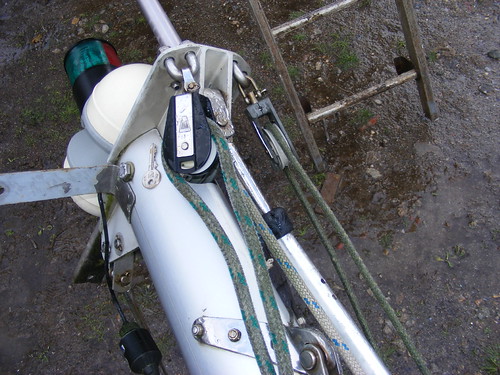
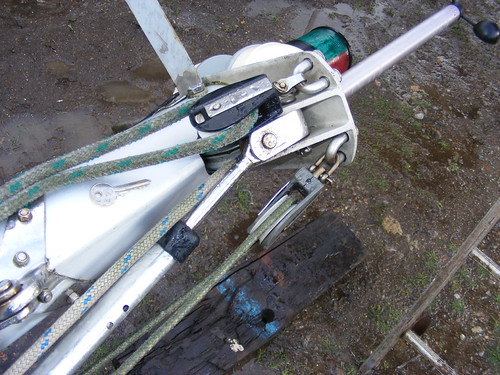
Here are the pictures of the top of my mast, you can make out the fitting at the bottom of each


mast /][/url]
 
I have had one for many years now, invaluable in a blow. The mast fittings are similar to winchard baby stay fittings with a sheave box underneath, I have internal halyards. The deck fitting is a modified stainless cleat which straddles a bulkhead, I you don't have this you may need to fit a bottle screw and cable to a fitting in the stem, the loads will damage the deck otherwise.
With my setup, I have no back stays or jumpers for it, therefore the mast fittings have to be higher than looks reasonable. I think less than 1m from the masthead so that the backstay takes the load.
It definitely isn't worth a permanent setup most of the time I'm a sloop, only occasionally a slutter.
 
Typically you would need an inner forestay that is detachable at the deck end and can be stowed against the mast or side stay. As said this inner forestay needs to be attached quite close to the top of the mast. If it is lower down you will get a bending force on the mast which is not counteracted by running back stays. (unless you go running back stays) The deck where the inner forestay attaches will need to be reinforced in some way. You will need a halyard just below the inner forestay to pull up a suitable storm jib.
In a storm you will have the wind resistance of the genoa furled. All of which might make you think good old fashioned hank on jibs (storm jib) would do better than furler and inner forestay. (or am I just a luddite not having a furler) ol'will
 
If your parking the inner forstay by the forward lower, whilst sloop sailing, you will find the forestay too long and wont park neatly.

The remedy I found is to make the stay the correct length for the parked position and add a long shackle or strop or somesuch to the deck working position.
 
Be sure that the additional rigging doesn’t make the yacht over-tender. I did as you are suggesting and was very pleased with the sailing options then available, but the boat was more tender no doubt and I found we were reefing earlier as a consequence.
 
Last edited:
I have an inner removable forestay for a storm jib on a Moody 33. When I bought it the stay was fitted to the mast, about 30cm below the forestay, but no deck fitting. I fitted a pair of Wichard fold down padeye on deck a few cm behind the anchor bulkhead with an identical padeye inside back to back. Then a turnbuckle to a 'U' bolt on the reinforced bulkhead. The stay is fitted with an overcentre lever to tighten the inner forestay. When not in use, tied to the toerail. Storm jib is hank on, with a 30cm strop to the 2nd padeye to keep it off the deck. Tightened using the spinnaker halyard. Not used in anger yet but works OK when tested
 
Agree with the above. Selden have a (part) page in their Masts catalogue - available online - which gives guidance on this.... very similar to that above.
Do ask your sailmaker about the leech of your staysail fouling your lower stays, the needed sheetleads, and the likely-unsatisfactory existing genoa track..
 
If your parking the inner forstay by the forward lower, whilst sloop sailing, you will find the forestay too long and wont park neatly.

The remedy I found is to make the stay the correct length for the parked position and add a long shackle or strop or somesuch to the deck working position.

Ours (44ft) came fitted with a full length forestay which when stowed goes round a stainless semicircular channel at the base of the mast and up to a small tackle to get it tight. Works well but even when tight would slap against the mast in some conditions so we had a little hooky gizmo (Selden iirc) fitted to the spreader which holds it away from the mast. All good now though I do keep a particular eye on the wire where it goes round the relatively small radius (100mm?) of the stainless semicircle - be a damn shame to discover it is not reliable when needed in anger.
 
Having fitted such an inner forestay to a Coronet Elvstrom 38, originally for a storm sail, I got enthusiastic and fitted a Hoyt boom, so now I can tack to windward with a lot less effort. The new forestay stay does make my big Genoa difficult to tack, to the extent that up wind I don't use it and I furl the Genoa when gybing.
 
A slightly different perspective. Fitting a removable inner forestay will entail a lot of work and cost - particularly when work through detail of all extra kit needed. Also more clutter even when stowed away. Is it really necessary?
For a voyage from Western Norway round Ireland, it is primarily coastal sailing - with a 36-72 hour crossing from Norway to Scotland. Nowadays it is easy to get reliable 3 day forecasts, so personally I would (and did) wait for a decent forecast for the North Sea crossing and no inner jib would be needed.
Instead I would invest a smaller amount of money in the best cruising laminate jib/genoa, with foam luff to aid reefing, which will give benefit 100% of the time when sailing, with no drawbacks.
 
Hi Dunedin,

Yes I do like that idea also. I will make some enquiries from the local sail maker and see what I can get. I had also considered using hanked on sails instead og the roller when doing a crossing. Maybe with a couple of sail options.

Cheers!
 
Top