Mystery tank on Volvo Penta...

long_ben

Member
Joined
19 Apr 2020
Messages
38
Visit site
DF365AF4-02FC-4E83-9609-39D3CE2E1E6A.jpeg
Hi everyone...
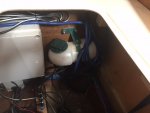
Can anyone tell me what the purpose of this tank is? I have a 49hp Volvo Penta and this is parked in the locker with my electronics equipment! Aside from the fact that Inshould probably move it somewhere less water sensitive, I’m curious as to why there is a header tank on an engine which draws water from outside. Forgive my ignorance as this is my first excursion into marinised diesel. The tank is empty (which I’m hoping is correct rather than the sign of a leak somewhere). Can anyone fill me in on the purpose of it and what, if anything, needs to go in it. Cheers all... Ben
 
It looks like a coolant header tank, in which case it should contain coolant, unless it's been fitted for some other purpose.

You could consider getting a VP engineer along for half an hour or so to check over the engine, and to tell you what are the main points to keep an eye on.
 
Hi everyone...
Can anyone tell me what the purpose of this tank is? I have a 49hp Volvo Penta and this is parked in the locker with my electronics equipment! Aside from the fact that Inshould probably move it somewhere less water sensitive, I’m curious as to why there is a header tank on an engine which draws water from outside. Forgive my ignorance as this is my first excursion into marinised diesel. The tank is empty (which I’m hoping is correct rather than the sign of a leak somewhere). Can anyone fill me in on the purpose of it and what, if anything, needs to go in it. Cheers all... Ben
What engine exactly are we talking about, D2-50 ?

You seem to think that is is raw water cooled but my first inclination is to agree with pvb, namely that it is a coolant head/ expansion tank for an indirect cooling system
BUT it looks a lot smaller than modern ones
If it is a header tank for a fresh water cooling system then it should contain coolant ( antifreeze mixture)

Not mentioned in your engine owners / operators manual? If you have mislaid that you can down load one from Manuals & handbooks | Volvo Penta

Any hydraulic systems on board that it could be the head tank for.
Or ( unlikely) an oil lubricated stern gland
 
Last edited:
You seem to think that is is raw water cooled but my first inclination is to agree with pvb, namely that it is a coolant head/ expansion tank for an indirect cooling system
BUT it looks a lot smaller than modern ones

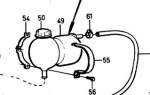
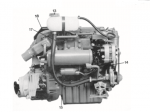
The OP said this is his first experience of a marinised diesel, so his mention of "an engine which draws water from outside" doesn't necessarily mean raw water cooled. I suspect it may not be a 49hp engine, quite a few Voyager 35s used the 43hp Volvo 2003T engine, and that header tank is exactly what VP fitted on that engine.
 
The OP said this is his first experience of a marinised diesel, so his mention of "an engine which draws water from outside" doesn't necessarily mean raw water cooled. I suspect it may not be a 49hp engine, quite a few Voyager 35s used the 43hp Volvo 2003T engine, and that header tank is exactly what VP fitted on that engine.
Yes I agree it does look like the header tank fitted to older engines . Was looking for a picture or diagram but this is the best I can do ( no prizes for guessing where that's copied from)

Volvo penta head tank.png
 
It's not uncommon for a header tank to be moved. It was done when I had my D1-30 installed as the engine bay front hatch would not close when it was in its original position on the front of the engine. A bit more worrying that it does not contain any coolant.
 
View attachment 89710
Hi everyone...
Can anyone tell me what the purpose of this tank is? I have a 49hp Volvo Penta and this is parked in the locker with my electronics equipment! Aside from the fact that Inshould probably move it somewhere less water sensitive, I’m curious as to why there is a header tank on an engine which draws water from outside. Forgive my ignorance as this is my first excursion into marinised diesel. The tank is empty (which I’m hoping is correct rather than the sign of a leak somewhere). Can anyone fill me in on the purpose of it and what, if anything, needs to go in it. Cheers all... Ben

Hi. Forgive me if I'm teaching my grandma to suck eggs but you did say you aren't experienced with marine diesels.

Most modern boat diesels have two separate circuits through which coolant or cooling water circulates. The first is similar to a car system but, instead of a radiator where the coolant is cooled by the passing air, fresh water coolant circulates through a heat exchanger before returning to the engine. In the heat exchanger it is cooled by sea water which circulates in the second circuit. This means that the sea water never mixes with the coolant and the engine never has salt water inside it (only in the sea water circuit and exchanger). In effect the heat exchanger works like the car radiator, with sea water instead of air to cool the engine coolant.

So the tank you've pictured is very like the water header or expansion tank in a modern car system. You keep it topped up to the right level with coolant which is usually water and anti-freeze / anti-corrosive additive mix.

It might be worth your getting the RYA booklet on marine diesels, or I'm sure there'll be a Youtube video explaining. There's also a very good RYA course on diesels which explains them and teaches you how to do basic maintenance.
 
Last edited:
Apologies for my being so slow to respond. Called away to a work 'emergency'...

Thinking about it, it was a bit of a lazy question. The suggestion of a looking through the manual is a good one! As is the idea of the RYA booklet. I think what set me back a bit was the emptiness of said tank. This said, I do know the engine was serviced in November last year so I'm assuming there are no leaks and that the engine has just been 'winterised'. Once I get back to the boat, I'll try and see if I can locate the manual. I've only just bought the boat and I'm on a bit of voyage of discovery. I didn't know that marine engines often use a sealed coolant system with a heat exchanger. That would make sense to save salt water burning its way through things. I'm still a little baffled as to why they chose to put it in the electrics locker. I think I may have to do some minor plumbing and rectify that once I've determined there are no unpleasant leaky surprises hiding anywhere.

Thanks all for your knowledge as ever... Ben :)
 
Thinking about it, it was a bit of a lazy question. The suggestion of a looking through the manual is a good one! As is the idea of the RYA booklet. I think what set me back a bit was the emptiness of said tank. This said, I do know the engine was serviced in November last year so I'm assuming there are no leaks and that the engine has just been 'winterised'. Once I get back to the boat, I'll try and see if I can locate the manual. I've only just bought the boat and I'm on a bit of voyage of discovery. I didn't know that marine engines often use a sealed coolant system with a heat exchanger. That would make sense to save salt water burning its way through things. I'm still a little baffled as to why they chose to put it in the electrics locker. I think I may have to do some minor plumbing and rectify that once I've determined there are no unpleasant leaky surprises hiding anywhere.

Thanks all for your knowledge as ever... Ben :)
Older engines were often directly cooled although conversion to indirect cooling, via a heat exchanger, was possible for many
Recent engines are mostly, if not all, indirectly cooled

Volvo Penta 2001, 2002 etc engines were basically raw water cooled but available also as indirectly cooled

You can download an owners manual from Manuals & handbooks | Volvo Penta.
Its always useful to have a copy downloaded in addition to the paper one on the boat
Just enter the model type in the "product designation" box. 2003T if that is what it is
 
I have a feeling that it is a 2003T and, from the sounds of it, it seems to have indirect cooling. Fortunately, as further searches on this engine seem to turn up a distinct lack of favour, it looks like it has been well maintained from the wealth of documentation on board which seems to refer to regular maintenance rather than remedial measures.

As soon as I get back, I'll try and track down the manual on board. I will, as suggested, also download a copy of the manual.
 
I have a feeling that it is a 2003T and, from the sounds of it, it seems to have indirect cooling. Fortunately, as further searches on this engine seem to turn up a distinct lack of favour, it looks like it has been well maintained from the wealth of documentation on board which seems to refer to regular maintenance rather than remedial measures.

As soon as I get back, I'll try and track down the manual on board. I will, as suggested, also download a copy of the manual.

The 2003T was only available with indirect cooling.

If your engine is the 2003T, there are two things you need to check regularly (or have checked by a marine engineer). The first is the oil cooler, which has an alloy body. It is hidden away behind the heat exchanger and is prone to corrosion. If the body corrodes right through, it allows pressurised oil to leak out of the engine, leading to the engine seizing. The second is a thin steel pipe which feeds pressurised oil to the turbocharger. If this pipe becomes rusty, it can develop pinhole leaks which allow oil to leak out of the engine, leading to - well, you can guess.
 
Hmmmm... that confuses things then as the tank that was the reason for this post does seem to point to an indirect cooling system. There was also a bottle of coolant in one of the lockers. I'm gonna have to determine the exact model I think. Should hopefully be back home on the boat tomorrow or Sunday. Will look into it then.
 
Hmmmm... that confuses things then as the tank that was the reason for this post does seem to point to an indirect cooling system. There was also a bottle of coolant in one of the lockers. I'm gonna have to determine the exact model I think. Should hopefully be back home on the boat tomorrow or Sunday. Will look into it then.
Why does that confuse things :confused:
 
Oh... hang on... just realised that what @pvb posted was that it was only available with indirect cooling. Totally misread that... and confused myself in the process... not an unusual occurrence.
 
Update: Have just checked the advert for the boat and it is listed as a 2003T. Will bung some coolant in when I get back and see what happens... am also going to look into the health of the oil cooler and turbo tube before I put any miles in. Might assess the viability of replacing them as a precaution.
 
Oh... hang on... just realised that what @pvb posted was that it was only available with indirect cooling. Totally misread that... and confused myself in the process... not an unusual occurrence.
I know the feeling

Update: Have just checked the advert for the boat and it is listed as a 2003T. Will bung some coolant in when I get back and see what happens... am also going to look into the health of the oil cooler and turbo tube before I put any miles in. Might assess the viability of replacing them as a precaution.
50% , preferably diluted with distilled or deionised water, if you have the concentrate otherwise "ready diluted "
ITYWF that engine should use the conventional, low silicate, type of antifreeze such as the Volvo "green" rather that the modern , long life/ advanced ,OAT type ( Volvo "yellow") But don't mix the two types

Check with the manual regarding the procedure for filling. You nay have to fill/ top up the cooling system via a cap on the heat exchanger then put a little in the head tank .... PVB will provide details.
 
Top