
Mystery parts

mrplastic

Well-Known Member
Joined
2 Nov 2002
Messages
277
Location
Algarve
Visit site
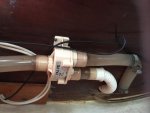
Just acquired a 1981 Cobra 750 needing a bit of tlc. I am working my way around the boat to draw up a list of jobs and would like some help identifying a couple of items. One is a tank at the rear of the heads, doesn’t appear to be a Holding tank as the heads outlet does not connect to it... It looks like a water heater but there are no hot water outlets on Board. The second is a valve which connects to the fresh water inlet. The ‘clear’ pvc tube feeds a small water tank located on the other side of the bulkhead below the sink but the flexible white tube is a mystery... thought it might be a vent but cannot immediately trace it and what is the valve for?
Anyone shed any light?? F1035802-6804-437E-8228-439737AF2BEF.jpg40F382EC-7D52-4FD5-95B2-6F79128596F3.jpg
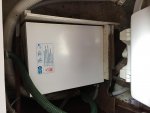
 
It has Jabsco written on a label it will be something connected to the head perhaps a fresh water tank for periodically flushing with fresh water or more likely a holding tank.
 
It has Jabsco written on a label it will be something connected to the head

It might well be related to the head, but the reason it has a Jabsco label stuck on it is that it's a convenient visible surface directly above the toilet itself and hence the obvious place to mount the instruction sticker for it. The sticker refers to the toilet pump, not the tank it's on.

One would hope that the small transparent PVC tube at the bottom of it isn't intended to carry toilet waste, but given the other picture, who knows what abominations this former owner has slung together? You'll need to follow the pipework to figure out what it's for.

The second picture is a Par ITT (another toilet manufacturer) two-way valve. According to its label, the upper pipe is the inlet and the lower two are outlets. I imagine the handle for selecting which outlet fitted onto the stainless shaft protruding between them; it was probably a plastic handle which broke off under vigorous use when the valve got a bit sticky.

Normally such a valve would be used for selecting toilet waste either to a holding tank or over the side, but you say yours is connected to a fresh-water tank? Maybe it's the tank filler, and was used to select which of two tanks to fill? Let's hope it was used for that from brand new, and not after a period in its designated role :p

The white corrugated tubing is intended for domestic bathroom basin wastes, particularly for use by unskilled DIYers as the flexible nature avoids the need to make odd-shaped joints in hard pipe. It's not particularly strong stuff and is utterly unsuited for use on board. Until I re-read your post and realised it was carrying fresh water, I assumed (because of the Par ITT valve) it was being used for toilet waste - potentially to a below-water seacock! That really would be a terrible piece of work - inevitable smell, and potential to either sink your boat or fill it with shit - and is what I was thinking of when I mentioned "abominations" above.

Either way, most of this stuff looks fairly shoddy, unhygenic, and overcomplicated and if she were mine I would give serious thought to ripping it all out and doing a decent straightforward job in proper materials.

Pete
 
prv,

you're obviously not used to half tide moorings.

Some people with sea loo's fill a bucket or two with seawater before the tide recedes if staying aboard through low water, I've not heard of a plumbed in tank before but it makes perfect sense for flushing.

In this context I don't see how it's unhygenic.

A chemical loo means I don't have this problem or those associated with holding tanks - and no hole in the hull either.

If the OP's system works OK I think the previous owner was quite clever - and probably encouraged to make the mod' by wife / girlfriend...
 
It might well be related to the head, but the reason it has a Jabsco label stuck on it is that it's a convenient visible surface directly above the toilet itself and hence the obvious place to mount the instruction sticker for it. The sticker refers to the toilet pump, not the tank it's on.

One would hope that the small transparent PVC tube at the bottom of it isn't intended to carry toilet waste, but given the other picture, who knows what abominations this former owner has slung together? You'll need to follow the pipework to figure out what it's for.

The second picture is a Par ITT (another toilet manufacturer) two-way valve. According to its label, the upper pipe is the inlet and the lower two are outlets. I imagine the handle for selecting which outlet fitted onto the stainless shaft protruding between them; it was probably a plastic handle which broke off under vigorous use when the valve got a bit sticky.

Normally such a valve would be used for selecting toilet waste either to a holding tank or over the side, but you say yours is connected to a fresh-water tank? Maybe it's the tank filler, and was used to select which of two tanks to fill? Let's hope it was used for that from brand new, and not after a period in its designated role :p

The white corrugated tubing is intended for domestic bathroom basin wastes, particularly for use by unskilled DIYers as the flexible nature avoids the need to make odd-shaped joints in hard pipe. It's not particularly strong stuff and is utterly unsuited for use on board. Until I re-read your post and realised it was carrying fresh water, I assumed (because of the Par ITT valve) it was being used for toilet waste - potentially to a below-water seacock! That really would be a terrible piece of work - inevitable smell, and potential to either sink your boat or fill it with shit - and is what I was thinking of when I mentioned "abominations" above.

Either way, most of this stuff looks fairly shoddy, unhygenic, and overcomplicated and if she were mine I would give serious thought to ripping it all out and doing a decent straightforward job in proper materials.

Pete

I completely agree with you, it is entirely possible that the sticker is a 'red herring' but I think the idea of a 'flush tank' is a plausible one. As for the valve, thanks for the I/D, I will be removing and replacing everything that is related to the fresh water system, the whole system is a bodge at best. I'm pretty sure that there is only a single water tank so the white flexible pipe remains a mystery until I start removing it all! Original or not it's not a part of the boats history I would want to embrace!!
 
you're obviously not used to half tide moorings.

Some people with sea loo's fill a bucket or two with seawater before the tide recedes if staying aboard through low water, I've not heard of a plumbed in tank before but it makes perfect sense for flushing.

We used to be on a half-tide (all right, maybe 3/4 tide) pontoon :)

I was delayed writing my post, so I hadn't seen yours about the flush tank, but I entirely agree it sounds quite likely. Good suggestion.

Pete
 
I like the idea of using a transparent hose for the heads outlet. Endless hours of visual entertainment to be had, rather than the rush to the stern at blast-off time. :ambivalence:

Richard

You can hardly share the heads compartment with the user to watch what is going through the transparent hose.

It therefore remains imperative to watch what is being discharged from the stern to be sure that everything, apart from a sheet or two of soft toilet tissue , has previously been eaten
 
You can hardly share the heads compartment with the user to watch what is going through the transparent hose.

It therefore remains imperative to watch what is being discharged from the stern to be sure that everything, apart from a sheet or two of soft toilet tissue , has previously been eaten

Paint a good picture there Vic!
 
You can hardly share the heads compartment with the user to watch what is going through the transparent hose.

It therefore remains imperative to watch what is being discharged from the stern to be sure that everything, apart from a sheet or two of soft toilet tissue , has previously been eaten
You must sail in very clear waters to see anything that has been discharged a foot or two below the waterline and 15 to 20 feet ahead of the stern observation position ?
 
Top