Mt new project - bilge switch.

So would a larger diameter pipe and a diameter reduction near the switch.

No you need it the other way round.

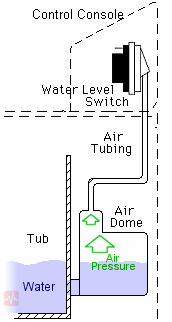
A largish dia bell with a small diameter pipe from the top of the bell to the switch.

I have the Jabsco pneumatic switches and have remade the broken plastic bell with a piece of stainless 32 o/d pipe 40 mm long with 6mm i/d plastic pipe to the switch mounted 2 to 3 meters away.
 
Like this:

WLC-console.gif
That wouldn't really work on a boat because the air dome would have to be mounted on the side of the bilge.
 
Very posh Nigel...
Yes, I know :)

I found it while looking for images of the device you mention, I'm sure I've got many such items in my hoard of stuff ripped out of old appliances. I've got a dishwasher in the shed that I wanted the stainless steel from, I bet that has one as well.

No, I'm not a pikey, I just don't like dumping stuff that "may be handy one day". Another plus point is that it drives Mrs Nige mad!
 
a simpler solution?

just an idea,not tried but a possible solution.a lot of cars have washer level float switches,already 12v and probably in plentiful supply at your local scrappies.they seem reliable/durable enough
 
I have mounted a float switch horizontally on a vertical plastic board, well above the water level, the float arm I have extended to which I have fitted a piece of polystyrene which is the only part in contact with the water, which lifts the float to switch the pump on. Tried and tested.
Debris in the sump can be fatal to float switches so keep it above the water level.
 
Whatever you do, it seems to be the rule (sorry!) that it will only last 2 seasons in an open boat or RIB.
The wiring often dies before the actual switch, despite efforts with heatshrink etc.

Very few AWB's should need an auto bilge pump.
It's better to sort the leaks, before your boat becomes an MAB.

There are various reed switch based float switches on the market, as used in car washer bottles etc, but they are just as unreliable afloat, and usually not rated for the current needed.

There are a few solid-state options, either based on the conductivity of the water, (can be fooled by encrusted salt/dirt, or not work in rainwater) or thermistor types which sense the water cooling the thermistor.
I'm told that's how the fuel light on my bike works, or should do, it doesn't at the moment.
 
Assuming the switch for the washing machine is a simple pair of contacts then it may have written on it an AC current rating. This may not mean it is no good for DC. The rating is often different for AC or Dc on switches. There may also be a voltage rating. A switch carrying AC can usually carry more current. The problem is that at the instant of opening while carrying current the small arc that is generated is in the case of AC is usually extinguished when the AC cycle falls to zero.(what about an AC arc welder you ask? Well there is just so much plasma around that it persists until the next current cycle) With Dc the current through the arc does not fall to zero so tends to be a greater problem. With DC switching current from an inductive load like a motor, the motor can act like a transformer to induce back EMF. This can be quite high voltage. So a diode is fitted across the switch to bypas this pulse of current. (reverse connected so that the conduction of the diode will not allow current rhough to the motor) This will improve the contact arcing problem a lot. A capacitor across the contacts can also help. However assuming your bilge pump only draws an amp or so you will have no problem with the switch.
On the other hand if it is a true AC only switch using electronic devices to carry the current then you will not be able to get a connection through the switch using a multimeter on ohms scale when it operates. In that casee forget it for bilge pump switch. good luck olewill
 
Assuming the switch for the washing machine is a simple pair of contacts then it may have written on it an AC current rating. This may not mean it is no good for DC. The rating is often different for AC or Dc on switches. There may also be a voltage rating. A switch carrying AC can usually carry more current. The problem is that at the instant of opening while carrying current the small arc that is generated is in the case of AC is usually extinguished when the AC cycle falls to zero.(what about an AC arc welder you ask? Well there is just so much plasma around that it persists until the next current cycle) With Dc the current through the arc does not fall to zero so tends to be a greater problem. With DC switching current from an inductive load like a motor, the motor can act like a transformer to induce back EMF. This can be quite high voltage. So a diode is fitted across the switch to bypas this pulse of current. (reverse connected so that the conduction of the diode will not allow current rhough to the motor) This will improve the contact arcing problem a lot. A capacitor across the contacts can also help. However assuming your bilge pump only draws an amp or so you will have no problem with the switch.
On the other hand if it is a true AC only switch using electronic devices to carry the current then you will not be able to get a connection through the switch using a multimeter on ohms scale when it operates. In that casee forget it for bilge pump switch. good luck olewill

I quote my post;- " As the switch is a.c. it will probably need a buffer relay and diode."
 
Top