MPPT Controller

I’ve just arrived on my boat to fit an MPPT controller- it’s a dual battery model - full charge goes to the domestic bank and a separate trickle charge to the starter battery. This one is from PhotonicUniverse (but other makes are available 😉) Hoping it’s the best of both worlds - assuming I can connect it properly!!!
 
I think much of the MPPT advantage will be lost here in Greece. A PWM in Scotland will spend a lot of time with low panel voltage, often not enough to charge. MPPT will increase the lower voltage to reach a point where it can charge.
With rare exceptions, nearly all MPPT controllers are incapable of increasing the voltage output of solar panels.
 
I imagine the higher consumption wouldn't usually matter when generating if it produces more than PWM anyway

Exactly.

Completely different in Scotland for some odd reason. :D

You can expect more advantage in colder climates with MPPT controllers.

The lower temperatures in Scotland increase the solar panel voltage (despite the lower light levels) compared to Greece. This higher panel voltage produces more gain from the voltage conversion technology inherent in MPPT controllers.
 
...

MPPTs are more expensive, that is their only disadvantage over PWM.
According to manufacturers ...
  • PWM can be more reliable because it is simpler.
  • PWM has less internal consumption. This can be important for maintainers through the winter, when panels can be covered with ice. Virtually zero vs. ~ 30-60 mA . During four weeks of snow cover (not unusual) that would be about 0.030x24x28=20-40 Ah. Not deadly, but not trivial.
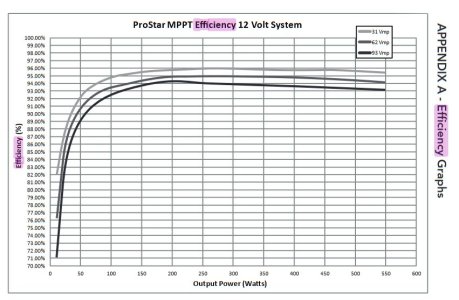
  • PWM has relatively constant efficiency through its range, whereas MPPT is often inefficient at very low power. Many (most) maintainer systems for boats that are day sailed, such as my F-24, operate most of the time at less than 5 amps.
As you say, basically, for battery keeping. But that is a common application.
  • 1756381348358.jpeg
 
According to manufacturers ...
  • PWM can be more reliable because it is simpler.
True.
For this reason, avoid low-quality MPPT controllers. Cheap PWM controllers or good quality MPPT controllers are usually fine.
  • PWM has less internal consumption. This can be important for maintainers through the winter, when panels can be covered with ice. Virtually zero vs. ~ 30-60 mA . During four weeks of snow cover (not unusual) that would be about 0.030x24x28=20-40 Ah. Not deadly, but not trivial.
Sort of.
If the solar panels are covered in ice, the solar controller will remain in sleep mode. In this mode, typical consumption is only slightly higher than a PWM controller. See Bagywrinkle’s post #17.

  • PWM has relatively constant efficiency through its range, whereas MPPT is often inefficient at very low power. Many (most) maintainer systems for boats that are day sailed, such as my F-24, operate most of the time at less than 5 amps.
As you say, basically, for battery keeping. But that is a common application.

The reason for poor efficiency at low outputs is just because the high self consumption (when the controller is working) reduces the output. However, the graph is misleading. With a Vmp of 31V, a PWM controller would have a maximum efficiency of around 50% across all power levels.
 
Last edited:
True.
For this reason, avoid low-quality MPPT controllers. Cheap PWM controllers or good quality MPPT controllers are usually fine.

Sort of.
If the solar panels are covered in ice, the solar controller will remain in sleep mode. In this mode, typical consumption is only slightly higher than a PWM controller. See Bagywrinkle’s post #17.


The reason for poor efficiency at low outputs is just because the high self consumption (when the controller is working) reduces the output. However, the graph is misleading. With a Vmp of 31V, a PWM controller would have a maximum efficiency of around 50% across all power levels.
Yes, all of that.

On my cruising cat, MPPT of course. About 300W total and three batteries. A smaller cat.

On my F-24 day sailing tri, all I have is 50W and a group 24 lithium battery. The battery is only that big for the VERY rare overnight (not every year) and long days with the tiller pilot running. 99% of the time, the system is just for battery keeping only, so simplicity rules. The main goal is no dead battery when we have snow cover for weeks and an ice storm takes out the power (I don't plug in anyway). That said, I seldom lose more than a few weeks of winter sailing to snow or ice on the water.
 
With rare exceptions, nearly all MPPT controllers are incapable of increasing the voltage output of solar panels.
You are quite correct. Fading memory from years ago. I could connect panels in series with MPPT but not the PWM.

The effect of that was that MPPT often got a useable voltage when PWM couldn't. The MPPT then lowered the voltage and increased the current to charge when PMW would be barely getting 12V from paralleled panels.

It's been so long since I had that problem that I only remembered the higher voltage and forgot the reason.:D

When it hits 43C here (feels like 53C) days with lower solar output are less of a worry.
 
A Victron 75/15 MPPT has a self consumption of 10mA ..... 0,01A so over 24 hrs it will consume 0,24Ah which at 12,8V equates to 3 Wh or 0,003kWh
https://www.victronenergy.com/uploa...-MPPT-75-10,-75-15,-100-15,-100-20_48V-EN.pdf

The expected yield from this controller with a run-of-the-mill 55W 12V panel is shown in the picture below with the self consumption in red.
MPPT Calculator - Victron Energy

View attachment 198513

The PWM from the OP has a self consumption of 6mA ... 0,006 A so over 24 hrs it will consume 0,144Ah which at 12,8V equates to 1,8 Wh or 0,0018kWh
https://www.solarversand.de/media/pdf/80/13/3c/121020-D.pdf (Sorry it's in German but the important number is "Leerlaufverbrauch")

That's a 0,0012 kWh difference per day = 1,2 Wh which at 12,8V is 0,094Ah difference ... or 0,016% of a 60Ah starter battery.

My conclusion is that the self consumption difference between the OPs PWM and the Victron MPPT is pretty much irrelevant.
I have I think this exact Victron MPPT seems to work well. With a few hundred watts of 40v panels and a 100AH battery feeding yard lights at home. I seem to be lost on instructions for the device. Search seems to come up with a slightly different controller. ie with 3 lights. I am confused about the blue tooth comnnection. Does that mean I just get near it with a phone? I would like to be abe to change it top a lithium charge profile. It seems like ther emight be a cable needed to connect to the 2 pins bottom LHS. Can you help with any info. ol'will
 
I have I think this exact Victron MPPT seems to work well. With a few hundred watts of 40v panels and a 100AH battery feeding yard lights at home. I seem to be lost on instructions for the device. Search seems to come up with a slightly different controller. ie with 3 lights. I am confused about the blue tooth comnnection. Does that mean I just get near it with a phone? I would like to be abe to change it top a lithium charge profile. It seems like ther emight be a cable needed to connect to the 2 pins bottom LHS. Can you help with any info. ol'will

First, make sure you have the SmartSolar version and not the BlueSolar .... BlueSolar has no Bluetooth and needs an adapter to add it.
Adapter: VE.Direct Bluetooth Smart dongle | Victron Energy

Once you have Bluetooth then download the Victron Connect App to your Smartphone.

VictronConnect App - Victron Energy

How to use the App is described here ...

VictronConnect manual

.. and the profiles and capabilities of the controller can be found here:

SmartSolar

MPPT solar charger manual

BlueSolar

MPPT solar charger manual
 
Thanks, everyone - very interesting.

Supplementary question: I have a couple of panels which are now a few years old, and I can't find the same ones now. IIRC, they're 80w. Can I add one or two 100w panels, or do they all need to be the same? If I can, using something like the SmartSolar controller, in series or parallel - or a mix? They should be mounted with little risk of shading.
 
First, make sure you have the SmartSolar version and not the BlueSolar .... BlueSolar has no Bluetooth and needs an adapter to add it.
Adapter: VE.Direct Bluetooth Smart dongle | Victron Energy

Once you have Bluetooth then download the Victron Connect App to your Smartphone.

VictronConnect App - Victron Energy

How to use the App is described here ...

VictronConnect manual

.. and the profiles and capabilities of the controller can be found here:

SmartSolar

MPPT solar charger manual

BlueSolar

MPPT solar charger manual
Thanks very much Baggywrinklle. ol'will
 
With MPPT controllers, if they have a similar voltage (Vmp), they can be connected in parallel. Within 0.5 V is a good rule of thumb.

If they have a similar current (Imp) they can be connected in series (although this is unlikely given the difference in wattage).

If you install individual controllers, any combination is acceptable.
 
Top