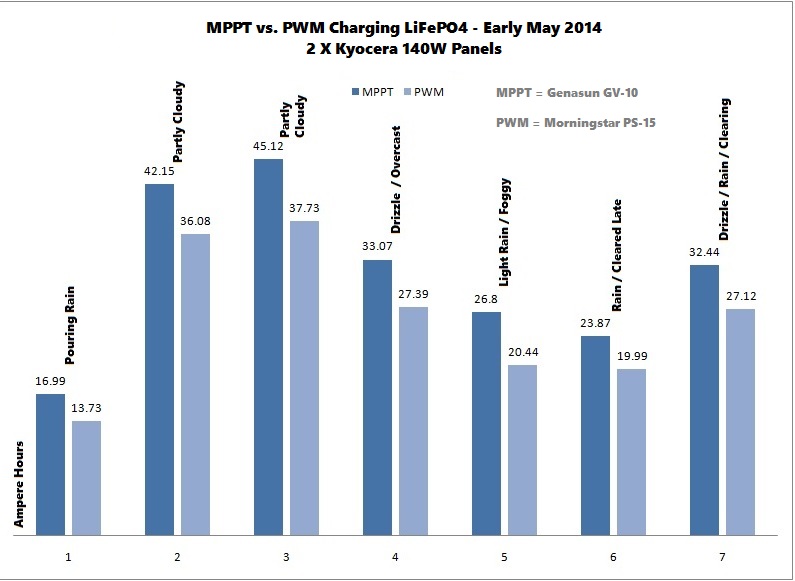
MPPT controller vs PWM

MPPT can also be advantageous if you combine panels rather than having one big one. I have pairs of panels in series, so double panel voltage going into the controller, which the MPPT "transforms" down to the correct 14ish volts for the batteries.
Double voltage means half the current for any given power, so the cable down from the panels to the controller can be thinner and/or drop less voltage.

Also charging starts a little earlier and continues a bit later in the day, as the double voltage exceeds 14V in dimmer daylight.
 
MPPT is needed for newer solar panels.
I was a bit disappointed with my new deck mounted 50watt solar panel power output. The best it could do was 2amps (about 26watts) in full sun at an angle of 45 degrees. I then replaced my PMW regulator with a MPPT module for just a few pounds on line and with a bit of soldering achieved 3.1 amps or 40 watts which is the maximum I can really expect for a horizontally deck mounted 50watt panel.
The MPPT runs the solar panel at its most efficient voltage in my case around 18volts and converts it to the battery charge voltage.


Look up ‘MPPT charge module lead acid’ on eBay for less than £5.

You must fit a 5 amp fuse to the battery connections. Also reverse battery polarity will kill these modules.

It may not help on older solar panels but the newer higher voltage ones need MPPT To be efficient.
 
MPPT is more modern technology and is more efficient. If you can afford one, buy it. I can recommend Victron (one with a Bluetooth interface) ... gives you a graph of the last 30 days. Very pleased with mine.

The difference looks like this ..... (general, not Victron)

05-MPPT-vs.-PWM-Controllers.jpg


https://marinehowto.com/mppt-vs-pwm-solar-controllers/
 
Last edited:
If you've got solar panels capable of significant wattage, the most important thing is often to have a controller you can trust not to overcharge the batteries. Not such a problem for liveaboards who use power every day, but can be a real issue for people who leave their boats unused 5 days a week 45 weeks a year while they're at work.
For a UK South Coast boat, if the panel is big enough to be useful in September, you may not need the extra efficiency of MPPT in the peak of Summer. It depends on how you use your boat.
OTOH if money is no object, buy the best...
 
Thanks guys.
Sounds like PWM will be ok to start with at least. When we start sailing longer distances and times we will look again but I think I will order the 50w panel kit with PWM.

I would suggest not getting a PWM and then replacing with MPPT for three reasons;

1. A decent MPPT is not much more money than a decent PWM. If you buy a PWM now and replace later, that spend on the PWM is wasted. Much better to go for MPPT now and not waste that initial investment.

2. If/when you come to replace you will have to remove the PWM and mount the MPPT - that is a waste of your time having to do it twice.

3. If you fit a PWM, at anchor you will have wished you'd fitted an MPPT to get the extra 10-20% output from a given panel!

Another +1 for Victron BlueSolar MPPT controllers. Now with bluetooth. Shop around to save a few £££
 
I'm going to differ from the MPPT consensus, for your specific "keep the batteries topped up while on mooring" situation.

I've got a 20W solar panel on the hatch garage, connected via a Photonic Universe dual battery PWM controller to both engine start and house batteries.
Even with this horizontally mounted, small panel, in the less-than-sunlit uplands of the far North of Ireland, it keeps both batteries topped up and even replenishes what battery power I use by running cabin lights & stereo when onboard overnight.

I've got 2x50W panels and a Victron MPPT controller for use when actually cruising. Note that the Victron controllers are generally for just a single battery -great for replacing the greater usage of your house battery when you're running autopilot, fridge etc while away, but maybe not what you need if you want to keep both batteries topped up when on the mooring.
 
I agree for MPPT
I went for this one as chaper than victron and from a reputable dealer of solar , no need for bluetooth for me I like to sail and my navstation is becoming like the Starship enterprise :p
https://www.photonicuniverse.com/en...nels-up-to-130W-12V--260W-24V-up-to-100V.html

Depending on the circumstances, the 2 hours a day of CV charging might be far too much or far too little.
These things are really designed for applications where the load is much the same every day, like signs, lighting etc.

For instance, let's say I leave my boat with the battery fully charged, then leave it on the mooring for 5 days. That's 10 hours of excess charging.
OTOH, if the battery is well down and there's plenty of sunshine, the charger will be in CV quite soon but 2 hours is not enough to fully charge the batteries.

AIUI, the Victron charge controllers use slightly smarter algorithms.
 
For what the OP currently wants to achieve, either the 50w or 100w packages below will do the job perfectly well and at a cheap price.

https://www.ebay.co.uk/itm/50-100-150-200W-Semi-Flexible-Solar-Panel-Battery-Charger-Kit-w-30A-Controller/303146517749?hash=item4694f0c4f5:m:mVEguUidhDY5bonD19H8iAQ

There are a few variants of Chinese 'solar controllers' I've seen.
Some are more sophisticated than others.
Some attempt 3-stage battery charging, some do not.
With the simplest ones, you could find the battery is at a high charging voltage whenever the sun's out. Which is great for some purposes, with some batteries. But I wouldn't recommend leaving such a set up unmonitored for extended periods.
Others can do everything a Victron unit does, if you can decypher the manual. Which may well be written for a previous edition of the firmware.
 
Adequate for what exactly?

Perfectly adequate for what the OP is after.

He can always upgrade to an MPPT controller at a later date, keeping the same panel (it's only 4 wires to re-connect). I have the same, and it keeps my batteries topped-up right through the year.
 
The blue controller looks exactly like ones that I've had which claimed to be one although I've no way of telling. The listing also has photos of a black, slightly different one. The ones I had were like the blue one and cost about £7.50, they did the job, kept battery charged and didn't fry it (but only 20w panel).
 
The blue controller looks exactly like ones that I've had which claimed to be one although I've no way of telling. The listing also has photos of a black, slightly different one. The ones I had were like the blue one and cost about £7.50, they did the job, kept battery charged and didn't fry it (but only 20w panel).
I've never been tempted to spend 10x as much for a Victron or similar but if I had a more powerful setup I might.
 
The blue controller looks exactly like ones that I've had which claimed to be one although I've no way of telling. The listing also has photos of a black, slightly different one. The ones I had were like the blue one and cost about £7.50, they did the job, kept battery charged and didn't fry it (but only 20w panel).

With only a 20W panel, you can get away with a simple regulator set to 13.7V for float charger and 14.4V when you know the battery needs a proper charge.
In winter a small panel will normally be OK with no regulation at all.
You pay your money, take your choice, but buying a cheap regulator and ruining expensive batteries is a mugs game, and I've known of a few people having that happen.
OTOH, many people get away with cheap regulators by keeping an eye on things and adding a bit of manual control. Some people shade some of their panels if they know the batteries are well charged and won't be used for a week or more.
The game has changed over the years as panels get cheaper and more powerful.
 
If you are loking to trickle charge batteries at a mooring, then PWM and a smaller panel are adequate. If you're looking to run the boat from solar power completely, with a daily requirement of 1kWh or more then a MPPT is going to do a better job.

It's down to percentages.

A MPPT controller is perhaps 15% more efficient than a PWM in northern climes ...

15% of a 50W panel would mean 7,5W lost by using a PWM instead of MPPT.
15% of a 400W array would mean 60W lost - here, MPPT is a better choice.

MPPT makes alot of sense if you need alot of power from your solar installation, PWM is fine for trickle charging on a mooring or marina berth or for low power applications.
 
Top