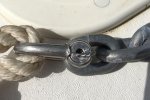
Mousing an Anchor Shackle/ Connector

It strikes me that many remarks made by surveyors show their ignorance or stupidity! If the screws are countersunk head, then he should have mad an advisory note to re-secure them to ensure they have threadlock applied.

On the subject of mooring fittings, before the days when the insurers insist on professional service of the assembly, we used several methods of securing them. When a new mooring was being prepared on the beach or an old one being serviced ashore, it was possible to weld all the pins after assembly. My preference when fitting a new shackle out on the water was a kind of belt, braces and sewn into your underwear! The shackle would be selected with a slightly over-length pin so that the threaded section protruded slightly. The pin was fastened with threadlock, then using two club hammers (one as an anvil), the protruding end was upset (deformed into a mushroom shape) and finally the head was moused with galvanized fence wire. Others will have also observed that many a galvanized shackle from an over-sized chandlers would have no thread left after a full season, whilst plain steel. accredited lifting shackles would last maybe three seasons.

Rob.
 
It strikes me that many remarks made by surveyors show their ignorance or stupidity! If the screws are countersunk head, then he should have mad an advisory note to re-secure them to ensure they have threadlock applied.

Rob.

I recently bought a Wichard countersunk 10 mm D shackle. It is described as self-locking, which seems to mean that there are indentations in the mating countersunk surfaces. It does seem to work well. http://marine.wichard.com/fiche-A|WICHARD|1305-0202060106000000-ME.html
 
He'd do well to get one those though a countersunk Allen head ;)

We've used similar shackles for years without problems, secured with Loctite, as Paul suggests. (One grade up from regular nut-lock.) Whatever a surveyor might write in his more anal moments, I'm not sure how mousing wire would fare being carted along the bottom on a regular basis, anyway.
IMHO mousing wire should last for a normal season, but those doing a lot of anchoring should check its condition regularly. I believe many boat owners now mouse their anchor shackles with cable ties.
 
I believe many boat owners now mouse their anchor shackles with cable ties.
I believe so, too. But not if the shackle pin has a countersunk Allen head, as the OP's seems to have. Ordinary Allen heads can be drilled to take lock-wire, and commonly are on aircraft and competition vehicles, but more rarely on boats. The trouble with using plastic ties in this way is that it's very difficult not to leave a sharp edge on the inner part of the drilling (where it breaks into the hex).
 
How is the cut end of the twisted wire secured? Or is it just folded back under the pin?
Once round the D then twisted (as you can see). Then split and round the pin from opposing sides twice, then twisted about 6 times to secure and the end tucked inside the D. Not sure if that is Ancient Mariner Approved so we will see what some used does to it.
 
Once round the D then twisted (as you can see). Then split and round the pin from opposing sides twice, then twisted about 6 times to secure and the end tucked inside the D. Not sure if that is Ancient Mariner Approved so we will see what some used does to it.

Lot of effort to save a spot of Loctite.
 
Not at all. Mousing a shackle with wire that I have on the boat is a lot less effort than going to my car, driving halfway across Portsmouth, buying the Loctite, driving back and applying a single drop to the thread. Yes I will buy Loctite next time I am in a Loctite shop ;)

Also a lot less effort than recovering the anchor and chain if you lose it. As per post #34, unless I'm missing something from your description, the lock-wiring is not secure. It's a basic tenet that the loop of wire between two fixed elements should not be longer than the distance between them, which your example seems to be. It can be swept off the fastener.

I daresay yours will be OK in the short time before you get some thread-lock, but wouldn't want anyone else to get the idea it's a long-term fix.
 
Last edited:
Also a lot less effort than recovering the anchor and chain if you lose it. As per post #34, unless I'm missing something from your description, the lock-wiring is not secure. It's a basic tenet that the loop of wire between two fixed elements should not be longer than the distance between them, which your example seems to be. It can be swept off the fastener.

I daresay yours will be OK in the short time before you get some thread-lock, but wouldn't want anyone else to get the idea it's a long-term fix.

I think the subtlety of my humour was lost. Of course I will get Loctite for a long-term fix :encouragement:
 
Top