Mounting a Wind Vane

Cian

New Member
Joined
27 Jan 2021
Messages
8
Visit site
Hi folks,
I plan on mounting a nice new Hebridean Wind Vane on my Sadler 32 in the next few weeks. I have been considering how best to reinforce the transom.

One idea is to fit a piece of 18mm marine ply on the inside, glass it in place, and then bolt through it.
On the other hand, I've seen people recommending steel plate backing.

What would you recommend?
I presume the forces on a wind vane can be fairly strong and come from surprising angles.
 
Hi folks,
I plan on mounting a nice new Hebridean Wind Vane on my Sadler 32 in the next few weeks. I have been considering how best to reinforce the transom.

One idea is to fit a piece of 18mm marine ply on the inside, glass it in place, and then bolt through it.
On the other hand, I've seen people recommending steel plate backing.

What would you recommend?
I presume the forces on a wind vane can be fairly strong and come from surprising angles.
The loads are not that significant. I simply have nylon washers on the outside and stainless steel washers on the inside.
From my Windpilot manual
‘1.5.2 DO I NEED TO REINFORCE THE TRANSOM?

• No. The forces on the transom are relatively low and should never exceed the steering force exerted on the tiller plus the weight of the system itself.’
 
Last edited:
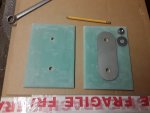
I've mounted my Seafeather and using their ss backing plates through some oversized 10mm G10 (about A5 size). The edges have been rounded and bolted in place with thickened epoxy with a fillet . I was going to glass over the top but I'm not going to bother now, seems a bit overkill.
 

Attachments

  • 20201002_191336_copy_1305x979.jpg
    20201002_191336_copy_1305x979.jpg
    186.1 KB · Views: 18
I made mine much stronger than demanded by the wind vane's needs, in the anticipation that at some point, it would be used to tie lines to, climb out of the water, or get spanked into by a fishing boat... the last one actually happened and penny washer type reinforcement would have just ripped out of your transom.
 
I made mine much stronger than demanded by the wind vane's needs, in the anticipation that at some point, it would be used to tie lines to, climb out of the water, or get spanked into by a fishing boat... the last one actually happened and penny washer type reinforcement would have just ripped out of your transom.
I guess if your boat is lightly built you may need to reinforce the transom. It will depend on how heavily the transom is built.
 
I can't imagine it would need any reinforcement at all bar penny washers under the nuts. Forces on the windvane are not great at all, a Sadler 32 is strongly built and the transom is so small it will be very tough indeed.
If you get walloped by a fishing boat it'd be much better if the bolts tore out of the transom than you got the transom torn off the boat...
 
Hi folks,
I plan on mounting a nice new Hebridean Wind Vane on my Sadler 32 in the next few weeks. I have been considering how best to reinforce the transom.

One idea is to fit a piece of 18mm marine ply on the inside, glass it in place, and then bolt through it.
On the other hand, I've seen people recommending steel plate backing.

What would you recommend?
I presume the forces on a wind vane can be fairly strong and come from surprising angles.

I have a Windpilot Pacific on our Sadler 32. I haven't needed to strengthen the transom. That would have been necessary for an auxiliary rudder type windvane like the Hydrovane but not for these servo-pendulum types where the forces are largely taken up by the existing steering gear as geem says in #2.
 
Last edited:
My Hebridean is mounted on a cantilever frame ( transom hung rudder) using 12mm marine ply backing pads.Pads are bedded in Sikaflex 292 which is made for this kind of thing and considerably more pleasant than using epoxy overhead in a confined space.This has proved fine for the loads involved - on a larger albeit well built transom paneL.Penny washers were used - there is also a thing called a fender washer available in s/s in up to 1½ Ø x 3/8 or ½ from Westfield fasteners if you want to gild the lily. I have found these very useful. I'm sure that your 18mm dense plywood would do the job.
shows my frame arrangement .
The blade can generate large forces which are magnified by the leverage available - with a highish transom plus a cantilevered pivot my ratio is circa 1: 4.8.Yes these are generally released by the recovery action of the vane but John does recommend a failsafe link operating at 70 kgs so that a jammed rudder or tiller cannot get a destructive force.This might occur in a broach I suppose if several things came together.
 
My Aeries has a length of tube that fits over the main rudder shaft. Into it, where the rudder shaft joins the vane shaft, there is a 3mm deep groove so that becomes a break point. In 2019 I was surfing at 8kts When there was an almighty bang that jerked the boat & the oar broke free. ( i did not loose it as it was attached to a line.)
there was also some damage to the side of the rudder.
My general feeling about this is that if one is going to have such an appendage trailing behind the boat one needs a good system of emergency failure. If not there is going to be either substantial damage to the rest of the gear, or to the transom of the boat. If there are 4 fixing points & 3 break The third could lever round & rip a section of GRP away with it.. I would ensure a sacrificial break point & strong transom fixing
 
I have a Windpilot Pacific on our Sadler 32. I haven't needed to strengthen the transom. That would have been necessary for an auxiliary rudder type windvane like the Hydrovane but not for these servo-pendulum types where the forces are largely taken up by the existing steering gear as geem says in #2.
I'm looking into a Hydrovane. Feedback from a sistership is that they didn't beef it up enough - they spent much of the ARC in the stern compartment trying to tighten up the nuts while the bolts ground away the plywood backing plate. Hence the Hydrovane instructions are pretty emphatic: big backing plates, big nuts, big loads.

I can see for other types of assembly it's much less load; presumably because they incorporate the leverage of the yacht's own steering gear.
 
My Aeries has a length of tube that fits over the main rudder shaft. Into it, where the rudder shaft joins the vane shaft, there is a 3mm deep groove so that becomes a break point. In 2019 I was surfing at 8kts When there was an almighty bang that jerked the boat & the oar broke free. ( i did not loose it as it was attached to a line.)
there was also some damage to the side of the rudder.
My general feeling about this is that if one is going to have such an appendage trailing behind the boat one needs a good system of emergency failure. If not there is going to be either substantial damage to the rest of the gear, or to the transom of the boat. If there are 4 fixing points & 3 break The third could lever round & rip a section of GRP away with it.. I would ensure a sacrificial break point & strong transom fixing

Yes to a sacrificial break point. The blocks that take the line to the tiller are secured with thinner line on our Windpilot Pacific such that the water blade of the vane will then swing harmlessly from side to side.
 
I'm looking into a Hydrovane. Feedback from a sistership is that they didn't beef it up enough - they spent much of the ARC in the stern compartment trying to tighten up the nuts while the bolts ground away the plywood backing plate. Hence the Hydrovane instructions are pretty emphatic: big backing plates, big nuts, big loads.

I can see for other types of assembly it's much less load; presumably because they incorporate the leverage of the yacht's own steering gear.
That's it. The type such as I have, a Monitor, operates on the tiller. It is not an additional rudder.
 
I'm looking into a Hydrovane. Feedback from a sistership is that they didn't beef it up enough - they spent much of the ARC in the stern compartment trying to tighten up the nuts while the bolts ground away the plywood backing plate. Hence the Hydrovane instructions are pretty emphatic: big backing plates, big nuts, big loads.

I can see for other types of assembly it's much less load; presumably because they incorporate the leverage of the yacht's own steering gear.

Yes, I epoxied in thick plywood and then used aluminium backing plates. On the outer side I didn't use wood - too hard to get to the correct curves - so I put expoxy and filler in a plastic bag between the hull and the Hydrovane pad and made a pad that way.
 
Yes to a sacrificial break point. The blocks that take the line to the tiller are secured with thinner line on our Windpilot Pacific such that the water blade of the vane will then swing harmlessly from side to side.
I was hand steering at the time, so my one was free , but it did not have a chance to swing free & was hit square on & solidly at 8kts
 
Wow. Thanks everyone for that wealth of info. Some clever thinking and good ideas there. I may well alter plans according.
 
Hydrovane being an aux rudder design will always put more load onto the transom than a servo pendulum which provides very little.

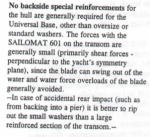
Just to reinforce the point here is as excerpt from the Sailomat fitting instructions, and remember the author, an aerospace design engineer, is making general observations for all transoms, big wide ones with weaking cutouts and gaps in them too not a tiny little Sadler triangle of, effectively, a ¼ in thick structure reinforced with ¼ inch thick GRP webs on two sides (the hull sides) and at least ½ in thick web on the top (the hull/deck joint).

Screenshot 2021-01-30 at 14.18.39.png
 
Top