Mounting a mast crutch

Highndry

Well-Known Member
Joined
7 Apr 2011
Messages
477
Location
Nr Uppingham, Rutland
Visit site
I want to make a mast crutch for my Hunter Medina. Both for raising the mast and for transportation on the trailer. It currently has a set of cross timbers knocked up from a couple of pieces of planking. They do the job (standing in the cockpit) but they're very agricultural and a pain to store.
Found a nice set of plans here http://captnpauley.typepad.com/.a/6a0111685112b3970c011570a4bb9a970b-pi and wanted the forum's advice as to whether the pintles and gudgeons would be strong enough?
 
I wouldn't use the rudder fittings for supporting a mast gallows - especially if it's to bounce along a road.
You'll have the outboard off no doubt, so why not make up something that clamps on there?
 
The attraction of this idea is that it's central and would accommodate the mast, in line, while it was connected at the step. The outboard bracket is off centre.
Do 'the panel' think it might work OK for stepping but not for transport?
 
The attraction of this idea is that it's central and would accommodate the mast, in line, while it was connected at the step. The outboard bracket is off centre.
Do 'the panel' think it might work OK for stepping but not for transport?

I'd prefer the alternative in the link fixed (lashed) to the taffrail

Personally I use an A frame that rests on the aft deck , with its feet just inside the fairleads on the quarters, lashed to the rail.

I do like that idea of a roller.

Not a bad idea to have one thing for transport, with the mast supported fairly low (and in the centre on the cabin top) and another much higher for use when raising/lowering the mast.

In our Owners Manual there is an idea that doubles as a ladder.
 
mast crutch

I would be surprised if the gudgeons/pintles on the Hunter Medina would not take the weight of half the mast and rigging via a crutch mounted on them,assuming that they are secure in the first place.
I have a Sun 2000,the Jeanneau mast raising kit for which includes a stainless tube crutch that is designed to replace the rudder when you are towing.
The Medina might have a heftier mast than our Z170 but if you can easily support that end,as with ours,then the transom fittings should accept that weight.It would be sensible to add side to side lashings so that the crutch can be relatively slender.
These sailors in I think Belgium have gone one stage further by mirroring the fittings so that they can leave the rudder mounted.http://www.jeanneau-owners2.com/hintsandtips/id188.htm
 
Using the rudder fittings is what we do on dinghies.
They should be pretty strong, although the weight of the mast is in a different direction to the normal load.
Better than point-loading the deck at any rate.
Possibly a good idea to give the mast some support near the middle too, perhaps a block mounted on the mast-step or coach roof?
You don't want the mast to wobble or bend and fatigue.
 
Mast support

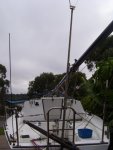
After trying a variety of styles I have built this one recently and think it is the best yet.
It is a SS pole which is big enough to go over the head of the bolt which is the pin for the top pintle.
It clamps onto the stern rail to keep it vertical and provide more support. 2 U bolts.flat plates.
http://www.ybw.com/forums/attachment.php?attachmentid=19056&stc=1&d=1339814161
http://www.ybw.com/forums/attachment.php?attachmentid=19057&stc=1&d=1339814161
The support is not vertical as I move it sideways for access to the cabin when home for the winter. Yes they are grey skies not blue (a rare sight).
You will see that it actually is 2 mast supports one high and one low for travelling/storage.
The high one has a roller built in to make it easier when removing mast to slide the mast forward until it is at the bow rail where it is slung in loops of rope. It is then very easy to get under the mast and lift it to the final rest. This is a hook of SS welded onto the side of the main pole. The top section is then removed. I fitted it back for the photo. I did try just telescoping the pole but that was too difficult with the weight of the mast in one hand so 2 rests is easiest.
I leave my boat on swing mooring so I remove the clamp on the stern rail. But fortunately the tiller is split so pole can remain in place for sailing. The high rest is good for traversing bridges as it is easier to raise the mast again it also means that the mast can be lowered to the high rest with boom attached and still have clearance from hatch cover etc.
The changes to the stern rail have been my winter project. 2 gates one to make it easier to fit O/b motor and one to make it easier to climb from water to boat. Pelican hooks close the gates. You might also note the new VHF antenna built into the sbd post It is a 17 inch piece of SS wire flattened at the end witha hole and a lug for the centre of the coax. This sits in a piece of plastic tube and the shield bolts onto the top of post. Very good VSWR.
 

Attachments

  • 100_6759scaled.jpg
    100_6759scaled.jpg
    83.8 KB · Views: 2
Last edited:
Mast support

I agree with Olewill about having a two level support. I have a s/s tube welded to the pushpit which the ensign normally fits in. I have a tube with a keel roller from a trailer fixed to it, this drops in the flag socket and the mast rests on this for transport. When raising or lowering the mast I found an old tent pole with a swaged down end that fits inside the flag tube, then the roller fits on top of this - it's about as high as my son can reach standing on tip-toe!
With the mast resting on it and with the bolt through the foot at the mast step, the mast clears the coach roof and with a rope attached to the forestay round the bow roller and back to a winch I can raise the mast single handed.
For transport I also have a wooden crutch which has a hole drilled through and the bolt which holds the mast foot in the step goes through it - stops the mast bouncing up and down in the middle.
Sailorbaz
 
mast raising

i use a mast crutch supported in the rudder stock to raise the mast on my medina with no problems, in the vee of the crutch there is a roller to help moving the mast to line up with the tabernacle. once the mast is fixed at the tabernacle and lying horizontally i can lift the crutch a couple of feet and place a pin through a hole in the shaft of the crutch this gives a better angle to use a gin pole to step the mast.
hope you can understand all this
 
Top