More Water in Bilges

jusw

Well-Known Member
Joined
23 Mar 2007
Messages
238
Location
West Sussex (UK)
Visit site
Do any of you know the "bilge layout" of a Hunter Horizon 27TK?

I know I have a leak through the stern gland - It's one of those "packless" seal systems - when stationary on the mooring its fine, but if motoring it seems to leak and the water ends up in the engine bilge - This doesn't seem to be connected to the other bilges, but I get water leaking into them too - is there a way between them?

Also forward of the engine. there are two access panels in the cabin floor that uncover the bilges that are divided into three compartments.

The rear two compartments each have a 30mm or so hole connecting them with the space under the bunks / side seats. On my boat, these holes have rubber bungs in them ! These would seem to be blocking the side bilges from draining - I have removed them for now - is this a correct thing to do? Comments??

Finally the quantity of water leaking in yesterday on a short motor from Bembridge to Chichester - about 3 hours - was approx half a large bucket full.

Incidentally, the boat is kept on a drying mooring taht may or may not be significant.

Any thoughts / help is appreciated.

Julian
 
If it's a Volvo seal like mine you'll need to bleed it of air if it dries out. Check the manual. it's just a matter of squeezing the seal until water flows out. Then it should not leak at all.
 
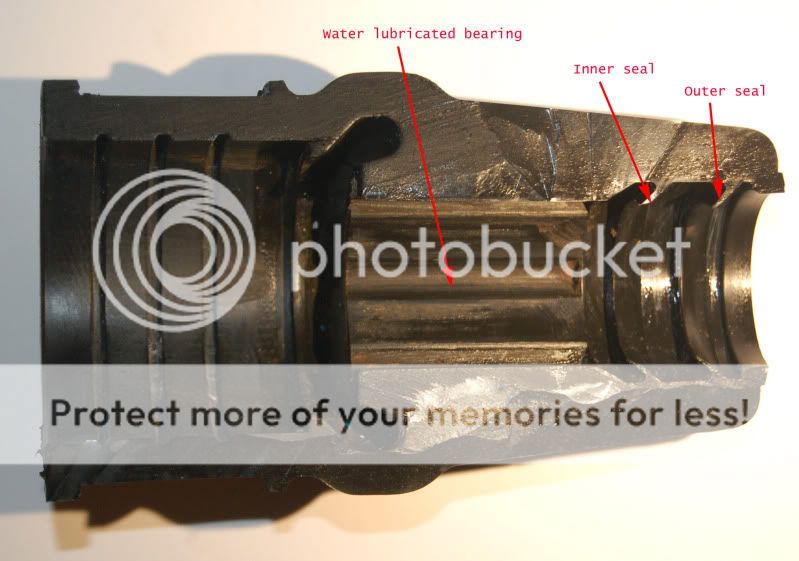
Any leaks from a non drip seal indicates something wrong. If it is a Volvo - looks like a rubber stub about 110mm long. tapered at the end near the engine. If it is leaking it means the lip seals have worn. This can happen if it runs dry, that is if it has not been "burped" after the boat has dried out. However, if it does run dry it usually makes a terrible noise to remind you! Apart from the seals it has a water lubricated fluted bearing, which is what makes the noise.

If it is a face to face seal then leaks are caused by wear on the faces, fouling build up on the faces or incorrect tension on the bellows. Immediate attention needed for any of these reasons.
 
Yes the drying mooring is significant.

Everytime yuou use the boat you should burp the sterngland, that is squeeze it a bit to let the air out and some water in. The water will lubricate the gland and stop it leaking. It is possible that by not doing this you have wrecked the gland.
 
The requirement to burp a Volvo seal after drying out also applies to other makes e.g PSS & Deep Sea.
On a drying mooring it can be a pain but you can add a water feed off the exhaust which eliminates the need completely.
Have done this on several boats with no problems.
 
If I assume that I have wrecked the gland and will need to replace - bearing in mind I'm on a drying mooring, would I be better with a traditional stuffing box and grease arrangement?

Julian
 
I wouldn t assume you have wrecked the gland till you have exhausted all avenues and so far all the comments have been very negative and NO ONE has questioned the fact that there is no leakage when stopped and there is when moving which could be due to poor setup..

In many cases I have found that far from the gland being wrecked there is nothing wrong with it. It is just not correctly set up correctly for the true engine position when unlder load.

Before you rip things out I would suggest you try adjusting the compression on the seal face. This is done by slackening the jubillee clamp or clip securing the gland to the shaft and ENSURING it does not move towards the engine..With the clip slackened move the shaft mounted portion backwards towards the stern about 5 MM and re clamp then test it..

If the leakage is stopped all well and good if reduced then try a little more.

The problem is that folk set these up for the correct compression with the engine at rest however when the engine is on load then it moves forwards and this reduces the compression on the seals and hence they leak!!!!
 
*If* it is a volvo seal (used by Hunter), have you added grease recently?

You need to get about 1cc of the blue volvo gease between 'inner' and 'outer' seals.

DSC_6040b.jpg


The cleverest way of doing this is to use a (McDonalds) drinking straw: squeeze some grease into the straw; flatten the end of the straw; push the flatteed end a suitable distance into the volvo seal; 'milk' the grease out of the straw into the seal.

As others have said, you need to 'burp' these seals after drying out. There is an engraved notice to this effect near the companionway on our Channel 323. I suspect that Hunters used an inner moulding for the engine mounts, etc. on the 272, like the 323. Once water is between that and the hull, I guess it can come out anywhere.

I would try some grease in the seal if you have a Volvo one. If the water's not coming from the sterngland, then perhaps use the talcum powder trick to try and see where it's coming from.

0.02p

Andy
 
It's not a Volvo seal - It's PSS
See here
It is adjusted by releasing the stainless steel disc held onto the shaft by allen screws - Trouble is I'm a bit reluctant to release it in case I can't get it to seal at all!

More courage needed!

JuSw
 
According to what is written in PARAGRAPH 11 the compression that you need would be 20mm. The process of adjusting it is clearly set out in para 12 onwards.

You have the advantage that you can do it when the boat dries out. I have replaced a Volvo seal on a boat that was afloat! OK there were two of us, but there was really not much to it. All it needs is a little bit of confidence. Make sure that you have all you need at hand (masking tape, Biro, measure and allen keys) and go for it. You can do it!
 
Have you checked each allen screw one by one that they are free.....IE loose and retighten each in turn without moving the seal. If you can get them all free then I can see no reason for not trying to loosen them all and trying to move the ring down the shaft to increase static sealing pressure.

Does the bellows feel as if it is under little compression. Can you easily make the seal leak when at rest by pressing the seal surface backwards.

You can be no worse off by increasing the compression on the seal as you are just pressing agains the bellows spring. Does the seal leak when going full astern??? If not then this all points to the seal being wrongly positioned for ahead running .
 
Top