More design questions - swept spreaders

HoratioHB

Well-Known Member
Joined
2 Oct 2006
Messages
895
Location
Near Plymouth
sowethereyet.blogspot.co.uk
So what with everyone asking about displacements and being rude about Bavarias - here's another conundrum - swept spreaders - wtf?? I did the ARC last year on a lagoon 380. No backstay and you shouldn't take the main down as it apparently adds stiffness to the mast to stop it pumping and falling over. We spent three weeks close to dead downwind and couldn't let the main out more than about thirty degrees because it fouled the spreaders. We tried reaching off a bit but our VMG just died. This meant that for three weeks the main was effectively working backwards with the wind entering the sail over the leach - bloody silly. Ok you can argue that without backstays you need them but my Jeanneau 42, the Bavarias I teach on and most modern boats all have the bloody things and a proper backstay as well. If you teach man overboard under sail they hold the top third of the main up to the wind when you are trying to spill the wind. They restrict how far you can let the main out downwind - the Lagoon example being the worst. So why the hell do modern rig designers use them? Discuss.
 
Used for flexibility. Bendy mast I suspect it was, so you may adjust and trim the sails, get the main flat for instance. Racing rig, for upwind performance. Well, it's cheaper too...
 
Even in a mast set up with in line spreaders and pre-bend, the mast will pump badly and perhaps fatally, without some form of restraint.We used to bring back the spinnaker uphaul to a winch initally, but soon sprouted a pair of runners, to obviate the need to always have a main rigged. in hairy conditions.
 
Swept Back Spreaders

As far as I know its all about weight aloft and strength, swept back spreaders enable a lighter mast section and are supposed to make for a better shaped main because you have (allegedly) more control over the bend in the mast. A well designed rig will stay up without a fore-stay AND a back-stay, I am satisfied this is so as a rigger was quite happy to go aloft on my rig with just the shrouds and lowers holding the mast up. However, Swept back spreaders as you have found do mean we have learn new tricks to sail downwind without damaging the mainsail and has been proven "tacking down the wind" or broad reaching is faster and many would suggest safer than a dead run - but not always as convenient.
 
Swept spreaders are fitted to fractional rigs to avoid the need for running backstays. Without one or t'other the masthead backstay would break the mast at the forestay junction. There is absolutely no reason not to run the boom out to very close to the aftmost lee shroud. It goes without saying that it mustn't come into contact with the shroud with any great pressure.

Sweep them back a bit further and you don't need a backstay at all. This is convenient for mainsails with huge roaches, which would become a nightmare to gybe as the battens foul on it.

There is also the racy fact that a light cat never needs to sail dead downwind, but that is a little disingenuous for a heavyish cruiser.

It is a completely sound design for the average sailor. A full on racing rig would have in line shrouds and running backstays.

Many masts have fallen where those have been involved in accidental or not fully discussed gybes.

The sail will need self adhesive wear patches at the ends of spreaders in contact with the sail.

And I have to ask of your ARC skipper, would he have let the sail touch the shroud if it was a masthead rig?
 
Last edited:
the Bavarias I teach on

Blimey HB

When did that start, You're supposed to be retired and now you're teaching, writing books and running sailing rallies!


As for the question isn't it all to stop the mast pumping in the absence of baby stays and forward lowers, which perhaps is to make the boat cheaper and the foredeck and fwd side decks less cluttered? We need a rigger or surveyor to answer.
 
Blimey HB

When did that start, You're supposed to be retired and now you're teaching, writing books and running sailing rallies!

As for the question isn't it all to stop the mast pumping in the absence of baby stays and forward lowers, which perhaps is to make the boat cheaper and the foredeck and fwd side decks less cluttered? We need a rigger or surveyor to answer.

Gotta keep busy. These answers are interesting though. To say they are necessary in a fractional rig so that you have better control of the mainsail shape - well that's fine if you can adjust the backstay tension but many modern boats don't have adjustable backstays - mine didn't. So you end up with the worst of both worlds an unajustable mast with a rig that's dreadful downind and wears out your sails. The only good thing might be it will limit the severity of the odd accidental jibe.........

'And I have to ask of your ARC skipper, would he have let the sail touch the shroud if it was a masthead rig?' No - especially on a long offshore trip, chafe becomes a major issue. But this particular boat was crazy - you couldn't take the main down and go Twissle (Spell?). Downwind tacking was no good as you had to go so far off course to get a better set and boat speed that our VMG to our waypoint 2500 miles away was hopeless. And because of the rig we couldn't let the boom out anything like properly and as I said the airflow over it must have been reversed!!

For what its worth I think its fashion - I've read boat tests where the reviewer comments on - 'the fashionably swept back rig.' Which is a **** reason for doing anything on a yacht!!
 
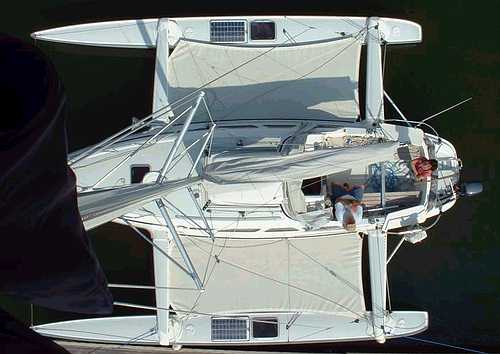
Dragonfly trimarans have an interesting spreader design which I have not see anywhere else. At each set there are 3 spreaders rather than 2, 2 swept aft and one forward. The forward two sides of the resulting triangle are braced. The 3 wires are diamond shape in that they return to the bottom of the mast and are independent of the hull. The forestay and two backstays are purely for holding the mast up, they add no stiffness. All the mast stiffness is in the self contained mast/diamonds unit.

This makes for a very strong and stiff mast, absolutely no need for the mainsail for stiffness and pumping never happens. The downside is that it is not possible to adjust the mast shape at all when sailing. It is not possible to get the boom out more than 60 degrees so dead downwind is inefficient. However, the highest VMG downwind is when the apparent wind is at about 95 to 100 degrees, so unless in restricted waters this is not a problem. The layout can be seen here...

topview.jpg
 
On any rig other than stayless, the sail must contact the shrouds when sailing downwind. Wear will be a problem that must be managed with sacrificial patches.

The fact that you have a backstay, but no easy tensioner for it says that you are sailing a boat that the builder/designer has decided that you are not a racer and (Sorry) can't be trusted with it. Too much ability to break your mast and blame the builder.


Having said that, and with respect to having to keep the main up to provide more backstay equivalence, is a sound propostion. Which could easily be circumvented with a strong topping lift and tight mainsheet or kicker.
 
On any rig other than stayless, the sail must contact the shrouds when sailing downwind. Wear will be a problem that must be managed with sacrificial patches.

The fact that you have a backstay, but no easy tensioner for it says that you are sailing a boat that the builder/designer has decided that you are not a racer and (Sorry) can't be trusted with it. Too much ability to break your mast and blame the builder.

.

Yes but if you have stays that don't sweep back you can let the main out a lot lot further which is far more efficient. As for producing rigs that are a compromise, to allow you to bend the mast and then not give you the facility seems to be stupid - yet most do it!!!
 
Yes but if you have stays that don't sweep back you can let the main out a lot lot further which is far more efficient. As for producing rigs that are a compromise, to allow you to bend the mast and then not give you the facility seems to be stupid - yet most do it!!!

Maybe this is the reason why...

Large headsails do not work well when reefed using roller reefing.
So that's a good reason to reduce headsail size and overlap.
That means a larger mainsail size to keep sail area up.
So that requires a fractional rig.
A fractional rig needs for/aft support at the top of the forestay.
So it's either swept spreaders or running backstays.
Runners are a no-no, so swept spreaders it is.
 
Maybe this is the reason why...

Large headsails do not work well when reefed using roller reefing.
So that's a good reason to reduce headsail size and overlap.
That means a larger mainsail size to keep sail area up.
So that requires a fractional rig.
A fractional rig needs for/aft support at the top of the forestay.
So it's either swept spreaders or running backstays.
Runners are a no-no, so swept spreaders it is.

OK that makes sense except why does a larger mainsail require a fractional rig? I've raced and cruised masthead rig boats with massive mainsails and when it comes to that used adjustable backstays on them to get mainsail shape. In the early seventies most racing boats were like this and then fashion for fractionals came in which made sense when racing. I still don't get it for cruising boats.
 
OK that makes sense except why does a larger mainsail require a fractional rig? I've raced and cruised masthead rig boats with massive mainsails and when it comes to that used adjustable backstays on them to get mainsail shape. In the early seventies most racing boats were like this and then fashion for fractionals came in which made sense when racing. I still don't get it for cruising boats.
Difference in aerodynamics at very small angle to windward. Can't recall what angle exactly, but only racing boats, very close-winded, can sail in such small angle - and there lower foresail rig is more efficient. Only in terms of drive per sail area, naturally. Over a bit bigger angle advantage is lost, and out of close-hauled masthead rig gets more efficient.
Naturally cruiser is not limited by racing rules in sail area carried, so no reason whatsoever for it to use the "Small area - high efficiency" type anyway. Better to have a rig that can carry as much as possible. The strongly stayed one, that is.

Large headsails are useful outside of close-hauled besides, more efficient, so for cruising rig no wonder cutter arrangement is used, to be able to change headsail, instead of reefing deeply.
 
Last edited:
Cats tend to have triangulated rigs - ie a forestay and two shrouds/backstays at equal, 120 degrees (approx) intervals round the mast. The mast is, therefore very well supported, particularly as these stays are taken down to the hulls and so have a very wide base. The mast itself will be supported either in column or with pre-bend by a series of diamonds, usually with jumper struts out ahead of the mast. The foot of these stays is taken to the foot of the mast so the whole thing is self-contained. Using the three main stays, the mast can be set up with more or less rake - often quite exaggerated rake.

The leech of the sail, through the mainsheet, also has a function is supporting the mast and controling sail shape though cat sails are usually pretty flat cut and need very little draught control.

Cruising cats almost never have runners. My sistership had them fitted for a Round-Britain race as part of a general beefing up of all the spars and rigging. In a near gale in the Celtic Sea last year I quite envied him but she came through unscathed.

As far as down wind work is concerned, in open waters I always tack down wind keeping the apparent at around 130 degrees, maybe 140 or 150 in stronger winds. With the traveller at the very end of the track and the sheet slightly eased the sail is at a pretty good broad reaching angle. At this point the sail is still well clear of the shrouds. The real killer for my sails is the chaffe or the battens in the pockets and any prolonged flogging of the sail which was a low teck laminate and is now a moderately high tech laminate.

In a confined channel I might run dead down wind and just accept that the main is not at it's optimum setting.
 
Has it occurred to anyone that having the wind reversing flow over the main can some times be useful
Ie in light winds with a spinnaker. By spilling some wind off the main into the spinnaker it helps it to stay filled
 
Top