More containers lost off Isle of Wight

  • Thread starter Thread starter wrr
  • Start date Start date
Re the article, it mentions the ships Lombok Strait and Baltic Klipper - these are both fast refrigerated cargo vessels in the Geest Line which has weekly sailings from Portsmouth to the Caribbean.
Home Page - Geest Line
Barbados is usually their first port of call, and they usually arrive on a Monday or Tuesday - but Luzon Strait did not arrive here until Friday this week.
MarineTraffic: Global Ship Tracking Intelligence | AIS Marine Traffic
They normally take 9 or 10 days for the transatlantic passage. They are all sailing on very tight schedules, and even though they can sail at 18 or 19 knots, they can still caught in heavy weather.
We have had a few survey assignments here in the past onboard Geest vessels where deck cargo / containers were damaged, usually while crossing Biscay on the voyage out here.
And I remember one time when two containers that were being carried as deck cargo on a hatch cover jumped overboard while the vessel was underway between two of the Windward Islands - the wind was typical winter tradewinds (perhaps 20 - 25 knots) and the seas were on the beam, causing the vessel to roll heavily.
Unfortunately the containers were carrying very expensive rally cars (they were either going to Barbados for a rally, or returning to UK - it was a long time ago now) - the owners were not amused.
 
I suspect that as the cost of being alongside in port is so high, and so turnaround time is getting tighter, the crews are having to prep for unloading well before the ship is tied up.
The solution to this is passing costs on to customers, not taking dangerous shortcuts. Perhaps government need to get involved if that’s really what’s happening.
 
What surprised me is that there’s no instant response plan for recovery. It’s absurd that they’re left to float about, and that volunteers are expected to pick up the mess from beaches.
There was a statement about ‘waiting on insurance’.
But it’s not the kind of incident that can wait for a year before insurers decide what to do.
 
I imagine they see it as the same procedure mid Atlantic as in the Solent, even though it's plainly not.

If someone had a boat and recovered them, they could very probably charge the insurance for the recovery. That may focus minds a little.
 
What surprised me is that there’s no instant response plan for recovery. It’s absurd that they’re left to float about, and that volunteers are expected to pick up the mess from beaches.
There was a statement about ‘waiting on insurance’.
But it’s not the kind of incident that can wait for a year before insurers decide what to do.

They weren't waiting on insurance. The District Council do the clear up and claim money back from insurers. The delay in the clearup was caused purely by the time it took for suitable contractors to become available. It's a rare event so, needless to say, there aren't "container clearer uppers" on 24 hour standby.

The clear up at Selsey is complete now although getting broken up plastic out of the shingle is very difficult so no doubt it won't be 100% perfect.
 
I suspect that as the cost of being alongside in port is so high, and so turnaround time is getting tighter, the crews are having to prep for unloading well before the ship is tied up.
Could be, but does if actually take long to “release” a container? Bearing in mind that once your shore lines are on the crane has to move into position to start picking them up. Turnarounds might be pressured - but does that actually save time? I could believe it’s the opposite end - once containers are loaded the owner wants it off the dock and underway ASAP and so securing the cargo may not be high priority?
 
I imagine they see it as the same procedure mid Atlantic as in the Solent, even though it's plainly not.

If someone had a boat and recovered them, they could very probably charge the insurance for the recovery. That may focus minds a little.
They could but a 40ft container weighs >3 tonnes empty and perhaps 10x that if it’s full. So it’s not like you just need a rib and some ropes. Then there’s the fact that these typically fall off in poor weather - would you want to be bouncing around in poor weather trying to rig slings etc for a container full of stuff that’s probably been ruined anyway? Is an insurer likely to save money by recovering from the water?
 
They could but a 40ft container weighs >3 tonnes empty and perhaps 10x that if it’s full. So it’s not like you just need a rib and some ropes. Then there’s the fact that these typically fall off in poor weather - would you want to be bouncing around in poor weather trying to rig slings etc for a container full of stuff that’s probably been ruined anyway? Is an insurer likely to save money by recovering from the water?
I was obviously talking about someone with proper equipment. These things float about for days or weeks, so plenty of time to recovery them properly and charge an appropriate fee for doing so to prevent environmental impact.
Whether the insurer wants it or not, they are liable for any charges whoever cleans up the mess.
 
Could be, but does if actually take long to “release” a container? Bearing in mind that once your shore lines are on the crane has to move into position to start picking them up. Turnarounds might be pressured - but does that actually save time? I could believe it’s the opposite end - once containers are loaded the owner wants it off the dock and underway ASAP and so securing the cargo may not be high priority?

It *is* strange. Something must have changed. I have no recollection of containers dropping off ships around the Nab Tower and then out of the blue it's happened 3 times in a few weeks.
 
Insurance companies are complaining about the increase in container loss numbers as well as the fact that larger ships can mean more container failures and therefore higher exposure to insurance companies.

2025 Article
Almost 1,300 containers lost at sea – insurers call for better container safety on ships

... While general cargo and heavy-lift vessels are subject to binding requirements for cargo securing, no such framework currently exists for container ships. Classification societies use differing assessment methods for stability, acceleration, and loads. As a result, identical ships may be evaluated differently depending on their origin. This inconsistency creates international safety gaps and increases the risk of container losses, particularly during storms or in challenging navigational situations where every detail matters ...

2022 Article
How to make container shipping safer again

This is already the second winter that the shipping industry is experiencing a sharp rise in containers lost at sea. Experts at GDV have analysed the causes of this development and are proposing possible solutions.

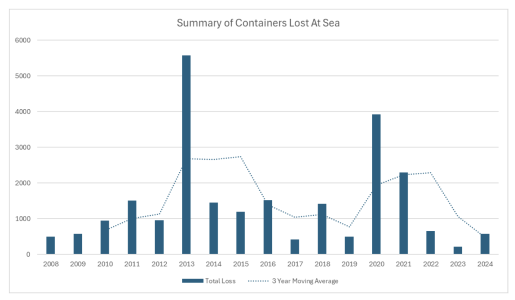
It's not all bad news as the container loss numbers are down.

World Shipping Council Releases Container Lost at Sea Report - 2025 Update — World Shipping Council

Washington/Singapore/Brussels/London, 30 June 2025 - The World Shipping Council (WSC) has released its annual Containers Lost at Sea report, showing that 576 containers were lost at sea in 2024. While this represents an increase from the record-low 221 containers lost in 2023, it remains well below the 10-year average of 1,274 containers lost annually, underscoring continued industry progress on safety and prevention. ... Despite these challenges, the proportion of containers lost relative to those transported remains exceptionally low - just 0.0002 percent of the approximately 250 million containers transported globally in 2024.

Containers Lost at Sea — World Shipping Council

Containers Lost at Sea Report 2025
The 2025 report reaffirms that the vast majority of containers are transported safely across global trade routes. With over 250 million containers transported in 2024, the number of losses remains very low.

Key findings from the 2025 report:

576 containers lost in 2024, out of over 250 million containers transported.

This equates to just 0.0002% of all containers transported.

While higher than 2023, 2024 losses are still significantly below the 10-year average (1,274 containers/year).

Trade route changes driving losses: Persistent hostilities in the Red Sea led to a 191% increase in transits around the Cape of Good Hope. The South African Maritime Safety Authority reports nearly 200 containers lost in this region alone, accounting for 35% of 2024’s total container losses.

Despite continued loss-prevention efforts by the industry, the necessary rerouting of vessels around the Cape of Good Hope, one of the world’s most difficult and weather-intensive passages, has introduced new challenges. These conditions have contributed to the rise in container losses in 2024.
1768511585153.png
 
I was obviously talking about someone with proper equipment. These things float about for days or weeks, so plenty of time to recovery them properly and charge an appropriate fee for doing so to prevent environmental impact.
Whether the insurer wants it or not, they are liable for any charges whoever cleans up the mess.
Many just sink - doubt anyone is recovering them and unless it’s a very identifiable cargo and it washes ashore insurance is paying nothing. But if it does wash ashore are a dozen guys with some simple PPE and a few skips for a couple of weeks not going to be cheaper than some sort of specialist salvage barge with lifting equipment and specialist crew - which has to cover its “available 365” costs as well as the day it’s actually used.

I’m assuming that insurers aren’t held liable if one of us sails into it - or certainly not after the NTM is distributed? If they were they might send someone in a rib to scuttle it.
 
I’m assuming that insurers aren’t held liable if one of us sails into it - or certainly not after the NTM is distributed?
Not sure why you’d assume that, they clearly are liable for damage whether there’s an NTM or not, especially if virtual markers are used since many don’t have AIS
 
I agree. What is happening for these containers to come off a ship. Is the shipping industry taking short cuts as to securing containers as they are only going across the channel ?
It certainly appears that way...

Commonly they are all relatively small "geared" ships (they have cranes), on short sea voyages "coasting" (but not coasters proper) before/after a longer deep sea passage.
Cost cutting/laziness/false sense of security? Maybe?
Not dedicated container ships, so no cell guides, just portable lashing bars/chains...probably...?
Lots of heavy work for a small, tired crew? Outdoors in poor winter weather. Often at night, on passage.

I've worked similarly sized dedicated container ships on transatlantic runs, with a 5 port Europe leg. Not easy...not that I'm excusing anyone, just scene setting as to why such work might be avoided if possible.

The Geest boats in particular really should know better, they do this run all the time...the others, I'm not so sure.
Are their crew/stevedore lashing arrangements, management, and cargo securing manuals adequate? These are all Statutory Requirements (for v good reasons), not just an "insurance" issue.

Balfic Clipper incident shows as currently under investigation by the MAIB, I would think it likely they'll expand that to include these two additional?

Marine Accident Investigation Branch: current investigations
 
Last edited:
Or is it that reporting procedures have been tightened up ?

I'm mainly talking about the three ships that recently shed containers to the East of the IOW which ended up on the beaches at Selsey and further along. I can say with some certainly that hasn't been a regular event over the last 20 years or so.

Better reporting could certainly explain the general increase in loss of containers.

For the recent local events crews unsecuring containers before arrival seems a plausible theory. Or have ships started to make a tighter turn around the Nab for some reason? I'd love to know, I can't believe it's coincidence.
 
Top