
Mooring ballast

RadiumRob

Well-Known Member
Joined
20 Sep 2011
Messages
148
Location
Portland Marina
Visit site
I need to add some additional weight to my sinker, which was dragged by my boat across Portland Harbour in last week's storm.

Currently have 9cwt sinker plus about 8m very hefty ground chain. The sinker comprises a 1 sq.m flat steel plate which I suspect doesn't dig in very well. I have looked around for train wheels without success, but have come across some fairly beefy tractor ballast weights which seem to fit the bill wrt mass (~800kg), geometry and ability to attach the ground chain.
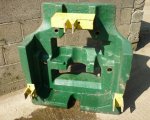
tractor weight.jpg

Has anybody used these in moorings? Does this seem a reasonable approach? Boat is 34', about 5.5 te.

Thanks,

Rob
 
Looks ideal as long as those 'spikes' are underneath. I've seen all manner of stuff used as sinkers, old engines, girders, dustbins full of concrete and old chain etc. etc.
I estimated my (fore and aft) mooring weight to be around 900Kg for a 28ft boat, I don't consider it overkill.
 
Don't know what the seabed is in Portland but I thought the principle of a metal sinker was that it sank into the substrate and it's surface area, rather than mass, provided resistance. If you are using a single weight is the 8m chain a riser rather than a ground chain?
 
Don't know if this still allowed, but years ago the old guys at our club used to use lorry wheels filled with cement. They need to be buried under the mud to work effectively.
 
Thanks for the suggestions so far.

I've called Swanage Railway and am awaiting their response as to availability of unwanted wheels.

The boatgeardirect wheels remain an (expensive) option too. One 200kg weight seems on the light side, but I'll seek their advice.
 
On the question of weight required, the Percuil mooring association guidelines for single sinker moorings are:

Boat Length Displacement Block weight
12-20ft <1T 2.5-10cwt
21-30ft 1 - 4T 6-20cwt
31-40ft 4 - 7T 10-40cwt
41-46ft 7+T 15-50cwt

It's only one data point, but would imply that the OP needs something in the region of 20cwt in total (1cwt = 50kg so 20cwt = 1tonne). Portland is more exposed than the Percuil river, and is more sandy and less muddy, so the Percuil numbers might be considered under rather than over specified.
 
. . . the Percuil mooring association . . .

One of their committee members (an ex-RAF engineering officer) did a lot of research into moorings and their construction. He wrote it all up in a book but I can't find my copy to check the exact title etc.

Suffice to say their guidelines are based on a lot of experience and fundamental research. I would say they represent the conservative (safe) end of the design spectrum.
 
One of their committee members (an ex-RAF engineering officer) did a lot of research into moorings and their construction. He wrote it all up in a book but I can't find my copy to check the exact title etc.

Suffice to say their guidelines are based on a lot of experience and fundamental research. I would say they represent the conservative (safe) end of the design spectrum.

Was it, by any chance, "Towards Zero Failures in Swinging Moorings" or something similar?
 
On the question of weight required, the Percuil mooring association guidelines for single sinker moorings are:

Boat Length Displacement Block weight
12-20ft <1T 2.5-10cwt
21-30ft 1 - 4T 6-20cwt
31-40ft 4 - 7T 10-40cwt
41-46ft 7+T 15-50cwt

It's only one data point, but would imply that the OP needs something in the region of 20cwt in total (1cwt = 50kg so 20cwt = 1tonne). Portland is more exposed than the Percuil river, and is more sandy and less muddy, so the Percuil numbers might be considered under rather than over specified.
Just to be pedantic, 20cwt = 1 ton ?
Regards
Donald
 
Was it, by any chance, "Towards Zero Failures in Swinging Moorings" or something similar?

Yes that sounds about right.

There's also some excellent and innovative work on yacht moorings on the west coast of Scotland with the cross over from anchoring systems on fish farms.
 
Top