Monitoring the bilge pump

Daydream believer

Well-Known Member
Joined
6 Oct 2012
Messages
23,576
Location
Southminster, essex
Visit site
I have a 20 ft open launch which I sometimes leave on a mooring. Sometimes it seems to leak & sometimes not. Sometimes the water may be due to a shower of rain. This is making it difficult to find the source. .
I have an automatic electric bilge pump & a decent battery, but I am always worried about finding that I have a flat battery.
What I do not know, is whether the bilge pump, which is left on a separate automatic circuit, has been working or not. I dare not leave it not turned on to see how much water comes in, as I may not be able to get to the boat in time. Besides it may rain, upsetting the equation.

What I want to know is if forumites have installed any device to measure how many minutes the pump has been running. Rather like an hour meter on an engine, but smaller units. If so, what is it & how is it wired in?

I do not want to get involved in making things with computer gadgets etc, as I do not have the skill set.
Any advice appreciated
 
I
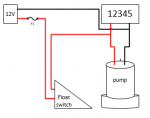
How about installing an engine hour counter in parallel with the pump, so that both the pump and counter are activated by the float switch? There are lots to choose from, but something like this: Amazon.com: DC 6-80V Mechanical Hour Meter - AIMILAR Hourmeter for Diesel Engine Generator Boat Motorcross Motor Truck Tractor : Automotive
Thanks, you have just reminded me that I have a spare hour meter, but a 10th of an hour is 6 minutes so the divisions are not very accurate. Perhaps I should look for a minute version. But it needs to be wired in such a way that it monitors when the pump is working but not have the power going through it in case the meter went wrong & I lost power to the pump
I am not sure how to wire it
Does anyone know?
 
Arcady is right. Wire it in parallel with the pump, not the sensor. I added an engine hours meter following the same principle. 6 minute divisions is probably OK for an open launch! But wouldn't it be simpler to clean the bilge out and then check if the water is salt or fresh when you return?
 
I monitor the battery Voltage and current. I can see when any load is on, and of course whether the battery is discharged. And the bilge level also. Not difficult to install. Commercial product, not home made.
 
Perhaps you are over thinking this?

Mount a rain collection instrument on the boat. That will give you the amount of rainfall between visits.

Calculate from the volume of H²O that the pump can extract from the vessel in a minute and the total surface area of the vessel. This will give you the running time for the pump.
 
I

Thanks, you have just reminded me that I have a spare hour meter, but a 10th of an hour is 6 minutes so the divisions are not very accurate. Perhaps I should look for a minute version. But it needs to be wired in such a way that it monitors when the pump is working but not have the power going through it in case the meter went wrong & I lost power to the pump
I am not sure how to wire it
Does anyone know?
I have used similar but a simple counter rather than "hours" this gave an indication on how often the pump had kicked in.
 
Calculate from the volume of H²O that the pump can extract from the vessel in a minute and the total surface area of the vessel. This will give you the running time for the pump.
There's a rather big assumption there - that the pump is working at it's published efficiency. You could always measure the output but, again, that's at a particular state of charge for the battery; as it drops, so will the output.

I'd also go with the hour meter. A cheap alternative, if you can find it, might be an analogue clock from a car breaker. I'd also think about a small solar panel to keep the battery topped up.
 
You want to know how many minutes your pump has run?
Drill a very small hole in the outlet pipe, and put a measuring jug under it, maybe even have a fitting and feed to the jug, or a suitable sized water bottle. Run the pump and time how long it runs for the jug to collect x ml of water.
 
You could also add a small solar panel - unless the battery is large.

Jonathan

Apologies, crossed with Stemar - great minds.....
100 amp lead acid battery. What size panel would one suggest. Most of the time the boat is laid up ashor with the drain plug removed, But keeping the battery topped up would be a good thing. I use the launch for laying the clubs race marks every year & all the cruiser moorings every 3 years using our air bags.
I wrote an article for PBO all about it but Robert the editor, refused to publish, as he thought it was advertising the airbag. Pity because it would have helped clubs lay moorings dead easy. The biggest we have laid is 2.5 tonnes.
 
There's a rather big assumption there - that the pump is working at it's published efficiency. You could always measure the output but, again, that's at a particular state of charge for the battery; as it drops, so will the output.
There is, but I am assuming that @Daydream believer does not live in the west of this small island or in a monsoon area.

I removed 10 litres of water from the bilge on Friday, after seven days away from the boat, and am investigating where the water is coming from. It has been raining heavily in Cornwall.
 
On an auto switch? Something amiss: usually the (mercury) switch 'tips', then the pump runs for thirty seconds until the switch tips back. Reed switch the same.
It would depend on the extent of the bilge area.
 
Analysing this, pumping for 5 mins: you evidently have a large flat bilge, so the, say, 3in rise needed to trip the switch is an awful lot of water, and/or it's quite a small capacity pump. If you had a sump it might mean pumping only a few litres at a time to drop the level 3in, but it would fire much more often with a lot less water present. Would this be preferable? Or even achievable? At least it would mean less water left in the boat if the system fails, or at the point the battery gives up.
 
100 amp lead acid battery. What size panel would one suggest.
As large as you can manage conveniently, because when you really really want it to recharge the battery, it won't be sunny!

10w won't need a controller, more will. In practice, I found 40w kept my domestic batteries charged up even in a UK winter, with me spending frequent weekends aboard and no other charging..
 
On an auto switch? Something amiss: usually the (mercury) switch 'tips', then the pump runs for thirty seconds until the switch tips back. Reed switch the same.
It would depend on the extent of the bilge area.
The switch is not in the pump like some. It is placed a couple of inches or more above the pump on a purpose built base installed , one assumes, by the builders.
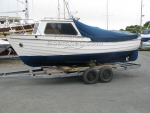
The launch is a Courier class
 
Top