Modifying mainsail to take full length battens

Elbows

Well-Known Member
Joined
24 Dec 2016
Messages
137
Visit site
Hello All,

I'm planning to fit full length battens to my Westerly Pageant mainsail instead of the short leach battens it has at the moment. It's a bog standard Dacron sail of about 12 sq metres, fairly old and baggy but still sound. A new sail is out of the question because of cost.

I've had extensive experience repairing windsurf sails I so won't have any problems carrying out the actual work, but the materials and construction methods are very different and I'm floundering somewhat with the details. I've done a fair bit of Googling but can't find much on the specifics of construction that I need. I'd be grateful for any information people can give me on the following points:

1. The sail currently has a bolt rope on the luff, although it's been fitted with plastic sliders which fit in the mast groove. I'd like to remove the bolt rope as it will get in the way of the new batten boxes and sliders. Once the bolt rope has gone, will the luff need much additional reinforcement along it's length to withstand the tension of the halyard?

2. How stiff should the battens be? They will be 30mm wide pultruded glass/polyester and I have a choice of thickness ranging from 2.4mm up to 5.5mm.

Thanks.
 
Do Not remove the bolt rope .
It's an integral part of the the luff tensioning .The sail will get longer,and may not fit the mast .
The luff boxes should fit just behind the bolt rope .
Depending on which type of box used ,they can be modified to allow the bolt rope or fit over it.
.The slide stud attachment to the box should have enough length and height to accommodate the bolt rope and slide offset .Battens 30mm wide and up to 3mm thick will be fine .
 
There is no reason to modify the bolt rope or go to sliders. Many cats have more sail than that and use a bolt rope sail, including most beach cats and many larger performance boats. Just don't.

1. Don't even think about cutting the bolt rope. It is vital to both the structure and shape of the sail. This isn't s windsurfer.
2. I would look an see if you can get beach cat battens. They might be just right. I believe they will be about the thinnest you mentioned.

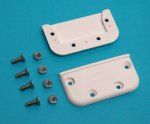
The inside batten pockets look like this and go ~ 3/16" away from the bolt rope.
01-1001.jpg
The outer end sticks past the sail and looks like this
http://www.sailrite.com/Batten-End-Caps-Catamaran-With-Hole-1

You will need a goo means to tension them. A few grommets on the leach and some string should do. Very important to full length battens.

As for whether the project makes sense, I'll let you judge. I do like full batten sails.
 
Thanks for the replies.

OK, the bolt rope is staying, glad I asked!

The sail already uses sliders and I'd like to stick with them rather than using the bolt rope to retain the luff.

I was looking at the Bainbridge Sailman batten boxes as they have a positive connection to the slider and a built in tensioner, but the bolt rope does get in the way of them.

Here's a pic to show how the sliders are attached at the moment. If I use the conventional batten boxes suggested by thinwater, can I just fit them up close to the existing cringles? That would be a cheap and simple solution.

Slider.jpg
 
You possibly have a full length batten at the top. In which case just copy that. Presumably it works OK. If not then start at the top and fit a full length batten and see how it goes. If you like it add more. However I can't imagine why you would want full length battens. olewill
 
Because I have a stack pack, and the general consensus seems to be that raising and lowering the sail works better with full length battens and reduces flogging. At the moment the short battens get caught up with the lazy jacks when hoisting if the sail is off to one side by the slightest amount. The top batten isn't full length.
 
I was wondering why you want to fit full length battens. To a sail which was not originally made for full length battens.
I'm not a sail maker so the following is just a guess.:)
I currently have a full batten main. One difference I think I notice from my old boat and old traditional main. Is the angle of the battens.
The Full length ones appear to be parallel to the foot and boom.
The traditional sail the battens were I think lined up more perpendicular to the leach.
These being very different. I wonder if it would work very well.
 
Last edited:
Ok I see now your problem is the lazy jacks.
My question would now be.
Why not fix the lazy jacks? I would suspect they are ether to close together. Or there is not enough slack in them when you are hoisting the sail.
Perhaps more slack in the lazy jacks. pulled closer to the mast prior to raising the main would solve your problem.
 
Hi Elbows and welcome to the forum. I'm going to take the other side of this and say don't do it!

First up fully battened sails have sticky-out end fittings perfectly designed to catch your lazyjacks, notwithstanding the fact that the unloaded sail is much more stable. BTW, are your lazyjacks attached to the mast or spreaders? The latter helps open the slot though be careful going out too far with continuous rigs.

Turning to a fully battened system. The advantage is that they hold the sail in a proper airfoil shape which has the added benefit of spreading the leech loads through a much larger section of yarn. Coupled with the increased tweakability and reduced propensity to flog it explains the 'quiver' of masts and threads you no doubt carry for your board.

The downside is that all of these forces must go somewhere and in this case they flow down the battens to create compression forces for which your luff slides/track will not be designed to take -- conventional battens can never impart a compression force so the sail/slides/mast will only be designed to resist extension. One can see this compression effect through 'batten droop' (leech end of batten falling below track end) every time one hoists a fully battened sail.

Sticking to the boltrope/slides question, also bear in mind that the fully battened sail is only supported by the 4 or so batten cars, which will in turn require reinforcing. The leech must also run slightly hollow between all of the batten leech fittings which might require yet another mod. Finally there is the question of the reef points as you won't want a clash between a batten end and a reef clew -- in fact they should work harmoniously with one another.

All in all my advice is to put your scissors away and explore a tweak as uricanejack suggests -- Happy sailing in 2017 :encouragement:
 
Last edited:
Thanks for the detailed explanation dom, that does give me pause for thought. I did wonder whether compression along the batten might be a problem which was why I originally wanted to go with the Sailman batten boxes as they connect directly to the sliders, which in turn led to the idea of removing the bolt rope. They also meant no protrusion at the leach as they have built-in tensioners. However I've been persuaded that removing the bolt rope is a bad idea. Might have to knock the idea on the head after all, unless I can think of a way of connecting the Sailman boxes to the sliders with the bolt rope in place.

Thanks for the contributions everybody, this has been most educational.
 
Last edited:
I have a fully battened main & lazy jacks & still have to watch out for the ends of the battens catching the lines.
It is a simple matter of technique in the way one hoists the sail.
You can, of course rig a light shockcord from the outermost line to somewhere near the goose-neck & by slackening the lazy jacks for the hoist a little ( have the tail at the mast with 2 sets of loops whipped in them set on a cleat so one loop is tight & one is slack for hoisting making it quick to adjust) you will pull the line forward to clear the leech. If you find that this shockcord affects the set of the sail then use a couple of light lines that you can slacken off. If, like me, you always hoist on starboard tack, you only need it on the port lazyjack

If you still decide on full length battens then they do not need to be tensioned as in a sailboard as they will be there just to hold the leech out. Use the pockets shown in post 2 & at the leech do the drop in leech pockets that dinghies use to avoid " sticky out ends" mentioned by Dom above. You only need a couple of very light flat fibreglass battens as the sails shape is what it is & you will not change it.
Some leech cars make the sail harder to hoist the sail unless dead to wind- my Batt cars do & they are on an expensive Hyde sail.
One further point is that the pockets do not need to be full length. You could just lay the batten along side & put 9 inch strips every so often to hold the batten next to the sail thus saving loads of work. You might even be able to do this with adhesive sail repair tape to test the theory for a quick hoist if you just buy the ends suggested in post 2 first before investing in expensive cars
 
Last edited:
I got a new main with full length battens a couple of seasons ago. It is 'quite nice', but not that so very much impressed by it.

The sail maker did offer the options of 3/4 length standard battens, in retrospect I think this would have been a better arrangement. As others have pointed out, the angle of the battens is different. It would be a lot less work to modify an old sail to take longer battens than all the faffing about with the kit for full length battens.
 
We had a decision to make on battens when buying a new sail for our Sadler 32 at the start of this season. One problem with sails with full-length battens is that the sail needs to be closer to the wind to de-power. So this may defeat your original objective of being able to bring the sail down without positioning the sail centrally between the lazy-jacks. In the end we went for the option of having the top two battens extended but keeping the other battens standard and this works well enough.
 
It's interesting to hear the downsides of full length battens, previously I'd only heard about the benefits. Seems like it's all a compromise - as usual. Combining the various suggestions with thin 3/4 length battens and dinghy style pockets could be the way to go. Try the top 2 first to see how they work. I've got an industrial sewing machine and most of the necessary materials so it would be a cheap and easy job.

Going back to one of dom's points I missed before: I'm a little reluctant to fit the lazy jack attachments to the spreaders as the shrouds are continuous and I'd be concerned about a major snarl up pulling down on the spreader. If I did that, what would be a maximum safe distance from the mast?
 
It's interesting to hear the downsides of full length battens, previously I'd only heard about the benefits. Seems like it's all a compromise - as usual. Combining the various suggestions with thin 3/4 length battens and dinghy style pockets could be the way to go. Try the top 2 first to see how they work. I've got an industrial sewing machine and most of the necessary materials so it would be a cheap and easy job.

Going back to one of dom's points I missed before: I'm a little reluctant to fit the lazy jack attachments to the spreaders as the shrouds are continuous and I'd be concerned about a major snarl up pulling down on the spreader. If I did that, what would be a maximum safe distance from the mast?

Personally, with continuous wires I wouldn't, but many people do otherwise. Have a look at what Harken recommend as it might solve your problem for a couple of quid! (See p6)

http://www.harken.co.uk/uploadedfiles/Product_Support/PDF/4059.pdf
 
Going back to one of dom's points I missed before: I'm a little reluctant to fit the lazy jack attachments to the spreaders as the shrouds are continuous and I'd be concerned about a major snarl up pulling down on the spreader. If I did that, what would be a maximum safe distance from the mast?

Mine are on the second spreader up & are 9 inches out & I also have the weight of the sail cover to carry as well.
What exactly are you expecting might snag?
In a panic you can always release the end & drop them altogether although I have only ever caught them on the hoist. Never on the drop. I have caught the leech cleats on the topping lift though but a quick tug released it. ( twice in 14 years )
 
On my previous boat (Iroquois cat) I had my main converted to full batten. The battens did not project beyond the leech, they were tensioned and held in tension (not very great tension) by a couple of Velcro covered flaps. The tension at the mast end of the batten was taken by a plastic pocket as shown by Thinwater then to a conventional style of slider except that it was 3 or 4 times longer than the normal (40mm?) size.
I was very pleased with the result both in sailing and in the use of the stackpack and lazyjacks. I can't remember any downside.
 
Hi Elbows and welcome to the forum. I'm going to take the other side of this and say don't do it!

First up fully battened sails have sticky-out end fittings perfectly designed to catch your lazyjacks, notwithstanding the fact that the unloaded sail is much more stable. BTW, are your lazyjacks attached to the mast or spreaders? The latter helps open the slot though be careful going out too far with continuous rigs.

Turning to a fully battened system. The advantage is that they hold the sail in a proper airfoil shape which has the added benefit of spreading the leech loads through a much larger section of yarn. Coupled with the increased tweakability and reduced propensity to flog it explains the 'quiver' of masts and threads you no doubt carry for your board.

The downside is that all of these forces must go somewhere and in this case they flow down the battens to create compression forces for which your luff slides/track will not be designed to take -- conventional battens can never impart a compression force so the sail/slides/mast will only be designed to resist extension. One can see this compression effect through 'batten droop' (leech end of batten falling below track end) every time one hoists a fully battened sail.

Sticking to the boltrope/slides question, also bear in mind that the fully battened sail is only supported by the 4 or so batten cars, which will in turn require reinforcing. The leech must also run slightly hollow between all of the batten leech fittings which might require yet another mod. Finally there is the question of the reef points as you won't want a clash between a batten end and a reef clew -- in fact they should work harmoniously with one another.

All in all my advice is to put your scissors away and explore a tweak as uricanejack suggests -- Happy sailing in 2017 :encouragement:

The only problem with the above argument is that there are many thousands of fully battened sails with simple sail slugs that simply have none of those problems. I think they are theoretical, not real. For example, they don't all have "sticky-out" ends.

Mack+Sail+2014+draft+low+res.jpg

As for lazy jacks snagging, this is misunderstanding of lazy jacks. With full battens you will only need two legs and they can be farther forward. You simply don't need that much support anymore. In fact, tying up the bunt after reefing or before covering is not required. Personally, with a fully batten sail that small, you have no need for lazy jacks at all.

Whether converting this sail is a good idea is a different question. Without a lot of roach I think they aren't needed. Fully 1/3 of the above sail's area is roach.
 
Last edited:
The only problem with the above argument is that there are many thousands of fully battened sails with simple sail slugs that simply have none of those problems. I think they are theoretical, not real.

View attachment 61883

..which is why you choose to illustrate your point with an illustration of a perfectly modest sail complete with specialised batten repositories and pressure absorbing slides/battcars -- probably Rutgerson? ;)

Incidentally that image also nicely illustrates the point about how the reefing points should sit just a little below the battens and the hollow leech required between batten ends. The point here is that whether its simply a beefed-up slide of a full-suss Harken roller setup, such systems must be properly specced subject to the sail size, dimensions, use, spars, etc.
 
Last edited:
..which is why you choose to illustrate your point with an illustration of a perfectly modest sail complete with specialised batten repositories and pressure absorbing slides/battcars -- probably Rutgerson? ;)

Incidentally that image also nicely illustrates the point about how the reefing points should sit just a little below the battens and the hollow leech required between batten ends. The point here is that whether its simply a beefed-up slide of a full-suss Harken roller setup, such systems must be properly specced subject to the sail size, dimensions, use, spars, etc.

No. This sail runs on 3/8" plastic sail slides and a grove in the mast. No cars.
 
Top