Mizzen Topsail laid to the mast ...

Slocumotion

Well-Known Member
Joined
18 Jan 2013
Messages
180
Location
Orkney
Visit site
Transcribing a ship's log of the 1830's - first pass was just to get to grips with the handwriting and make out the stained and faded bits. An unexpected stay in Hospital has enabled me to complete that task, begun over twenty years ago and then laid aside to do "over the winter".
Phase 2 is to interpret the terminology, and one outstanding issue here is the above phrase. I am assuming that the Mizzen course (if the lower sail on a mizzen mast is so called) was a Gaff, fore-and-aft job and that its topsail was a square sail so what exactly is meant by laying it to the mast ? Unfurling it? (doesn't seem quite right does it?)
In the case I'm looking at it has nothing to do with sending up spars and sails , the ship having been laid up. This is in the course of a passage. Or perhaps it does ? Might a topsail yard and sail together have previously been sent down in heavy weather or perhaps as of no use on the wind?
I have a note to myself written some while ago when I obviously expected to remember the significance of it that just says " Master and Commander p209 : Mizzen topsail laid to the mast...." Unfortunately I seem to have given my copy of the book away. Would some kind soul be able to provide more of the context of that quote ?

While I'm at it - estimates of distance to sightings are given in Miles and Leagues but also occasionally just the tick mark is used ( ' ) any ideas which of miles, leagues chains or whatever? Phase three, extracting all positions, landmarks, courses steered, distances etc into a number of track sketches is done too so I might be able to work backwards from them to what the tick signifies.

Noon observations are of Latitude only, but I know we are in Hudson's Bay so phase four (lines on charts) can begin, perhaps "over the winter."
 
I have not much of an idea really but have seen paintings of old boats in harbour with the gaff sail main or mizen released at the clew of the boom so that the bunt of the sail is lashed to the mast. Instead of what might be normal to drop the gaff and sail and lash it to the boom. Yes it looks very untidy in paintings. Just a thought. Like wise the top sail if was a fore and aft sail could be released from the gaff and lashed to the mast. However if it is a square sail then this doesn't make sense as I thought they were always lashed to the yard arm.

good luck olewill
 
Last edited:
I think you need to start by establishing what rig this vessel actually had. If she was a full-rigged ship, then the mizzen topsail would have certainly been a square sail, regardless of any spanker etc carried aft of the mast. If a barque or barquentine, it would have been a fore and aft sail like a gaff cutter's topsail. She could also have been a three (or more) masted schooner, in which case again it's fore and aft. A brig or brigantine doesn't have a mizzen mast, so we can rule those out.

It seems to me highly unlikely that a square topsail would be sent down for any reason except maintenance, and then rarely. On the brigs I sailed in, the lower topsails (together with the fore-topmast-staysail) were our storm canvas, made of double thickness Duradon canvas and with sheets made of chain. We kept them set through a force ten Biscay storm.

I've never heard the phrase "laid to the mast". I'm more familiar with square sails, but I did do a short voyage on a polacca barquentine which set a gaff topsail on the mizzen mast. That sail was set flying, like a yacht's topsail. But I believe I've seen pictures of barques with a gaff topsail on the mizzen which was instead brailed in to the mast and its gaff. If I had to guess, I'd say that brailing up such a sail could be your "laying to the mast". Some context would help - was it done in a rising wind, or while shaking out more sail after a blow?

Pete
 
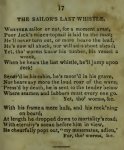
Whether sailor or not, for a moment avast,
poor Tom's mizzen topsail is laid to the mast;
he'll never turn out, or more heave the lead;
he's now all aback, nor will sails shoot ahead.
He ever was brisk, and tho' now gone to wreck.
When he hears the last whistle, he'll jump upon deck.
 
A ship is said to be hove to after having taken in her lower sails the fore and mizen top sails are allowed to remain full and the other is laid to the mast in an inverse manner with reference to the wind so that while the sails which are standing full propel the ship forward the others which are laid to the mast have a contrary tendency and the ship is kept as it were in a stationary position thus the ship N is hove to with the main top sail to the mast
 
Ah ha, that makes sense. We're talking about backing the sail, as for heaving to or some other manoeuvres.

Definitely a square topsail in that case.

Pete
 
Yes that sounds right the context could well have been heaving-to.
Starting off knowing how the vessel was rigged would have been convenient, and fair in an exam question however the log makes no reference to the ship's name or type. That will have to be back-engineered from those few words on how she was handled.
There are references to "bringing"(this time) the fore topsail to the mast as well which may have the same meaning.
Would either sail be backed to assist in bringing the head round when tacking (as I used to do with the staysail of my old gaff cutter)?
Actually, I doubt that a detail like that would have been mentioned in the log , most often " tacking occasionally through a lane in the ice" is all you get.
In passing if anyone is still with me here, the log has columns headed H for hour, K for knots, F for Wind speed (Beaufort Force presumably), Course ,Wind (direction) , a narrow unlabelled one, then comments. The unlabelled one is mostly empty but occasionally has entries "1\2, 1, 1 1\2, or 2" only those values. Any suggestions?
Thanks all for your interest and help.
 
Would either sail be backed to assist in bringing the head round when tacking (as I used to do with the staysail of my old gaff cutter)?

I'm trying to remember the exact procedure for tacking the brigs. My point of view was fairly limited to controlling my watch's group of sails as ordered from the bridge - down on the deck we weren't paying much attention to which way the ship was pointing at any given moment :). But yes, I think the squares would have been backed at one point during the manoeuvre.

The unlabelled one is mostly empty but occasionally has entries "1\2, 1, 1 1\2, or 2" only those values. Any suggestions?

Only thing I can think of is some private notation for how much sail was being carried?

Pete
 
The unlabelled figures column could be soundings from the bilges, which would increase up to point before being pumped dry again?

Yes I think that could well be right . The figures are not random but do rise quite markedly , at first glance at least, corresponding to periods spent tacking frequently to avoid ice or when a head sea is mentioned a lot - then decline steadily once things have quietened down a bit. It seems to take many hours to pump out.

Thanks for that
 
A fascinating project Mike, it would be of great interest if you could post some more information, such as the name of the vessel, the master, the ports visited... and how came you by this old log book?

This is the most interesting thread I have seen started on these forums for a while!

I hope you are soon out of hospital, cheers Jerry
 
A fascinating project Mike, it would be of great interest if you could post some more information, such as the name of the vessel, the master, the ports visited... and how came you by this old log book?

This is the most interesting thread I have seen started on these forums for a while!

I hope you are soon out of hospital, cheers Jerry

+1 :)
 
Whether sailor or not, for a moment avast,
poor Tom's mizzen topsail is laid to the mast;
he'll never turn out, or more heave the lead;
he's now all aback, nor will sails shoot ahead.
He ever was brisk, and tho' now gone to wreck.
When he hears the last whistle, he'll jump upon deck.

That's not your man Tom Bowling is it? Doesn't seem to be the same metre as the famous song.
It does suggest that the mizzen topsail aback is a distressed/accidental condition. But then, I guess one would not expect to learn much about the operation and maintenance of 97HP diesel engines from the line -
"Hold very tight please Ding Ding!"

The technician imaging my heart just a few days ago spotted my address in my notes and (almost) sang me a verse from another old song featuring "Fiddlers Green". He knew it from a folk club he used to frequent but did not know F G as the place where a sailing man lucky enough not to end his days in Davy Jones' Locker would retire surrounded by dancing girls and with rum flowing free.
 
"....it would be of great interest if you could post some more information, such as the name of the vessel, the master, the ports visited... and how came you by this old log book?"

The log was inside a lathe and plaster partition in our house in Orkney, along with a letter from some mid-nineteenth century emigrants to Australia. It probably fell into the open top of the partition from in the loft.
The ship was about in Hudson's Bay through 3 sailing seasons and laid up through the winters up Churchill and Seal Rivers.
No idea yet of the name or type of vessel, or Master's name though one "Captain Sinclair" was known to have lived in our house and in retirement taught local youths navigation. The log book has Nav exercises worked in the back. Very tempting to make the obvious inference.
The air-ambulance flight down to Aberdeen and subsequent little cardiac procedure was a short-lived excitement (though I would not have thanked you for telling me in quite those words that it would be) and now that I have a few weeks off work and no chance to go boating I might be able to do more on this project. I have a few more queries to add to the thread, but the biggest obstacle at the moment is (mirrored in another thread )- I can't get the latest version of Open CND, CPD, COD (what-the-hell's it called?) to download. Google Chrome will not co-operate at all.
 
That's not your man Tom Bowling is it? Doesn't seem to be the same metre as the famous song.
It does suggest that the mizzen topsail aback is a distressed/accidental condition. But then, I guess one would not expect to learn much about the operation and maintenance of 97HP diesel engines from the line -
"Hold very tight please Ding Ding!"

The technician imaging my heart just a few days ago spotted my address in my notes and (almost) sang me a verse from another old song featuring "Fiddlers Green". He knew it from a folk club he used to frequent but did not know F G as the place where a sailing man lucky enough not to end his days in Davy Jones' Locker would retire surrounded by dancing girls and with rum flowing free.

I'm not really sure what happened but one thing I am certain of is it didn't end well for our protagonist. Here's the full version:
The Sailors Last Whistle.jpg
 
Top