
Missing RPM at WOT on KAD300

About Time

Well-Known Member
Joined
10 Sep 2014
Messages
215
Location
Denmark
Visit site
Hi,

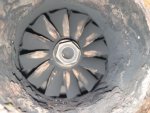
I have an issue with my port engine in my KAD300 twin installation. Once the supercharger cut out ard. 2700 RPM the turbo should have build enough boost and continue bringing the engine up to 3950 RPM at WOT (as per the manual). Meanwhile it could not build enough boost so lost revs and the supercharger came back on. This circle would repeat itself. I checked my turbo and I see blades on the exhaust side are quite damaged due to the carbon build up (see attached). The turbo therefore lost boost. I bought a new turbo - original one - and mounted it and the problem seems solved. Now the supercharger kicks out and the turbo takes right over with no hesitation. Meanwhile now I cannot get more than 3600 at WOT ... I miss 350 RPM same as abt. 4-5 knots. Usually I could do 40-42 knots at WOT but now it is same as 35-36 knots. Not that it is a big problem but I wonder where my last RPMs went ?

As it is a twin installation and the turbos have the same hours on them (850 hours - 17 years) I guess it is a matter of time before the 2nd turbo (starboard) will blow and I have to replace this with a new one too. Could the reason for the 3600 RPM WOT be that the other turbo is not giving the same boost as the new one and therefore I am short on RPMs... or what could be the reason. I guess in a twin installation the engine will less power will control the RPMs ?

Now when I make this thread I wonder if a simple re-calibration of the controllers may be able to fix it ?

One last question. We now run on GTL (Gas-To-Liquid) fuel here in Denmark - very little marine diesel is available. They claim this is a better fuel compared to regular marine diesel with less particles. Should I expect less carbon build up in the future running on GTL fuel ?
 

Attachments
  • turbo1.jpg
    turbo1.jpg
    42.5 KB · Views: 32
Last edited:
have you got any air leeks ?
I am also starting a thread to do with the elbow and exhaust riser as I didnt want to hijack your other thread.
 
I see no signs of the props being dinged but if they were I guess I should still be able to catch the 3950 RPM but the speed will be less than the 40-42 knots ? - correct or not ?
 
Can you check your boost pressure for both engines?

when was the last time you made WOT?

lots of extra recent weight added?

weak turbo on the other engine?

dirty intercoolers?

the list goes on.
 
The photo I attached is the old turbo that I exchanged with a brand new one.
Meanwhile the other engine still has an 'old' turbo and this one may have a weak boost as same age/ hours as the one I replaced.
I will do some study.
 
I do not see any leaks so the 2nd turbo being same age as the one I replaced most likely is weak ... I will have to do a boost test.
However once I figure this out .. and replace the 2nd turbo as well if needed then I should like to know if any maintenance can be done going forward so this is the last turbo(s) I need to replace.
 
EGT,s .....first pic shows tips of the vanes burnt off .

Prevention tactics
-Clean stern gear
- Reduce kg,s .....clutter .


ps my earlier point above about “ dinged “ props ....a clean but bent out of shape prop might inadvertently have greater pitch , get too long = engine can’t reach WOT .


Post a pic of the 2 nd turbos vanes ...the exhaust so we can compare .

If it’s not excessive EGTs it’s it bearings which is when the oil comes under suspicion.
More about turbos + oil later .
 
Oil + turbos ......not wanting to ignite another oil debate :)

"The number one cause of most turbocharger failure can be traced back to the engines lubrication system. The turbochargers bearings depend on a constant flow of clean oil to function properly. Several factors can lead to the break down of the oiling system, lack of maintenance, improper oil or filter, severe driving conditions, or in most cases simply the age of the vehicle can contribute to degradation of the turbochargers supply of oil.
The bearings in 90% of all production turbochargers are a full floating bronze bushing which supports the turbochargers rotating group. The clearances between the bearings and housing are very tight so any contaminants held within the oil can do damage very quickly if not corrected. The best defence you have against oil borne contaminates is a very strict maintenance schedule. Often the OE manufacturers recommended interval between oil changes will not be sufficient. I recommend changing your oil and filter any time the oil starts to change from its original golden brown to a darker brown colour. In some higher mileage cars this could happen within 2000 miles or even sooner. The reason the oil is changing colour is due to a few key reasons. First, most of today's oils are very high in detergent, this is designed to keep engines cleaner longer. Unfortunate for the turbocharger, these detergents deposit a large amount of engine "dirt" into the oiling system. If left unchanged for 3500 or more miles the oil becomes saturated with this accumulated dirt and starts to become very abrasive to the fine clearances inside of the turbocharger. Strict scheduling and maintaining regular oil and filter changes is critical to the life of the turbo.
The other key factor is engine heat. Today's newer engines run very high water and oil temperatures to help with emissions and fuel economy. This heat is very hard on the oil, causing it to break down on a molecular level resulting in having a reduced ability to provide lubrication and viscosity. The increased heat is also compounded when you shut down your engine and the car is allowed to heat soak. Along with frequent oil changes it is also advisable to allow the car about one to one and a half minutes of idle time before the engine is turned off if you have been driving at higher speeds, for example on the interstate.
Over-speeding is a cause of turbocharger failure that is fairly difficult to diagnose. The compressor speed, or boost pressure, is determined in most cases by a waste gate actuator that simply regulates the speed of the turbine by allowing exhaust to bypass the turbine wheel once a desired manifold pressure is achieved. If there is a leak between the compressor and the engine, proper pressure will be harder for the turbocharger to obtain; the waste gate will remain in the closed position until the turbocharger overcomes the leak and provides pressure within the intake manifold. Even a small leak can cause the turbo to work 20% harder than normal to reach its desired pressure, so great care should be given to the plumbing system on the pressure side of the turbocharger. Inspect all hoses and fittings for fitment and tightness, looking closely for piping that could rub and wear holes that could cause leaks. Also inspect the intercooler core and compressor, bypass valve, if equipped for proper function.
The exhaust system after the turbocharger needs regular inspection. Increased back pressure due to clogged or damaged catalytic converters, resonators or mufflers will decrease the flow out of the engine and also raise the temperature inside the turbochargers exhaust housing, which contributes to the oil coking and also raises the risk of gasket failures or cracks in the exhaust manifold and turbine housing area. Usually this only occurs in older cars, or with higher mileage cars. 10 years or 100,000 miles is an average life span of most modern exhaust systems.
 
I do not see any leaks so the 2nd turbo being same age as the one I replaced most likely is weak ... I will have to do a boost test.
However once I figure this out .. and replace the 2nd turbo as well if needed then I should like to know if any maintenance can be done going forward so this is the last turbo(s) I need to replace.

Considering the salty marine environment I think that 850 hours / 17 years is pretty remarkable (mine have lasted even longer)!
 
Thanks so much guys. Your help/ assistance is very much appreciated.

The 2nd turbo looks similar to the one I replaced. It means that the blades are also slightly burned ... What is just so odd is that this 2nd turbo can still fight the supercharger. Once on plane it will not loose revs so the supercharger kicks back in. This was the case with the 1st turbo I replaced on the other engine. I take it that if the blades are slightly burned the turbo may work... but not with 100% boost. Maybe just enough to keep the turbo operational but result will be less power (so less WOT).

I do not see any problem with my oil... I change it every 60-80 hours (A season is 4 month for me). The service includes new oil filter, fuel filter and air filter. It seems sometime overkill but better safe than sorry. The oil may not be exactly same colour as new oil but really not very old. The KAD 300 asks for 15W40 VDS-3, API CI-4 og ACEA E5 oil (VOLVO spec) and I use Shell Rimula 15W40 R4L that is VDS 4 , CJ-4 og ACEA E5/7/9 so fully comparable (or better). The engines use zero oil during a season and run very smoothly. I checked bearings in both turbos and both shafts are perfect (no tolerances are felt). I am sure the reason I have lost my turbos are the burned blades ... probably because of the carbon build up on the exhaust side (see photo of the turbo I replaced)... the engines have never run hot (80-90 degree Celsius is what I see under different conditions). The question could be if I actually run to slow most of the time .... I guess 90% of my trips are 7-8 knots (12-1400 RPM .. just before the supercharger kicks in) and 10% 3000-3500 RPM.

The only thing I need to check is if I have dinged prop(s)... I will do that when she will be out of water in 4 weeks. If they are fine I guess I will have to change the last turbo.

... There is a product called Wynns diesel cleaner and many other similar products ... Anyone of you using such to keep turbo clean ?
 
If your turbo bearings are fine then there's really nothing wrong with the oil that you have been using. I have my oil changed every year and it's quite normal for it to darken very quickly due to the residual oil that is in the sump and some carbon in the galleries.

The turbos on these engines do have a fixed lifespan and yours have done better than most. I suppose you could faff about cleaning them etc and you might get an extra year or so out of the replacements in 15 or so years time. If you can be bothered!

Note that most people tend to replace both sides at once unless you can be sure that the one that the other one still has good boost pressure (you can get a Yacht Devices plug-in that will give you boost on your chart plotter). Running with a new turbo and a tired one on the other side will put a strain on one engine so isn't advisable.

Note that these turbos can be re-built (ensure that the exhaust housing is replaced or sleeved). Alternatively new ones can be purchased for £750 or so.
 
try these guys
STK Turbo Technik
Auf`m Rottland 14
57577 Hamm (Sieg)
Germany
Phone: +49 (0) 2682 26299-0
Fax: +49 (0) 2682 26299-99
http://www.turbolader.net

This is for KAD 44 Turbo's though and Price in August 2019 -

Price for a repair of your turbo: 170,00 EURO (+ 19% VAT if applicable) plus required spare parts
(Availability of spare parts provided!)
Duration 1-2 Days

Exchange turbo: 890,00 EURO (+ 19% VAT if applicable)
In stock!

Please note that all our NEW turbochargers are brand new and original. There are NOT remanufactured or repaired!!!

Guarantee / Warranty: 2 Years
 
Top