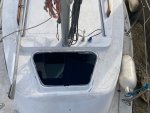
Missing forehatch

Sadly BlackSheep was a mark 1 bradwell and they obviously made a substantial change to shape and style of forehatch in the mark 2’s like mine, so I got some ployester resin and some glass mat today and will have a go at building one from scratch. Got to start somewhere so-may as well be now. I’ll post a pic of the finished article if i actually succeed in makeing “something” :)
 
Sadly BlackSheep was a mark 1 bradwell and they obviously made a substantial change to shape and style of forehatch in the mark 2’s like mine, so I got some ployester resin and some glass mat today and will have a go at building one from scratch. Got to start somewhere so-may as well be now. I’ll post a pic of the finished article if i actually succeed in makeing “something” :)
Pretty easy to make a female mould from Formica covered ply. Use plasticine in the corners to give a nice radius. Wax everything then gelcoat several layers on before glassing.
I did my fridge lid the same way and it turned out pretty good
 
Im going to cut a piece of ply and tape it over the hole, put a sheet of polythene over the lot, then do 3 layers of glass mat over the lot in situ, to make ot stiff enough not to deform when I lift it off the boat. I assume it will release from the polythene as I dont think resin bonds to that?
At that point I’ll trim excess mat off the edges and take the mew formed hatch lid home and let it set overnight. Then I’ll glass in the ply piece I used to cover the hole, and so,e thin strips aroumd the sides, with 3 more layers of glass, to ensure the lid is strong wnough to stand on when closed, and thick enoughto screw himges and catches into.Im using polvinyl resin and 450gm csm, except in the last layer whichis woven roving bit thinner, 250g maybe? Picked to give a smooth finish.
Seems the simplest and quickest way to make the new lid, anyone see any problems with this approach?
 
Hey Steve, I'm not sure about moving the process from boat to home. If you make a plug (that may be a term peculiar to injection moulding rather than glassing) you could do it all at home and not have to make the glassing of the ply a separate lay-up?
 
Im going to cut a piece of ply and tape it over the hole, put a sheet of polythene over the lot, then do 3 layers of glass mat over the lot in situ, to make ot stiff enough not to deform when I lift it off the boat. I assume it will release from the polythene as I dont think resin bonds to that?
At that point I’ll trim excess mat off the edges and take the mew formed hatch lid home and let it set overnight. Then I’ll glass in the ply piece I used to cover the hole, and so,e thin strips aroumd the sides, with 3 more layers of glass, to ensure the lid is strong wnough to stand on when closed, and thick enoughto screw himges and catches into.Im using polvinyl resin and 450gm csm, except in the last layer whichis woven roving bit thinner, 250g maybe? Picked to give a smooth finish.
Seems the simplest and quickest way to make the new lid, anyone see any problems with this approach?
You need to wax the polythene. Getting 450g to go around corners will be a problem. Even 300g cloth doesn't like sharp bends.
Far better to make a female mould in my view and do all the glassing at home
 
I had removed the hinges completely and filled all the holes. Fitting new hinges was a minor outstanding job I was going to do shortly. The hatch ir quite heavy, and still had the catch on it, it never occurred to me it could actually blow away! I suspect I left it propped open slightly for airflow, as I always do.
Given its weight can it have travelled very far?
 
what is a plug? or female mould? or male mould for that matter? and why would one be better than laying up insitu so to speak, then adding some extra layers and strength at home?
And if it is, how would I make one, this is the profile of the hole I am building a lid for
5F08AD7E-9F7A-4DFD-8FB2-58347E7AED04.jpeg
 
Oh wow - no wonder my hatch didn't fit; I wasn't expecting something that isn't rectangular! We need to keep a record of differences between Mk I and Mk II Bradwells.

I can see that trying to replicate the construction of my hatch wouldn't work either. Not an easy task.
 
The plug/former is a an exact replication of the hatch - the coaming and the opening - made of something ridgid enough to withstand you pushing a paddle roller over it as you wet out the glass & squeeze out the bubbles.
How high is the coaming? Looks to be about 2". Are they vertical or slightly angled?
To make the plug -
Make a stencil of the opening - cardboard over the hole, pencil round from inside. Decide how much of a gap you want between the coaming & the inside of the hatch sides, add that (2mm maybe?) to the thickness of the coaming & add the total to the outline you've penciled on the cardboard. Use a pair of compasses to mark the offset round the corners, just measure out from your pencil line for the straight sides.
If the coaming is angled be sure to use the dimension at deck level for the bottom layer of MDF (below) & reduce dimensions of the layers above to accommodate the angle.
Cut the outline out of 18mm MDF, make 4 of them, screw together like a layer cake and angle the sides with either a router, by sanding, with a plane (MDF will bunt a plane iron v fast but cheap & relatively quick & easy diy) or on a spindle moulder.
The plug then allows you to lay up the glass to the exact dimension you want.
Hope that helps a bit, I'm sure there's loads on YouTube, I've used the boatworkstoday channel as my tutor.
 
what is a plug? or female mould? or male mould for that matter? and why would one be better than laying up insitu so to speak, then adding some extra layers and strength at home?
And if it is, how would I make one, this is the profile of the hole I am building a lid for
View attachment 131924
The quick answer the quality of the finished product. In my experience, if you want it to look good then a mould gives the best results. The time taken to build a mould is no longer than filling and faring over laid up glass. It's also a far more pleasant job
 
What he said :)
The plug'll give you a better finish on the inside surface, the mold gives a better finish on the outer surface.
The plug allows you to be a little less precise as you just carry on laying on the glass until you're happy. But then you have to finish the top side.
The mold takes a bit more working out to start with but the outside surface will be better. Geem is right, the mold is the way to go.
 
Thanks for that explanation Kilo, I'm not sure it sounds like less work than just laying glass over it directly, although it removes the risk of bonding the whole lot directly to the deck :)
I'm not to fussed about an immaculate finish, its an old boat. I'm more in the way of a hurry, as I was pretty much finished with working on her and intended to be sailing her now.
I'm going to try it on sunday, working tomorrow. I understand moulds give a better finish, but they are for making replicas are they not? This is a one off, so if it can be done directly, I may as well. I'll happily take a bit of a rougher finish for time and simplicity.
 
I get it.
I think I'd rig a temporary cover out of 18mm ply bolted through to a batten inside and save the glassing for evenings when I'm not sailing.
I've a bit of board if you wanna pick it up on the way down tomorrow evening.
 
Last edited:
@geem,
As a matter of interest, if you're making the mold & want a slightly domed top to shed water, how would you go about it?
The only shape I've made like that's been chair seats with scorp & compass planes.
 
@geem,
As a matter of interest, if you're making the mold & want a slightly domed top to shed water, how would you go about it?
The only shape I've made like that's been chair seats with scorp & compass planes.
Make a couple of frame to the curve you want and bend some thin ply onto the curved frame. Then stick some Formica to the ply.
 
Top