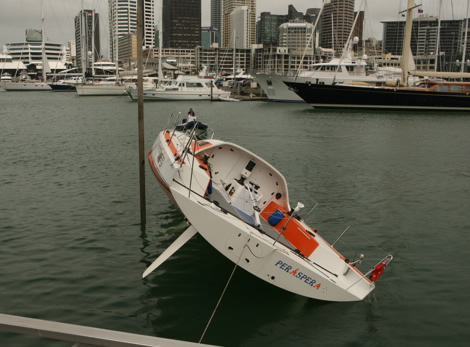
Misleading stability

I don't mean a poll on Scuttlebutt because it is clear that very few here have actually bought a new boat, so their opinion is of little interest to boatbuilder

Well I chose, and my father who had the money then, seconded our selection of boat - a large part of this decision was based on ballast ratio, which another poster here has mentioned is a bettter guide than most.

The photographs and text from the inversion test are especially revealing, and should be a warning to all, it seems there is a clear requirement for an internationally agreed standard in testing and classification - and the latter need not be over-simplified but does need to be thorough and beyond doubts!
 
Assuming, of course, nobody includes the ironwork within the hull to take the keel as part of the ship's ballast ;)

YES THEY DO!!

When considering any boat I wanted to know ballast ratio, AVS and if available the STIX and I was just buying an AWB!

I seriously looked at "X" boats and could not understand their figures of a high ballast ratio yet relatively low AVS until the dealer explained that the inner galvanised steel frame it added into the ballast!! Now on a conventional AWB the mast/shroud forces are taken down to GRP ribs and stringers and yet these are quite rightly IMHO included in the hull weight! Not sure whether Acona do the same as X boats.

To answer another post I have bought 3 new boats over a 7 year period and the AVS was a factor that I took into account yet now the more I learn the more I believe I have been mislead. eg The Dufour38 classic has an advertised AVS of 131.

I don't think the manufacturers will get their acts together until the buyers demand it of the EU regulators!1

I prepared spreadsheets at the time of each purchase that included many things but the interesting one was price per kg then you got a better measure of why production boats are cheap enough for me to buy 3!

I will be going to LIB to review yet again what boat I would replacve my current 6 yr old one but having trouble with the change cost when I see all the fitting getting smaller and I like the internal layout of my DS albeit with now a suspect AVS of 124 deg!
 
It is just too much to demand fairness on the data that is published by the builders?

No but it is naive. The builders want to sell boats and they will put their best slant on their boat. Which is not to say they tell lies - they dont unless they are stupid. But they will work all the areas in the test specs that they can.

But in any case, someone who decides to buy one boat because its avs at 120 deg is 10 more than another boat doesnt know what he is talking about. But thats the sort of thing that happens and the boatbuilder has to fight against. Its the same issue with categories - lots of boats are very marginal at category A and indeed some boats are classed A but are underneath the limit for A for historical reasons. But the boatbuilders find that anything other than A is a problem with soime customers ever iof they do no more than sail on Windermere for example.

The irony of all this is that the RCD and CE marking system as it applies to boats was set up to as much as anything to stop the French from cheating on standards and favouring their own industry against the then existing British boatbuilders. Seems like nothing much has changed.
 
Is this all a bit academic, given that any boat will capsize if hit in the right (wrong) place by the right (wrong) wave?

What we need is a measure of how quickly a boat will right when rolled, rather than a metric for how difficult it is to roll it in the first place (because it isn't difficult if you meet a particularly malevolent wave). That's why ballast ratio is useful figure. I'd rather be upside down in a boat that has 50% of its weight sticking up in the air than 30%.

Another aspect is that is difficult to imagine a capsize in flat water, yet that's where inclination and righting tests take place. Even a boat which is stable capsized in calm conditions may soon pop up in a big sea.
 
Last edited:
What we need is a measure of how quickly a boat will right when rolled, rather than a metric for how difficult it is to roll it in the first place (because it isn't difficult if you meet a particularly malevolent wave). That's why ballast ratio is useful figure. I'd rather be upside down in a boat that has 50% of its weight sticking up in the air than 30%.

And many times you would be wrong. What matters is the shape of the stability curve and the area under that curve ie the energy needed to invert / revert. But that of course is ignoring all the damage done when a boat is rolled plus the risk of flooding. Its also ignoring the very sound argument of the multihull types that " a mono can sinks when rolled, an multi says inverted but afloat". The only really safe boat is one that cant sink.
 
Is this all a bit academic, given that any boat will capsize if hit in the right (wrong) place by the right (wrong) wave?


Not often I would disagree with you Ken but I think the area above the curve, the intial slope and the higher AVS is useful and gives a measure of the boats stiffness.

Few of us choose to go blue water sailing or in marginal conditions but many want the boat to be as stiff as stable as possible in the F6.

PS I admire your choice of the Arcona. Its one that would be on my shopping list of possibles but do you know whether the inner frame is included in the ballast weight as per X boats?
 
Not often I would disagree with you Ken but I think the area above the curve, the intial slope and the higher AVS is useful and gives a measure of the boats stiffness.

Well - yes, but a test sail on a breezy day will tell you a lot about how stiff a boat is.

Few of us choose to go blue water sailing or in marginal conditions but many want the boat to be as stiff as stable as possible in the F6.

PS I admire your choice of the Arcona. Its one that would be on my shopping list of possibles but do you know whether the inner frame is included in the ballast weight as per X boats?

Not entirely sure. My impression is that my 1900 kg of ballast is comprised entirely of the lead hanging off the bottom, but will ask for clarification. I guess X's attitude is defensible if they consider the frame and keel to be a combination of internal and external ballast

TK
 
Last edited:
Is this all a bit academic, given that any boat will capsize if hit in the right (wrong) place by the right (wrong) wave?

.

When I had my close encounter with a ship last August,the boat was rolled to well below 90º.I know that because the portlights were fully submerged and given the Fulmar's reasonable beam of 3,30m the real figure must have been closer to 100º from vertical.The boat righted herself very quickly and I atribute that to the generous ballast ratio of 42%.So the best indicator will be a decent ballast ratio and of course good deck/cabin bouyancy.
 
So the best indicator will be a decent ballast ratio and of course good deck/cabin bouyancy.

You have a point on both counts. You can get the same AVS with different ballast ratios because AVS uses form stability, righting moment, downflooding and buoyancy in its calculations as well. The reason for going to AVS as the measure was that ballast ratio on its own is too simplistic.

To go further just AVS is a relatively simplistic single point figure. As suggested by a number here, the curve in theory gives a good guide to stability characteristics over the range - accepting the problems in actually measuring it.
 
It's not twenty AVS values versus twenty AVS values: it's one AVS method against nineteen AVS methods. Repeating an inaccurate calculation does not make it more credible!
.

There are two issues here that you mix. The first is to know how the ORC method based in real inclining experiences compares with the "19" methods used by each designer and generated by computer. The other is to know which of the methods (based on real inclining experiments or computer generated) match better reality. Off course, has you have "19" diferent computer/program generated stability curves, you will have one method against 19, all producing different results.

Independentely of that, the ORC method has an huge advantage because it is used on all the boats and that means that the results are comparable. You will know that a given boat has a better AVS than another, a better stability curve and so on.

The "19" different designer methods (computer generated) will give different results if applied to the same boat, therefore comparing stability curves (and AVS) of boats that have their stability curve assessed by different programs using different parameters is useless. They are not comparable and you will never know if the AVS of boat A is superior to the AVS of boat B, unless both have been assessed by the same program using the same parameters.

It would be interesting, though, to know how closely the ORC limited-heel experiments match theoretical predictions by the designers.

The answer is on post 32, on that list that I have posted:

http://www.ybw.com/forums/showthread.php?t=259138&page=4

You can see that the results obtained on the Swan, on the Hanse and on the Dehler and on x-Yacht (and I will add on the Luffe and on Salona) are very close to the ones that are obtained with the ORC method. That means that some designers obtain computer generated curves that are very close to the ones obtained with the ORC method based on real inclining experiments, while others obtain much more inflationed results.

You don't find odd that the boats with a real better stability (they are the boats with a better Ballast/Displacement) are the ones that show comparable results with the ones provided by the ORC method?

Regards

Manuel
 
Last edited:
Would some of the suggested ORC figures not put a number of large boats into Cat B?

..bet that would concentrate a few minds.

Not in the cases I have posted but certainly in many boats. The boats that have a ORC international certificate (ORC AVS) are boats used for racing, most of them are cruiser-racers. Those are the boats that have a better Ballast/displacement and have a better overall stability. They are more stiff and have a better AVS than the typical big production cruiser.

Regards

Manuel
 
..

I seriously looked at "X" boats and could not understand their figures of a high ballast ratio yet relatively low AVS until the dealer explained that the inner galvanised steel frame it added into the ballast!! .

I don't think that is the real reason. If you look at the figures I have posted on post 36 ( http://www.ybw.com/forums/showthread.php?t=259138&page=4 ) you will see that the AVS that is provided by the X-Yachts is close to the one that is obtained with the ORC inclining based method, while there are manufacturers that provide results that are 13º above the ones that are obtained by that method.

If you join to the X43 ORC AVS (115,3) 13º, you would obtain 128,3 AVS, probably a more comparable figure if we consider French boats. That figure will also be more compatible with the relative differences in Ballast/Displacement.

Regards

Manuel
 
Last edited:
..

To be honest people have been buying boats without this knowledge for many many years, so why do we start needing it now? Quite frankly if my boat gets to 107 degrees, then statical stability (and that is what the stability curve is, a measure of statical stability) is irrelevant.

I don't agree. Correct knowledge of your boat basic stability with an emphasis on reserve stability is very important for a boat owner. If you know you have a boat with 107 AVS you should know that it is dangerous to have a main furling system and a radar dome on the mast. Those two addictions can, in a 40ft boat, reduce the AVS in more than 10º. With the weight of the furling genoa (that is not considered on the AVS measure) chances are that the boat will not recover from a simple knock down.

If you know that your boat has an AVS of 125º you know that you can mount a Furling main and have a mast radar dome and still have a reasonable safety stability.

These kind of knowledge is important to any owner.

I have a master's degree in Naval Architecture and although I never went into ship design, let alone small boat design, I was always surprised at the smooth nature of the curves published in the magazines. Surely there would be a discontinuity at deck edge immersion, another at deck house immersion, keel emergence.... and the curve should stop at the angle of down flooding - all bets are off at that stage.

Seven or eight years ago when they started to consider the effect of deck house immersion such discontinuities started to appear on the stability curves. Not in all but in the ones that effectively considered that parameter.
...
..
I would imagine if you pressed any Naval Architect involved with crunching these numbers, would caution the interpretation of curves. You can generate these curves at all stages of design - hull only, hull and deckhouse, lightship, an infinite number of combinations of load cases and so on. The marketing men will decide which curve goes into the literature and it might not even be the one used to determine the RCD rating.

That's why there should be a mandatory regulation about how the stability curve used to CE certify the boat is generated. I mean a very well defined parameterization and the use of an approved computer program, the same to all. This seams quite simple to me, not difficult to implement, if there is a will to do so.

After all, that is what is made in what concerns the way the ORC curve is generated, only Instead of a program they use real inclining experiments and a mathematical model.

Regards

Manuel
 
Was that a realistic test, though? Quite apart from the apparent activity needed to get her come up again - “The boat came upright and rolled easily with one ballast tank full and one still only half full. There was no need to fill up the forward compartment. Full credit to Farr for the design and Francesco and Luca did a great job inside the boat.” - the other pictures suggest that they may have missed a few rather important bits out when doing the test...

180_3_470.jpg


Perhaps I'm missing something, but "This boat will roll upright in just under half an hour as long as the rig has fallen off and you are in a position to pump large amounts of water into two ballast tanks" is not the most reassuring situation I can imagine.

How very true! If you were upside-down for 1/2 hr in a gale, goodness knows how much the boat would have been trashed in that time. Perhaps they should also have said ".. and you haven't got a mast through the hull, or drowned, or succumed to hypothermia"
 
Yes you are right. The ORC method starts with an experimental test that permits a mathematical model. But the point here is that that method and model is the same for all the boats.

The stability data for the CE certification is based on a computer generated stability curve provided by the designer. There are not any kind of verification on the accuracy of that stability curve neither there are an approved program with equal parameters to guarantee that the results are comparable, and they are not.

Believe me, when that Naval Architect said that to me, I had trouble in believe in what he was telling me. But as you can see from the numbers I have provided there are manufactures that provide data that is comparable with the one obtained by the ORC method and others (most of them) provide data that is way off, so off that it can vary in 15º (ORC AVS and CE AVS).

What is the purpose of a CE certification if the basic stability data provided is random and untrue? What is the gain if the consumer can be completely mislead with the information they provide?

I was, several times and I knew something about stability: I was mislead on the Dehler 39 on the Hanse 430 and on the Luffe 43, boats that apparently had a poor stability (resulting from the comparison of their CE stability curves with the ones from other similar boats). I know now that they have a better stability than most of the other boats I was comparing them, boats that have stability curves with inflated results, if compared with the ones from ORC, boats that really have poorer stability curves, if we use comparable data (ORC method).

Regards

Manuel

Have you considered, Manuel, that it could be that the ORC method is not accurate, whereas most of the manufacturers data is quite accurate (excepting for, maybe, a few errant cowboys) ???

If I am not mistaken, the ORC method uses a simple heeling test, and conjures up from that a value for AVS. This would only be correct, and accurate, if the hull shape and weight distribution was an exact replica of that underlying the ORC model. This is most unlikely for most modern boats. Hence, a correctly calculated Stability Curve and AVS using actual hull shape data and weight distribution is probably far more accurate than the ORC method.

Someone may come up with the comment that the ORC method is designed to be conservative !!!! That would just confirm that any curve or AVS value calculated by the ORC method would be lower than an accurately calculated value based on hull shape and weight distribution.

Others may say that some manufacturers spruce up their stability curve and calculated AVS value. If you have hard evidence that that has occurred, please make it known to the competent authorities, as that probably constitutes some form of crime, as to misrepresent a vessels capabilities is a serious matter. If you don't believe me, search for the case of a boat sold as sea-going that should not be used outside a bathtub. I think it occurred somewhere in Wales ??? Maybe some other forumite can provide a link to the court judgement or MAIB report. As I recall, it was quite scathing, and I think the guilty party paid dearly for his error.

Plomong
 
Last edited:
The accuracy of the model is far less important than the use of several different models (different computer programs) that generate stability curves that are not comparable and then use non comparable results as basis to all the calculations needed to certify a boat and to provide information to the consumers.

Just because the values are calculated by diferent programs does not mean that they are not comparable -- they are. They are the calculated AVS values and so can be compared as what they are.

The ORC stability curves and AVS are comparable because they are all generated by the same method, using the same parameters and in my opinion it should be so for the stability information provided for the CE boat certification.

This is not so -- they are not comparable because they are calculated by a one-method-fits-all procedure that does not allow for the variability in hull shape and weight distribution between different boats. However, being ORC AVS Values, they can, as such, be compared - but each value is just what it is -- a value determined by a predefined model, which is probably a tad conservative so as to avoid the unwanted consequences of being the other way round.


I am not saying that it should be the ORC method, but one method, mandatory for all, with the same parameters (and same program), as a way of obtaining comparable and meaningful stability curves and not random ones.

I very much doubt the values calculated by most manufacturers are random values, leaving aside the possible cowboys out there !!! You will probably find that the designers are quite conscious that their AVS value and stability curve must be justifiable just in case it is ever brought into question in a court of law. And that has never happened ??? Oh yes it has. Look up the case of the trawler that capsized off Bilbao some years ago, and many other more relevant cases, where yachts are concerned, in the UK MAIB reports.

Plomong
 
Seven or eight years ago when they started to consider the effect of deck house immersion such discontinuities started to appear on the stability curves. Not in all but in the ones that effectively considered that parameter.

How on earth were they calculating them before that? Surely the shape of the thing being measured is necessary to make it a calculation rather than a vague guess?
 
Was that a realistic test, though? Quite apart from the apparent activity needed to get her come up again - “The boat came upright and rolled easily with one ballast tank full and one still only half full. There was no need to fill up the forward compartment. Full credit to Farr for the design and Francesco and Luca did a great job inside the boat.” - the other pictures suggest that they may have missed a few rather important bits out when doing the test...

180_3_470.jpg


Perhaps I'm missing something, but "This boat will roll upright in just under half an hour as long as the rig has fallen off and you are in a position to pump large amounts of water into two ballast tanks" is not the most reassuring situation I can imagine.

If the rig stays intact the boat would re-right itself faster.

In a real situation with waves capable of rolling that boat, even without messing with the water tanks, that boat would right itself up in about one minute (or less).

Those boats have an 125º AVS with the water ballast on the worse position.

Regards

Manuel
 
Independentely of that, the ORC method has an huge advantage because it is used on all the boats and that means that the results are comparable. You will know that a given boat has a better AVS than another, a better stability curve and so on.

No. Sorry. Doesn't follow. That's the trap I was warning you about. Repeated use of a bad method doesn't make it a good method. Not that the ORC method is necessarily bad, you understand, but without verification you can't place any reliance on it - not even in comparisons between boats.

The "19" different designer methods (computer generated) will give different results if applied to the same boat.

How do you know?

They are not comparable and you will never know if the AVS of boat A is superior to the AVS of boat B, unless both have been assessed by the same program using the same parameters.

And if the program is correct. That's the killer. Just using the same method with the same parameters isn't enough.

The answer is on post 32, on that list that I have posted:

It isn't, you know. In that post you list ORC and designers' AVS values. I'm interested in knowing how accurately the designers' curves match the results of the heeling test done by ORC.

You sometimes seem to suggest that the ORC method measures AVS. It does not.
 
Top