Misleading stability

However, if you really want to I can go much deeper into the topic, but not sure it would add anything, which is why I kept it at this level

Go on then, I'll take the risk my little mind won't be able to cope...
 
However, if you really want to I can go much deeper into the topic, but not sure it would add anything, which is why I kept it at this level

Go on then, I'll take the risk my little mind won't be able to cope...

As I said, not sure it will add anything. You could start with "The Case for Qualitative Research" Morgan and Smirchich The Academy of Management October 1980. Should give you a flavour of where you could go. You may also find "Images of Organization" by Gareth Morgan, Sage Publications, 1986 quite thought provoking.

Let me know how you get on.
 
Am I right in thinking that the ORC AVS is not actually found experimentally? As I understand it they do a load vs heel test for a fairly small angle and then use that to adjust the mathematical model which predicts AVS.

It would be very interesting to know how the experimental results for small angles compare with manufacturers' predictions.

Yes you are right. The ORC method starts with an experimental test that permits a mathematical model. But the point here is that that method and model is the same for all the boats.

The stability data for the CE certification is based on a computer generated stability curve provided by the designer. There are not any kind of verification on the accuracy of that stability curve neither there are an approved program with equal parameters to guarantee that the results are comparable, and they are not.

Believe me, when that Naval Architect said that to me, I had trouble in believe in what he was telling me. But as you can see from the numbers I have provided there are manufactures that provide data that is comparable with the one obtained by the ORC method and others (most of them) provide data that is way off, so off that it can vary in 15º (ORC AVS and CE AVS).

What is the purpose of a CE certification if the basic stability data provided is random and untrue? What is the gain if the consumer can be completely mislead with the information they provide?

I was, several times and I knew something about stability: I was mislead on the Dehler 39 on the Hanse 430 and on the Luffe 43, boats that apparently had a poor stability (resulting from the comparison of their CE stability curves with the ones from other similar boats). I know now that they have a better stability than most of the other boats I was comparing them, boats that have stability curves with inflated results, if compared with the ones from ORC, boats that really have poorer stability curves, if we use comparable data (ORC method).

Regards

Manuel
 
...

You may well be right that one particular method may be more accurate than another but it will still be only an estimated representation that might be just as misleading - but at a different numerical level.

...

The accuracy of the model is far less important than the use of several different models (different computer programs) that generate stability curves that are not comparable and then use non comparable results as basis to all the calculations needed to certify a boat and to provide information to the consumers.

The ORC stability curves and AVS are comparable because they are all generated by the same method, using the same parameters and in my opinion it should be so for the stability information provided for the CE boat certification.

I am not saying that it should be the ORC method, but one method, mandatory for all, with the same parameters (and same program), as a way of obtaining comparable and meaningful stability curves and not random ones.

Regards

Manuel
 
What is the purpose of a CE certification if the basic stability data provided is random and untrue?


I am not sure what you're arguing for at the moment? Do you want more accurate models or more consistent modelling?

The manufacturer's stability curves need not be any more random and untrue than the ORC ones. As many, many people have said, it's a complicated business which relies on all sort of assumptions. The only additional merit in the ORC method is that it allows comparisons between boats, but even then you are comparing figures derived from assumptions which may not apply in real life.

The real possibility exists that the ORC model is consistently wrong - the more so since, as you point out, the one method used by the ORC is consistently contradicted by the many methods used by designers and builders.

If you think the ORC figures are more reliable than the manufacturers' ones, why do you think so?
 
...The only issue that the OP raises is whether one of the measures is reliable. And all I am saying it is not necessarily more or less reliable because the whole idea of a single measure representing a complex phenomenom is fraught with problems - some of which I have mentioned. ...

It seems that you don't know the formulas and calculations used for certifying a boat. It is not one of the measures. The Stability curve (and the AVS that is just a point on a SC, as the downflooding angle, or the area under the positive part of the curve) is not one of the measures but the central information over which all the calculations are made.

Different AVS (and very different in some cases) mean different Stability curves and different Stability curves will provide different boat assessments.

Regards

Manuel
 
Last edited:
I think the conclusion of these discussions ( and thanks Tranona, note you are recommending other people's work not your own remarkable insight ) - is that in a perfect world we really need a different autonomous authority with the ability to properly test boats, and be able to publish results without fear of financial or political implications.

As this doesn't seem likely in the short term ( I'd like to believe it WILL be the case one day ) all we can do in the meantime is exercise judgement, and hope novices have the sense to research and ask around...
 
I am not sure what you're arguing for at the moment? Do you want more accurate models or more consistent modelling?

The manufacturer's stability curves need not be any more random and untrue than the ORC ones. As many, many people have said, it's a complicated business which relies on all sort of assumptions. The only additional merit in the ORC method is that it allows comparisons between boats, but even then you are comparing figures derived from assumptions which may not apply in real life.

The real possibility exists that the ORC model is consistently wrong - the more so since, as you point out, the one method used by the ORC is consistently contradicted by the many methods used by designers and builders.

If you think the ORC figures are more reliable than the manufacturers' ones, why do you think so?

The ORC figures are comparable (among them) because the method used was the same for all the boats.

The figures provided by boat designers are not comparable among them because they were generated by different methods (different computer programs) that use different parameters. Then you use those non comparable
results (stability curves) to provide the consumers comparable information about the boats (CE certification, STIX number).

This makes no sense and misleads consumers.

Looking at the stability curves provided by the ORC method (equal to all) I can assess the differences in the stability of different boats. Looking to stability curves provided by different methods and using different parameters, I cannot make any assessment because they are not comparable and that is what happens with the CE stability curves.

What I want is the Stability curves provided for the CE certification to be made the same way, using the same parameters and the same model. Only this way would they be comparable. They are the central information for the CE boat certification and with no comparable stability curves it is impossible to have a meaningful assessment of boat stability.

Regards

Manuel
 
Last edited:
It seems that you don't know the formulas and calculations used for certifying a boat. It is not one of the measures. The Stability curve (and the AVS that is just a point on a SC, as the downflooding angle, or the area under the positive part of the curve) is not one of the measures but the central information over which all the calculations are made.

Really? Who actually measures it, then, with a real boat and real water?
 
Really? Who actually measures it, then, with a real boat and real water?

Completely? Nobody, except some racing class, like Open 60. For the ORC certificate you need an AVS (LPS) that is taken after an inclining experiment with the boat on the water. From the real values taken from that experiment and from the boat dimensions the stability curve is then obtained through a mathematical model. They don't accept the results from the stability curves that were used to certify the boats (CE), and with good reason.

The ones provided by the designers for the CE certification are obtained from computer programs without any experimental verification with the real boat on the water. Each designer use its own program and experience shows (by comparison wit the ORC ones) that each program produces different results. Even with the same program there is always some possible parameterization and not even those are defined. So results are different and non comparable.

Regards

Paulo
 
Last edited:
( and thanks Tranona, note you are recommending other people's work not your own remarkable insight ) -

Do you have an objection to that? I thought it was normal practice to refer to an original source if you wanted somebody else to gain some insight to a particular subject. Saves me from re-interpretation and gives you the opportunity to assess its value for yourself rather than believe what I think it means.
 
Completely? Nobody, except some racing class, like Open 60. For the ORC certificate you need an AVS (LPS) that is taken after an inclining experiment with the boat on the water. From the real values taken from that experiment and from the boat dimensions the stability curve is then obtained through a mathematical model. They don't accept the results from the stability curves that were used to certify the boats (CE), and with good reason.

The ones provided by the designers for the CE certification are obtained from computer programs without any experimental verification with the real boat on the water. Each designer use its own program and experience shows (by comparison wit the ORC ones) that each program produces different results. Even with the same program there is always some possible parameterization and not even those are defined. So results are different and non comparable.

Regards

Paulo

Thanks for clarifying that. Whilst adopting a single method which includes some empirical data might improve comparability, the other limitations still remain. The measurement is only valid for the boat in the particular tested condition and uses a mathematical model so it is only robust to the extent of the accuracy with which it represents what it is trying to measure.

One also has to consider cost/benefit. That is clearly more expensive than straightforward computer modelling so there needs to be a clear benefit to justify the cost. Is there a compromise that might involve a common model that leads to comparability?

As I suggested earlier you have identified a potential shortcoming (which is already known), but there needs to be a strong case that it is causing real harm and then there needs to be a sound workable alternative.

There is a standing working party on standards - the RYA is a member. Changes will only come through that mechanism. To be honest I don't think there is big consumer concern, which of course might be through ignorance, but is more likely because it does not have a significant influence over buying decisions!
 
So should boating rags continue to publish this data?

To be honest people have been buying boats without this knowledge for many many years, so why do we start needing it now? Quite frankly if my boat gets to 107 degrees, then statical stability (and that is what the stability curve is, a measure of statical stability) is irrelevant. I have a master's degree in Naval Architecture and although I never went into ship design, let alone small boat design, I was always surprised at the smooth nature of the curves published in the magazines. Surely there would be a discontinuity at deck edge immersion, another at deck house immersion, keel emergence.... and the curve should stop at the angle of down flooding - all bets are off at that stage.

As Polox and others point out the curve is a complex beast and requires expertise to interpret; expertise beyond what you need to successfully purchase a boat. So to be honest, I think publishing the Stability curve is nothing more than a marketing stunt. It is only the fact that this information is very simple to generate using modern software that we have it at all.

I would imagine if you pressed any Naval Architect involved with crunching these numbers, would caution the interpretation of curves. You can generate these curves at all stages of design - hull only, hull and deckhouse, lightship, an infinite number of combinations of load cases and so on. The marketing men will decide which curve goes into the literature and it might not even be the one used to determine the RCD rating.
 
For the ORC certificate you need an AVS (LPS) that is taken after an inclining experiment with the boat on the water. From the real values taken from that experiment and from the boat dimensions the stability curve is then obtained through a mathematical model.

Exactly. Now if you think there is a problem with different models giving different curves, you need to check (a) whether the mathematical models used accurately reflect the physical assumptions made and (b) whether the physical assumptions made accurately reflect reality.

If the ORC calculations and the designers' calculations made precisely the same assumptions - about loading, hatches, crew and cargo shifts and so on - and produced significant different results, I'd be worried.

If either the ORC calculations or the designers' calculations made unrealistic assumptions about physical reality (no crew on board?), I'd be worried

If they make different, but reasonable, assumptions and get different, but reasonable, results then that's just life. I repeat, though, that since a very large number of people seem to disagree with the ORC results, I'd be rather wary of the ORC results. It's not twenty AVS values versus twenty AVS values: it's one AVS method against nineteen AVS methods. Repeating an inaccurate calculation does not make it more credible!

It would be interesting, though, to know how closely the ORC limited-heel experiments match theoretical predictions by the designers.
 
...... To be honest I don't think there is big consumer concern, which of course might be through ignorance, but is more likely because it does not have a significant influence over buying decisions!

Would some of the suggested ORC figures not put a number of large boats into Cat B?

..bet that would concentrate a few minds.
 
Would some of the suggested ORC figures not put a number of large boats into Cat B?

..bet that would concentrate a few minds.

See my comments earlier on the subject of categorisation. Minds are already concentrated - on ensuring that boats meet the requirements of categorisation. Remember it is all an arbitrary construct (sorry about that) and all that would happen is that the marginal activity would take place at a different level!

AVS (which is only one of the measures that determines category) is not an external truth but a construct - hence you can get a different figure using different methods as this thread shows. The same problem exists in my own field where measures of financial stability, value, security etc get established to reflect peoples' views of what is good and bad at the time and become accepted "truths" until the world changes along with attitudes and the measurements get abandoned or revised.

The point I was making here is that there does not seem to be any pressure from boat buyers for any changes, nor that boats with marginal AVS for "Ocean" use are foundering (I hope that Joshua Slocum is keeping a watching brief on this thread).

I suspect if you had a poll amongst new boat buyers on the key criteria for choosing a boat, AVS would not get a single mention. And I don't mean a poll on Scuttlebutt because it is clear that very few here have actually bought a new boat, so their opinion is of little interest to boatbuilders as such people have little impact on sales.
 
Well, lots of opinions (of course) but not much light at the end of the tunnel.

I wonder how many of us (apart from the OP) have directly quizzed any manufacturers about this? Granted it's probably a waste of time trying to tackle the big firms at the Southampton Boat Show. The sales-droids are only programmed to speak sales bullshyte.

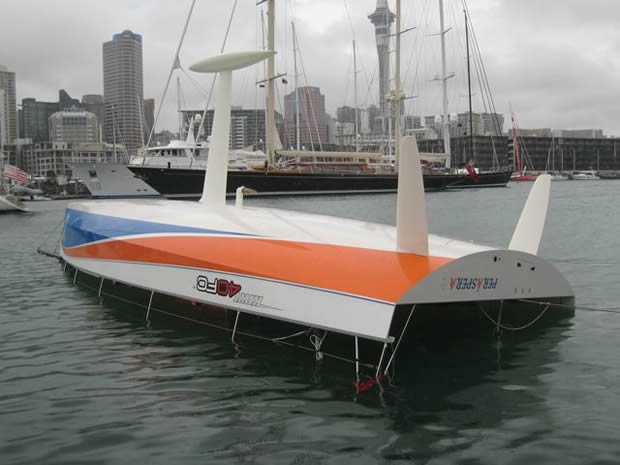
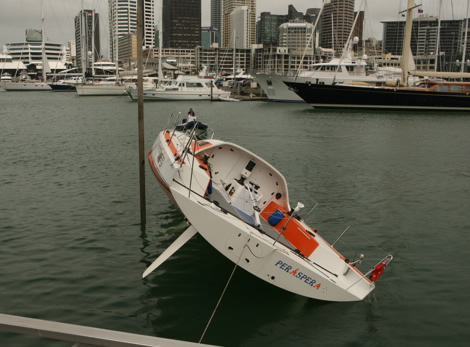
But some smaller manufactuers are quite open with info, including inversion tests.

180_8_620.jpg


For more critical reporting, I suggest sites like The Daily Sail or Sailing Anarchy

Plus, there are other websites (heretical mode on) where these things are discussed in fine detail. Like Boat Design Net. (Have I just broken the T&Cs?)
 
But some smaller manufactuers are quite open with info, including inversion tests.

180_8_620.jpg

Was that a realistic test, though? Quite apart from the apparent activity needed to get her come up again - “The boat came upright and rolled easily with one ballast tank full and one still only half full. There was no need to fill up the forward compartment. Full credit to Farr for the design and Francesco and Luca did a great job inside the boat.” - the other pictures suggest that they may have missed a few rather important bits out when doing the test...

180_3_470.jpg


Perhaps I'm missing something, but "This boat will roll upright in just under half an hour as long as the rig has fallen off and you are in a position to pump large amounts of water into two ballast tanks" is not the most reassuring situation I can imagine.
 
Last edited:
Top