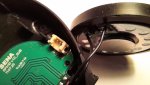
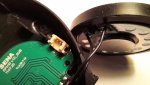
Micro cable connector for new LiPo battery

TwoHooter

Well-Known Member
Joined
6 Sep 2014
Messages
1,005
Location
marinetraffic.com MMSI 235116115
Visit site
I have spent hours searching and am going round in circles.
I need a micro cable connector to connect the 2 wires from a new LiPo battery to the 2 wires from an existing PCB.

Full story:
  • The LiPo batteries in our expensive Sena bluetooth headsets have died.
  • I have found replacement batteries and they are on their way. I only found one source of the correct spec (4500 mAh) and they come with bare wires.
  • The original battery has a micro connector (aka plug, male) crimped on to its wires - picture 1.
  • The plug fits into the PCB receptacle (aka socket, female) - picture 2
  • I cannot find this type of plug as a loose item for me to crimp to the new battery wires.
  • I think the plug is a standard 2,54 with 1.25mm pitch and it might be a genuine JST "GH" formfactor, or possibly a Mouser 51021, and I would be willing to buy both to see if one fits, but after a lengthy search I can't find a supplier. I placed an order for a possible match for the JST formfactor from China but I'm not confident they are correct and they won't be here until July, or later. Just to avoid others going down the same blind alleys as me, there are literally dozens of sources for these and similar plugs pre-crimped to wires, but that's no use to me at all, I've already got that on the old batteries. I want loose plugs with new crimps for me to crimp to the wires on the new batteries.
  • My plan now is to push the plug back into its socket, snip the wires to an appropriate length, and fit a connector to join the wires from the new battery to the wires from the PCB.
  • I have studied the websites of RS and other suppliers, and Ebay, but I can't find a suitable male<>female pair of crimp connectors because I don't understand the jargon of this trade. I can't use ordinary crimps, there isn't room inside the housing. I need micro crimps. Surely these must be made for electronics assembly? There must be occasions when wires need to be joined away from the PCB.
  • Can someone tell me what such things are called and where I might find them?
  • I know I could solder the wires together and that is my last resort, but soldering is a second-rate solution and every time I replace the batteries I will have slightly shorter wires than I started with.
Thanks

Sena plug (original).jpg

Sena Socket 20210522_234851.jpg
 

Attachments

  • Sena Socket 20210522_234851.jpg
    Sena Socket 20210522_234851.jpg
    376.9 KB · Views: 1
I have had similar issues with my RC planes.
I would cut the wires close to the battery, pre fit shrink sleeve, parallel / butt solder to the new wires and shrink sleeve them.
Why will the wires get shorter next time just de-solder the joint.

I have micro crimp pliers for the RC extension leads and they and the connectors may well do the job. They are expensive and very fiddley, for a one off like this I would take the easy solder route.

Regards Clive
 
I have had similar issues with my RC planes.
I would cut the wires close to the battery, pre fit shrink sleeve, parallel / butt solder to the new wires and shrink sleeve them.
Why will the wires get shorter next time just de-solder the joint.

I have micro crimp pliers for the RC extension leads and they and the connectors may well do the job. They are expensive and very fiddley, for a one off like this I would take the easy solder route.

Regards Clive
Thanks.
I thought that by soldering, de-soldering, and re-soldering the wires will get more and more brittle. On the boat itself, built to ABYC standards, soldering wires to make a connection is prohibited because of this problem.

I'm amazed that these little plugs are so hard to find. There must be a source which the battery-makers use.
 
The crimp tools for that kind of size tend to be pricey.
I'd solder it.

Alternatively, you could probably fit a smaller battery, do you really need over 4Ah ?
 
Your connector is a bit odd 'tho as it's not round connectors but small blades. But looking at JST's range is still likely to be in the right direction.
Thanks. Yes it certainly is odd. I have spent ages trying to match what I have now in the JST, Mouler, and un-branded ranges and I have failed. The nearest I have got is the (I suspect obsolete) JST "GH" series, and an un-branded item on ebay but that is only available with wires already crimped to the male connector which of course is useless to me.
I am trying to convince myself that those are a male<>female matching pair but I'm not entirely sure. Have you actually bought them? Having asked that question the cost is low enough to take a gamble.
 
Thanks. Yes it certainly is odd. I have spent ages trying to match what I have now in the JST, Mouler, and un-branded ranges and I have failed. The nearest I have got is the (I suspect obsolete) JST "GH" series, and an un-branded item on ebay but that is only available with wires already crimped to the male connector which of course is useless to me.

I am trying to convince myself that those are a male<>female matching pair but I'm not entirely sure. Have you actually bought them? Having asked that question the cost is low enough to take a gamble.

I have bought these, or at least the surface-mount pcb end which I buy in volume and use in our products. The batteries I buy in bulk with that connector already attached. A word of warning: even with the right connectors and pins, making up the plug without the special crimping tool is a nightmare, and the tools are expensive, so it may be best to obtain the battery with connector, and then replace the PCB socket - a slightly bizarre approach! But, tbh, given you've a battery with bare wires if it were mine I'd just solder the new battery's leads directly to the PCB. How many times will you have to do it in the life of the headset, once more maybe?
 
I have bought these, or at least the surface-mount pcb end which I buy in volume and use in our products. The batteries I buy in bulk with that connector already attached. A word of warning: even with the right connectors and pins, making up the plug without the special crimping tool is a nightmare, and the tools are expensive, so it may be best to obtain the battery with connector, and then replace the PCB socket - a slightly bizarre approach! But, tbh, given you've a battery with bare wires if it were mine I'd just solder the new battery's leads directly to the PCB. How many times will you have to do it in the life of the headset, once more maybe?
Thanks for that. I have only found the 450mAh battery with bare wires and I am coming to the conclusion that soldering + heat shrink is the only viable answer.
 
Top