MD2030 using water.

MM5AHO

Well-Known Member
Joined
1 Oct 2007
Messages
2,550
Location
Central Scotland
Visit site
My VP MD 2030 has started using fresh water. No leaks visible, suspect to goes to the seawater circuit and out exhaust. Reseating tube bundle has not helped. Any suggestions? Using about 1L per hour.

 
It could
be a leak at the heat exchanger exhaust elbow connection due to corrosion of the heat exchanger. Take off the exhaust elbow and check. You do not want water getting Into the cylinders
 
Mine was the same, I put a bottle on the end of the overflow pipe and I was getting out what I was putting in. I think I have cured the problem by not refilling the HE all the way up. I fill it half way so you can just see the level. I also replaced the cap. It seems ok now, I did a 6 hour trip today and no water in the overflow bottle.
 
It could
be a leak at the heat exchanger exhaust elbow connection due to corrosion of the heat exchanger. Take off the exhaust elbow and check. You do not want water getting Into the cylinders
Wouldnt that be a seawater leak?
I've had the tube bundle out, end caps off, nothing looks amiss there. It's only the freshwater side losing water. No signs of cylinder lock with water in them. Engine runs well, just loses water. New pressure cap tried.. same. It's not building pressure, and that, I think further suggests a leak from higher pressure fresh circuit to lower pressure salt circuit. I just can't find where.
 
If there us a leak in the freshwater jacket then the freshwater can be forced into the exhaust manifold and then either be ejected through the exhaust system or find it's way into the exhaust port and then into the cylinder. The 20x0 engines have a weak point in this regard which can lead to heat exchanger failure. If you google MD2030 heat exchanger failure you will find plenty of photos
 
Just about to ask the same question and wondered if it was heat exchanger. Unfortunately, we were approaching a bridge-opening this afternoon when alarm went off. Check engine not on fire and anchor out. Turns out it was low fresh water. No obvious indication of leak.

Was going to check elbow soon so I will expedite that.
 
If there us a leak in the freshwater jacket then the freshwater can be forced into the exhaust manifold and then either be ejected through the exhaust system or find it's way into the exhaust port and then into the cylinder. The 20x0 engines have a weak point in this regard which can lead to heat exchanger failure. If you google MD2030 heat exchanger failure you will find plenty of photos
Thanks for the lead. This sounds plausible, sorry I doubted to start, maybe misunderstood. Will investigate.
 
Further advice sought: we are tied by the 90 day rule by time, and autumn storage by place. So we will have to use minimal engine (we do that anyway). However today we had to run engine for 7 hours and lost 700ml of coolant. I am wondering, if that is a constant then, I can get away with max of 4 hour stints in our return to home base (400NM) with monitoring and replacement. Once their, we will have facilities to repair.
 
Without knowing where the leak is no one can tell you if motoring will be OK or if you have been lucky so far. I would remove the exhaust elbow and see if there is any corrosion of the heat exchanger.
 
I measured my loss at 500ml per hour. But my engines capacity is about 4.5L, so that's about 10%. I stopped hourly and topped up. A telling thing was that there was no pressure under the pressure cap.
 
It's either leaking through the HE core or rubber boots into the seawater flow or leaking into the exhaust manifold. If it is leaking through the core/ boots you might be able to manage the situation by topping up and not running the engine hard. If it's leaking into the exhaust manifold it's only a mater of tome before water finds its way into a cylinder. You really need to find out which of the above scenarios you have
 
I had this problem and it turned out it was caused by the exhaust elbow being coked up so replaced with a stainless steel one from eBay and new rubber end caps and I’ve not lost a drop in 2 seasons. My guess is it’s some bypass on the rubber end caps caused by the restricted flow of exhaust/water from the elbow. If you take the elbow off you’ll see it’ll be clogged.
 
How do I work out which please?
It's either leaking through the HE core or rubber boots into the seawater flow or leaking into the exhaust manifold. If it is leaking through the core/ boots you might be able to manage the situation by topping up and not running the engine hard. If it's leaking into the exhaust manifold it's only a mater of tome before water finds its way into a cylinder. You really need to find out which of the above scenarios you have
 
When you take off the exhaust elbow you can inspect the exhaust outlet of the heat exchanger for any small holes or evidence of a water leak. You can also check the exhaust elbow for blockages where the seawater enters and clean or replace as necessary.
To test the Heat exchanger tubes you need to remove the bundle from the heat exchanger, re attach the rubber boots, block one end off and then connect the other end to a water supply and check for any leaks. Lots of pictures and videos if you google.
 
Further advice sought: we are tied by the 90 day rule by time, and autumn storage by place. So we will have to use minimal engine (we do that anyway). However today we had to run engine for 7 hours and lost 700ml of coolant. I am wondering, if that is a constant then, I can get away with max of 4 hour stints in our return to home base (400NM) with monitoring and replacement. Once their, we will have facilities to repair.
I had a similar issue on my MD2040. I replaced the elbow and end caps at the same time and it was fixed, so don’t know which of the 2 actually sorted it. I did find that I could quite happily run the engine with the heat-ex cap off (with a cloth over the hole to stop coolant spitting out!) under medium revs and the engine was quite happy without needing the freshwater circuit pressurised until I fixed it properly.
 
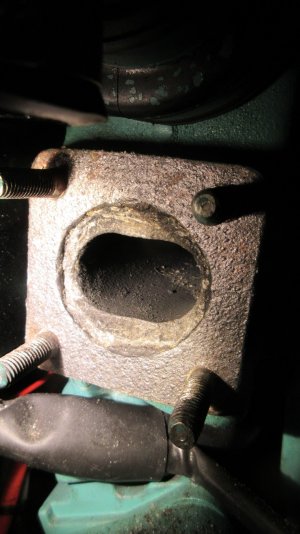
The 1st photo is my engine after 2600hrs and 3 exhaust elbows.
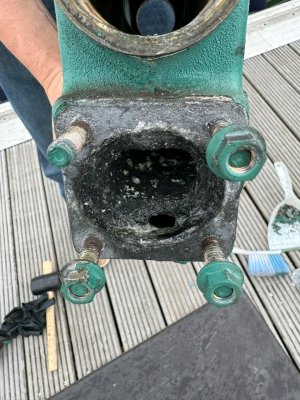
The second is a photo off he internet showing a perforated water jacket
 
When you take off the exhaust elbow you can inspect the exhaust outlet of the heat exchanger for any small holes or evidence of a water leak. You can also check the exhaust elbow for blockages where the seawater enters and clean or replace as necessary.
To test the Heat exchanger tubes you need to remove the bundle from the heat exchanger, re attach the rubber boots, block one end off and then connect the other end to a water supply and check for any leaks. Lots of pictures and videos if you google.
Thanks, I plan to do all that. Just thought I'd be able to test without removing anything 😂
 
Top