Mastervolt charger repair.

Yes, my 2004 sq58 also had no engine battery charging so I fitted one of the small mastervolt chargers around 25amps.
Later big mastervolts have 2 trickle feeds for engine batteries i.e. 3 feeds from one charger unit and fairline fitted those after your build.
I was already intrigued when jrudge said that FL "don’t charge engine batteries by default", but now you are making me even more curious.
Aside from the fact that I never got my head around the rationale for dedicated starting batteries for each engine, which imho is a total waste (but FL is not alone in this respect), am I understanding correctly that when chargers were only available with 2 feeds, they used just one for the domestic bank, leaving both the starting banks uncharged (hence with the 2nd feed unused, I guess)? If that doesn't sound silly, I don't know what else does!
Btw, with this separate starting banks setup, how are the two alternators connected?
Thanks in advance to anyone who can enlighten me, because there MUST be something I'm missing... :confused:
 
I was already intrigued when jrudge said that FL "don’t charge engine batteries by default", but now you are making me even more curious.
Aside from the fact that I never got my head around the rationale for dedicated starting batteries for each engine, which imho is a total waste (but FL is not alone in this respect), am I understanding correctly that when chargers were only available with 2 feeds, they used just one for the domestic bank, leaving both the starting banks uncharged (hence with the 2nd feed unused, I guess)?
If that doesn't sound silly, I don't know what else does...
Btw, with this separate starting banks setup, how are the two alternators connected?
Thanks in advance to anyone who can enlighten me, because there MUST be something I'm missing... :confused:

Play d'eau has a domestics battery bank (4x8D) and a separate bank (2x8D) just for engine starting. The port engine charges the engine start batteries, whilst the stbd engine charges the domestics.

Apart from this, the 12v instrument bus is powered by two 24v-12v droppers from the domestic bank, each dropper being able to provide sufficient power for the bus. The bus also has its own 12v battery in case both droppers fail.

It's worked OK for 16 years, but I don't like the fact that the stbd engine's alternator charges the domestic bank on its own with no load sharing from the port engine's alternator. In other words, it does all the work on it own whilst underway.
 
Yup P, that's a classic configuration, whose logic I fully understand.
You aren't specifying this, but I can easily guess that you've got a 2 feed charger (or charger/inverter) that takes care of both battery banks.
That's essentially the same setup I always had on all my boats, bar the 12V battery as a backup of the droppers, which is a nice touch.
I suppose it has its own dedicated 12V charger? Or maybe a 2 feed 12V charger that keeps both that battery and the genset starting battery topped?

The only additional sophistication which I've got on the current boat is an automatic system with industrial relais, that when the engines are on connects both alternators in parallel to both banks.
Mind, I'm only mentioning this because it's a way to address what you don't like, but I can actually see potential arguments against this setup, which I've never seen on any boats other than DPs.
Though I must say that it has worked nicely for 14 years now - and counting, touch wood! :)
 
I suppose the logic is that the batteries only get used to start the engines and when moored are doing nothing so why charge then with the attendant risk that the charger cooks the batteries?

There is a change over switch to use the domestics to start the boat in need.

Something must have prompted the original owner to install it however .....

Re some other posts ... why did the plumbing fitting fail. I dont know ... the bilge alarm went off twice at 6am. I found the issue, turned the pump of and went back to bed. Fixed in the morning. Fix took 15 mins, getting a few hundred litres of water out rather longer! It was not connected to shore water. It is in Cala Dor and I dont even top up the tanks there any more - head round to Porto Petro for E40 and fill up there!
 
Well, starting batteries do get discharged (albeit slowly, of course) also by sitting there doing nothing.
The fact that not only the previous owner of your Sq58, but also jfm on his, and eventually FL as standard with the advent of 3 feeds charger pretty much confirm that it makes sense to keep also the starting batteries topped, I reckon.

The change over switch to use the domestic bank for starting engines is well and good of course - I had it on all my boats with a single starting bank, and I bet that also Piers have that on his Fleming.
But that's exactly the reason why having a dedicated starting bank for each engine is useless, in my books! :encouragement:

All agreed ref. plumbing, my previous comment was just meant to tell PF that having a shore water connection isn't necessarily a recipe for sinking the boat as he was envisaging, sort of... :rolleyes:
 
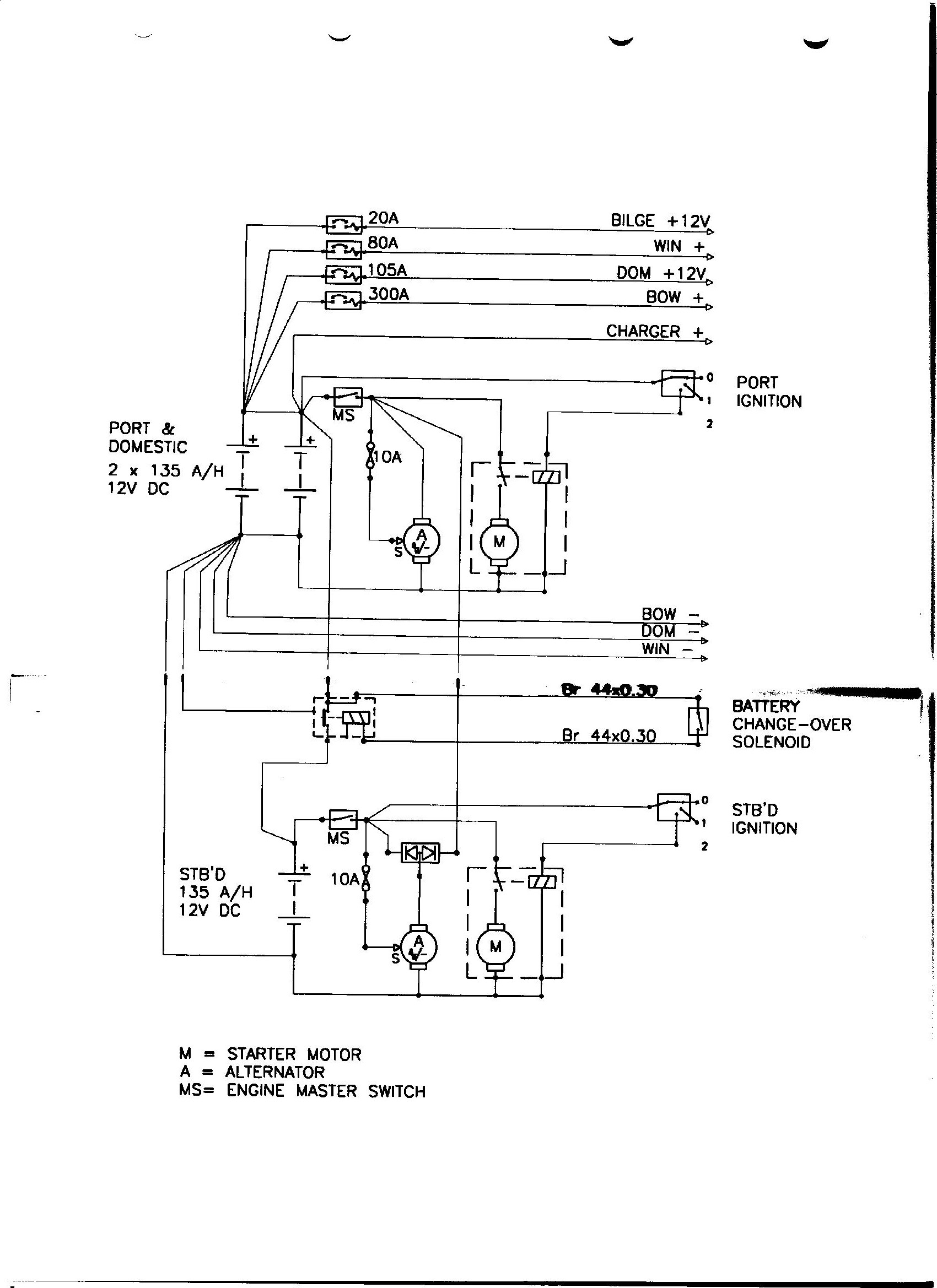
For clarification, (for the umpteenth time :)) the standard FL battery architecture is as follow:

1) Port side battery bank powers the domestics and port side engine starter
2) Starboard battery powers the starboard side engine starter only
3) Only the port side engine is charged from the 240v charger
4) Both alternators charge both battery banks via a split charge diode
5) There is an emergency changeover that allows either engine to be started from either battery

My suggested reasons for not charging the s/b bank from a 240v charger:

1) To prevent the risk of frying the s/b battery (surmountable with modern chargers)
2) To reduce the risk of a short circuit in the charger thus discharging the s/b battery (low risk)
3) To reduce the potential issue of using a single charger to charge banks with different capacities (probably not a risk these days)
4) Cost
5) Because it's unnecessary given the architecture.

Saying that I have managed to discharge my s/b battery when I left the engine master switches on in between visits. It didn't spoil my day as I was able to charge both engines from the port battery and a 30 minute cruise to the lagoon charged the s/b sufficiently to start the engine. I'm not sure why leaving battery master switches on would cause this but it's something that I'm now careful to avoid.

Here's a T43 diagram that illustrates the above:

Wiring%20Digram.jpg


I hope this helps!
 
Yup P, that's a classic configuration, whose logic I fully understand.
You aren't specifying this, but I can easily guess that you've got a 2 feed charger (or charger/inverter) that takes care of both battery banks.
That's essentially the same setup I always had on all my boats, bar the 12V battery as a backup of the droppers, which is a nice touch.
I suppose it has its own dedicated 12V charger? Or maybe a 2 feed 12V charger that keeps both that battery and the genset starting battery topped?

The only additional sophistication which I've got on the current boat is an automatic system with industrial relais, that when the engines are on connects both alternators in parallel to both banks.
Mind, I'm only mentioning this because it's a way to address what you don't like, but I can actually see potential arguments against this setup, which I've never seen on any boats other than DPs.
Though I must say that it has worked nicely for 14 years now - and counting, touch wood! :)

Yes, I have a Mastervolt 24/100-3. Main output is to the domestic bank, secondary is to the engine start bank. I also have a stand alone 12v charger which charges the two generator start batteries, separately.
 
4) Both alternators charge both battery banks via a split charge diode
Actually P, according to your drawing, it seems that the stbd alternator can charge both banks, but the port one is for port+domestic bank only.

Besides, my understanding so far (at least as far as the Sq58 goes, also based on what jfm said) was that she has 3 battery banks: 1 domestic (only)+2 starting.
For the setup in your drawing, any plain vanilla 2 outputs charger could handle both banks, with the main output dedicated to the joint port & domestic bank, and the trickle output to stbd bank... :confused:

Regardless, if that's as you say "the standard FL battery architecture", it's now crystal clear, so thanks for educating me.
And sorry if you already posted it and I missed it.
Or forgot it, which is actually rather likely, because frankly speaking it ain't a setup worth memorizing, imho.
In terms of logic behind it, I can't help thinking that it must come from some office for complication of otherwise simple affairs... :rolleyes: :p
 
Last edited:
Actually P, according to your drawing, it seems that the stbd alternator can charge both banks, but the port one is for port+domestic bank only.

Thanks, I stand corrected.

Besides, my understanding so far (at least as far as the Sq58 goes, also based on what jfm said) was that she has 3 battery banks: 1 domestic (only)+2 starting.

I'll let JFM/jrudge clarify what they meant (although I suspect the sq58 has the same set-up as the smaller boats).

For the setup in your drawing, any plain vanilla 2 outputs charger could handle both banks, with the main output dedicated to the joint port & domestic bank, and the trickle output to stbd bank... :confused:

I agree. If / when I replace the original charger I may connect it to the s/b bank too.

Regardless, if that's as you say "the standard FL battery architecture", it's now crystal clear, so thanks for educating me.
And sorry if you already posted it and I missed it.
Or forgot it, which is actually rather likely, because frankly speaking it ain't a setup worth memorizing, imho.
In terms of logic behind it, I can't help thinking that it must come from some office for complication of otherwise simple affairs... :rolleyes: :p

I suspect this design came from Sam Newington's days in charge.
 
Sorry to the OP for the slight Fred Drift.

Apart from the confusion introduced by petem's summary not quite agreeing with his cct diag (and also saying the mains charger charges the port engine, lol), I'm with Mapism; I never understood why the Fairline EEs designed it that way.

If I've missed the point someone please explain.

On my Prinny, there were two battery banks, one domestic and one start (started both engines), both engines charged both battery banks via 2 blocks of 2 diodes each. The 240v charger charged both battery banks plus the genny bat, all 3-state-controlled individually at different rates according to the temp sensor on each bat. No exploding or cooked bats and the engines started every time. There was a switch to parallel the domestic and start bats for an emergency start, but it was never used.
 
Last edited:
Pete, what you describe is just the smaller fairlines. Mapism, the old sq 58 only had one starter battery set not two so wouldn't use 3 charger feeds if available. Before the trickle feed charger came in the engine battery did self discharge in winter which is why I fitted a small charger in my 2004 sq 58.

The design gets more elaborate as space increases. I agree that separate engine starters are overkill but don't mind. My boat's OEM, not upgraded, spec is

3 sets of 24v batts- engines x2 and house
1 battery for 12v. Therefore 9 x50cm battery units. Half a tonne incidentally because 55kg each
2x 100a 230v-24v chargers, one with 3 feeds to trickle charge the engine batteries. The house batteries can absorb 180amp charge when flat.
One 230v-12v charger 25 amps
Each engine alternator charges all 3 x 24 v battery sets via mastervolt multiple splitter diode units. 2x150amp 24v alternators-awesome c. nominal 5hp each
Temp sensors on batteries talk to the 230v chargers and the alternators.
One engine alternator also feeds a mastervolt 28-14v charge dropper to charge the 12v batt.
Link switch to connect port starboard engine batts, in case flat.
Each genset has 24 v starting (importantly, from the house batteries) and 24 v alternator. I don't know where the alternators feed to but this thread has made me curious so I'll look

This is overkill and maybe why fairline went bust (:D) but I quite like it. So long as you can start one of the 4 Diesel engines you can bring the whole boat back to life.

Pete this is not Sam newington because it is much more hardware than he could get. It is Simon's work. He is nicely OCD :D

On my jobs list is a 12v batt on the flybridge to run the vhf, and small charger. To give more time before 12v and comms fail in a sinking scenario.
 
Last edited:
Nothing special. Don't want to digress too far from the OP's topic. The heavy duty bat temp sensors - thermistors/diodes, whatever - always got in the way when replacing the vented covers over the 2 main battery banks after checking them. Grrrr!

Two years ago the charger failed. I confidently dismantled it, to clean the PCB connections, look for burnt components, check voltages and if nec to reverse engineer it then rebuild. Found an extra PCB in there, looked custom made. Suspected it was for the genny, didn't check, but on reassembling, both main bat banks went through their usual 3 stage routine and continued to do so ever since, I was happy enough until the genny bat went flat a few months later. Boat gone now so can't confirm name but I think 3 phase. My white van diesel man said they weren't the best, but what did he know about electronics?
 
3 sets of 24v batts- engines x2 and house
1 battery for 12v. Therefore 9 x50cm battery units. Half a tonne incidentally because 55kg each
In other words, 2 pairs of batteries for engine start and the same for domestic? If so, what's the point?
I mean, it's not a matter of overkill, but just of making the most efficient use from that half a ton which you are carrying around.
Wouldn't it be better to use 3 pairs for domestic and 1 for the engines?
 
In other words, 2 pairs of batteries for engine start and the same for domestic? If so, what's the point?
I mean, it's not a matter of overkill, but just of making the most efficient use from that half a ton which you are carrying around.
Wouldn't it be better to use 3 pairs for domestic and 1 for the engines?
As I said, I agree. I have often thought of re-wiring into 6+2 instead of 4+2+2 but there are 4 units each side and therefore I would need to make up some longish fat cables and to be honest i have never found the time in 5 years of owning the boat. It's not an urgent issue to solve. I should have specced it in the build. But I agree your logic.
 
I suppose the logic is that the batteries only get used to start the engines and when moored are doing nothing so why charge then with the attendant risk that the charger cooks the batteries?


as others have said, battery's get slowly discharged, especially in winter when long time no use, moreover its is nearly impossible to have "zero" load on battery's in a big boat, there might be a minimal drain of a solonoid, indicator or alarm system..

I'm alway's impressed how many times people refer to "cooking" battery's on here,
imo the best way to avoid "cooking" a battery, is keeping them in top shape with a modern and "smart" charger

There is a change over switch to use the domestics to start the boat in need.

yes its good to have such a switch, but keep in mind that if you have drained the battery's so that you need to use that switch, you have done harm to the batt's,
each time a batt. is drained below 50% of the nominal charge, reduces the livetime noticebly !

On my jobs list is a 12v batt on the flybridge to run the vhf, and small charger. To give more time before 12v and comms fail in a sinking scenario.

that was standard fit on our C70s, indicator, breakers and cabling still on the main switch panel, unfortunately one of the previous owners bypassed the system and F/B battery
 
imo the best way to avoid "cooking" a battery, is keeping them in top shape with a modern and "smart" charger

I would always have agreed, but last year I had the Fire Brigade visit my house because a 'smart' charger fitted to the car in the garage (OEM supplied) went rogue cooked a battery, turning my house into a potential bomb. Needing 2 fire crews, all with breathing apparatus to clear the house, push the car out of the garage before touching the electrics etc., has made me a little wary of smart chargers! (I did think their reaction was a bit OTT, but they insisted they needed to do it!)
 
Thank you for all the views and interesting debate.

So ... The inverter charger is nice but many Euros, and quite a bit of work to re route the shore power, generator and then separate the inverter fed services from the non inverter. It also solves a problem I dont really have as the gen is usually on for (a) battery charging or (b) cooking / AC - both of which would still require the gen anyway! Plus this charger is connected to the engine batteries in any event! Have a house to build so not looking for winter projects at the moment ...

The repair of the Mass unit is £246.60 + vat ( £295) plus postage from me to them and I guess return post as well. The units new are £1000 ish which seems over kill - so in effect it is a write off.

Given comments re batteries draining over winter etc I will replace it.

Posible options are

https://www.ebay.co.uk/itm/Victron-...890854&hash=item3b08ef2719:g:HKgAAOSwHgRbrkqM

complete with bluetooth !

https://www.ebay.co.uk/itm/Mastervo...612739&hash=item4add987317:g:VR0AAOSwEppUNAG8

The modern direct replacement for £309

https://www.ebay.co.uk/itm/Mastervo...864807&hash=item35f408a2f6:g:cLkAAOSw5VFWJ6cV

Very small but epoxy sealed and fully water proof and will do the job.

Less charge amps ( all of them) but bear in mind this is simply to top off the engine batteries and can do it over weeks with no practical issues.

As always views welcome.
 
I would always have agreed, but...
Yup, that can and does happen.
Back in the early naughties, my boat model came standard with a Dolphin charger which back then was rather sophisticated (24V/100A, 3 stages, 1 main + 2 trickle outputs, temp sensor, remote control...), but the builder did experience a few battery explosions, urgh!

Replacing the unit PDQ has obviously been my first thought, but I was assured that the problem became evident very shortly after the installation, and all other units which didn't create any troubles in their early life are still working just fine nowadays - which so far has been true also for mine, fingers crossed.

Otoh, one should wonder how difficult it can be to include in a charger some "fail safe" feature that disconnects the unit as soon as there's any fault... :confused:
 
If you only need it for trickle charging your engine batteries then I would get a very small charger as for trickle charging you need a tiny output, even with flooded batteries. Given long enough on charge, a small one will also top up the charge. Ctek have a good reputation. They make a huge range and very inexpensively too. Another advantage of a small charger is if the charger output is very low then even if the charger protection failed and the battery simultaneously failed that there would be not be enough power going into the batteries for it to be hazardous. I have small Ctek chargers for this job.
 
Top