oldmanofthehills
Well-Known Member
Many thanks Laminar - must work out how to get PBO while in Lockdown. Ho hum!


Online?Many thanks Laminar - must work out how to get PBO while in Lockdown. Ho hum!
I thought of adding end plates to our new rudder. Not a problem on the bottom, but at the top I was afraid that the end plate would be in cross flow as the water tends to follow the up curve of the hull. In case of the LM the distance rudder - hull is greater and so perhaps less of a problem.Looking at the pictures I realise the rudder end plates could be substituted by larger plate along the strut below the rudder, which is much easier to fit and still constrains and improves flow along the rudder. Oh to get my hands on our boat again!
Tread DriftI thought of adding end plates to our new rudder. Not a problem on the bottom, but at the top I was afraid that the end plate would be in cross flow as the water tends to follow the up curve of the hull. In case of the LM the distance rudder - hull is greater and so perhaps less of a problem.
Comparing SA/D ratio; a LM 27 (12.12) is a thorough bred racer compared to a standard CW32 (8.68).

Yachting & Boats magazines PDF download onlineMany thanks Laminar - must work out how to get PBO while in Lockdown. Ho hum!
Sadly cannot do single issue only 1 years subscription. I dont always buy every month, only if I am interested in the articles, but also as I work on puter all day, I prefer paper copies for my reading


It has to do with the interference caused by the mast. The greater the mast dimametre, i.e. the larger the cross section, the lower the lift. C.A. Marchaj, Sailing Theory & Practice, Page 96 and Pierre Gutelle, The Design of sailing Yachts, page 138.
This effect becomes more pronounced at the top of the sail as the apex narrows and the relationship between sail cord and mast diametre worsens.
I have not noticed any particular problems of weather helm or insufficient rudder area for sailing on my LM27, nor can I recall any mention of such issues on the (UK) LM Owners forum.
I mentioned it on the LM Forum. Singularly useless, the opinion seemed to be that the LMs were in everyway perfect. As an engineer that seemed improbable and didnt help with my real world example. I thus had a horrid feeling that many LM27 owners were motoring and not bothering with sails, which is a shame as she sails quite well in moderate airs. (The seller of mine and both I had met in Bristol mostly motored, and I know no others locally to discuss things with)
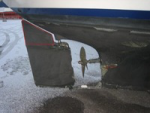
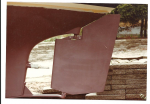
Just asked out of interest. People usually 'don't fix things that ain't broke'. I have seen at least three of these particular mods, in different countries, and I was rather impressed with this rudder technology. I also saw one LM, in Marstal I think, that had simply enlarged its existing rudder blade.I have not noticed any particular problems of weather helm or insufficient rudder area for sailing on my LM27, nor can I recall any mention of such issues on the (UK) LM Owners forum.
Sorry, I don't really want to get in the line of fire here. Done enough of that on the CW forae.I am sorry that I did not recall your post on the LM Forum, and that you felt the contributors all viewed LMs through rose tinted spectacles. In my experience they are not blind to the LM's faults, but forgive them as being minor weaknesses in an overall great package. I don't know how much sailing the average LM owner does, but I do know there are certainly keen sailors among them.
It does seem your experience of weather helm is unusual. I have just done an Google advanced search for threads on that forum which mention rudders, and of the handful it found only one was specifically about weather helm and that dated back to 2014. In that case the enquirer's lack of battens in his mainsail was suspected as the root of his problem, as others said they did not experience this issue and spoke of controlling the tiller with two fingers. Having looked again at a few videos of LM27s and LM24s under sail, they generally seem to be sailing with the tiller no more than about 10 degrees from the centreline and putting no particular strain on the helmsman's hand.
Other posts about rudders did mention 'Becker rudders'. I didn't know what they were when I had previously read them, but apparently they are the articulated rudders shown in Laminar Flow's pictures above. Someone also mentioned being aware of a couple of people in Denmark having extended their rudders upwards and slightly forwards, as shown in these pics:
View attachment 88313
View attachment 88314
p.s. I've just checked your account on the LM forum, and as far as I can see you've only ever made 5 posts on that forum, none of which mentioned weather helm!

The best thing you could do for those rudders, under sail, would be to fit a feathering prop, or a 2 blader locked in line with the keel.
The articulated rudder is interesting, it is similar to what was used in some self steering gears, turning the trim tab turns the rudder, the rudder turns the boat.
With such a shallow, low aspect rudder, what some people call excess weather helm, as in force needed on the tiller, is really more a case of an unbalanced rudder contributing some lateral resistance. Extending the blade forwards to give some balance seems like the right thing to do.
I agree on the feathering prop suggestion; it is a common observation on converted boats (Presbyterian?).The best thing you could do for those rudders, under sail, would be to fit a feathering prop, or a 2 blader locked in line with the keel.
The articulated rudder is interesting, it is similar to what was used in some self steering gears, turning the trim tab turns the rudder, the rudder turns the boat.
With such a shallow, low aspect rudder, what some people call excess weather helm, as in force needed on the tiller, is really more a case of an unbalanced rudder contributing some lateral resistance. Extending the blade forwards to give some balance seems like the right thing to do.
Too much foreward balance is easily and quickly achieved and not a good thing either. The pressure point is at 25% of cord and the axis should never be further forward than 15% - 17% of cord.Forward extension would work well to lighten the wheel load when sailing, not so hot for motoring though. Compromise, curse of the motorsailor...
One Dutch sail maker suggested that type of sail to us when we re-canvased and I would have liked to have tried; alas, I was simply not brave enough to have running back stays on a deck-stepped spar.The latest racing designs are moving the mast ever further aft. This has been enabled by the move to square top mains and split backstays, so a lot of main area can still be accommodated without the need to fit that area inside the backstay. So the main is still approx ⅓ as "wide" at the very top as it is at the foot.
The advantages of this are more sail area in large asymmetrics and the ability to use multiple headsails on a reach.
For example the new Dehler 30.
Dehler Yachts - Dehler 30 One Design
Or the latest IMOCA boats
HUGO BOSS
Compare that to a boat with similar design intentions to the Dehler from the 1990s, the J92
https://sailboatdata.com/sailboat/j92
Or a Volvo 60 from the early 2000s.
File:VO60 2002 Kiel illbruck.jpg - Wikimedia Commons
A little different from the motorsailers, but interesting I think.
A couple of degrees is about right on a good sailing boat. This is a different problem. Lift is directly proportional to area, and roughly proportional to angle of attack. So a rudder three times too small will need three times the angle. Interestingly, the drag curve is exponential, and at 10 degrees you may only see twice the drag for three times the lift!Sorry, I don't really want to get in the line of fire here. Done enough of that on the CW forae.
Just two points; closing the gap between rudder and hull significantly increases rudder efficiency as the hull acts as end plate.
10 degr. rudder angle is significant and is already slowing down the boat. 2-3 degr is beneficial in generating lift to weather.
The standard LM rudder is superior to that of the CW as it is profiled, which the CW is not. A profiled rudder generates significantly more lift.
On a profiled form that is correct. Still doesn't make her go quicker, which would be the preferable way of creating more lift.A couple of degrees is about right on a good sailing boat. This is a different problem. Lift is directly proportional to area, and roughly proportional to angle of attack. So a rudder three times too small will need three times the angle. Interestingly, the drag curve is exponential, and at 10 degrees you may only see twice the drag for three times the lift!
