mast position

Madhatter

Well-Known Member
Joined
23 Sep 2009
Messages
3,316
Location
Minehead / boat Porlock (I hope)
wp.me
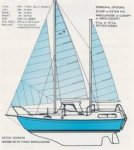
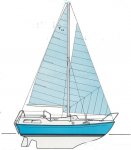
On my 24 floating caravan there seems to be 3 types of mast configurations ketch and 2 types of sloop or at least 2 different positions for the mast :-
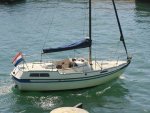
tamar-24-07733030121170705268486550544566g.JPG In front of the front combing
Tamar 24 ketch.jpg Ketch


tamar24 line d.jpg Inside the combing

Mine is the inside the combing are there any advantages to the different configurations please
 

Attachments

  • 471b0010.jpg
    471b0010.jpg
    43.5 KB · Views: 0
The mast on a sailing boat is placed in such a position that the centre of effort of the sail plan is
correctly located in relation to the centre of lateral resistance of the hull.

I assume that your boat is sloop rigged: if so, if you added a mizzen mast and sail you would have to
move your existing sail plan forward to rebalance the effect of the sails.

In the case of the Tamar 24, I don't know if they wanted to offer a wheel shelter so had a ketch rig, or
if they designed a ketch rig and then added the wheel shelter.

In terms of handling, the sloop rig is simpler and slightly more efficient. On your boat, having the mast at
the forward end of the cockpit is very convenient for dealing with the mainsail.

The ketch rig offers more combinations of sails eg sailing in stronger winds under part furled genoa and mizzen
gives a balanced rig with easily handed sails if the wind picks up or motoring with just the mizzen up as a
steadying sail. Also whilst at anchor, the mizzen would keep the boat head to wind.

Hope this helps,

Andy
 
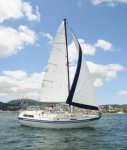
Thank you Andy, what I am trying to understand is the boat in the photographs seems to be the main mast of a ketch but with out the mizzen in place, the boat looks unbalanced in this photo mind you it is a bit of a beast :D
473a5010.jpg
 
It was argued during the 60s/70s that larger boats ( >50' ) could more easily be worked 'shorthanded' if the sail plan was split between two masts. The sail control gear around then was inefficient, compared with today's winches/jammers/deck organisers/roller bearing cars, and the penalty of extra weight and windage was, for some, worthwhile. Among ocean racing types, there was some rating advantage to be created.

On a smaller boat such as the Tamar 24, the benefits of a ketch/yawl rig are much outweighed by the penalties. Sail size remains manageable on a small sloop, and simpler, cheaper sail control gear makes for more efficient sailing. more of the time.

On many a boat, the mizzen sail contributes little drive, simply countering the imbalance of the forward rig. That's a heavy and expensive solution to a design problem.... both initially and in terms of replacement and maintenance.

However, some people like the look of a ketch, so the industry is willing to sell them what their hearts desire.....
 
Yes, I see what you mean. The ketch is shown with the genoa tacked to a bowsprit but in your photos the genoa is tacked to the stem.

I have no experience of the Tamar 24 but hazard a guess that the design might not be too sensitive to switching between the two
mast positions if sloop rigged without a bowsprit.

I suppose the only way to find out is to change the rig but I can't see any advantage other than being able to add a wheel shelter.

Andy
 
MadHatter,

your mast is definitely in the right place in the designers' eye if it's inside the coaming; if bothered by handling you could try mast rake, basically the more you rake the mast the more weather helm / less lee helm you'll get.
 
Top