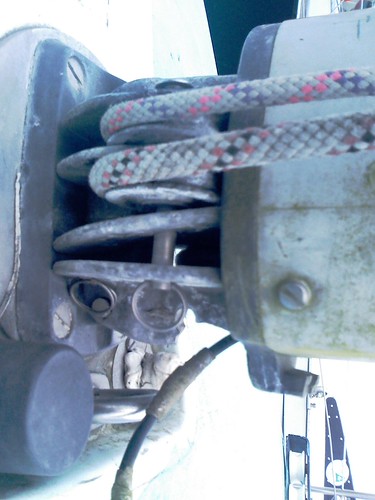
mast foot problem

joewalsh

New Member
Joined
2 Jul 2006
Messages
22
Location
Carrigaline, Co Cork, Ireland
Visit site
During this years ailing season, I noticed that the flanges at the end of the mast foot had started to crack and some of them had started to bend. Where they don't seem to be the main loadbearing part of the mast, I am concerned that whe the boat is well healed tehy may perform some sor of support role. I would like to fix the problem. I am not sure whether this can be repaired or whether a new unit is required. I have included a photo of the base.
Advise is very welcome.
 
Invisible photo... so is it an alloy casting that needs replacing? maybe they are only there to fix the fore-aft position of the mast foot, therefore could be doubled by a plate or some other means.
 
If bending and cracking has occured the part must be under some strain it wasnt intended for.

Have another go at posting the picture.
 
Re: mast foot problem picture included

2080702958_304393e7e2_m.jpg


I have enlarged and rotated the original pic.

I don't think the bent bits are structural. The absence of a sheave in the right slot has allowed the centre sheave to push the divider over. Is this because the halyard goes on to the winch at an angle? If so then the halyard would be better located in the right slot and an empty sheave put in the centre. If it distorting then perhaps the sheave bearing is knackered and needs replacing anyway. I found that mine were flattened off underneath so they didn't turn but the rope just skidded on the sheave.
 
Re: mast foot problem picture included

this is bigger, I hope, but don't undersatnd the question

2080702958_304393e7e2.jpg
 
I think you need to establish exactly what is happening. I cannot tell whether the angled plate is intended to be fixed or not. If you remove the sheave axle can you remove any of the plates to give you a better view of the interior? If the central plate(s) are obviously free it may be as others suggest that they are merely separators for the sheaves.

Whatever is wrong, I don't think you can carry out a safe repair. This is an aluminium casting and I doubt if a weld repair can be made. It looks as though the mast foot is easily removable by extracting the self-tappers but the problem may be finding a replacement, as many of these older designs and mast sections are now obsolete.
 
Not welding, but brazing. Successfully brazed a cracked Canondale aluminum mountain bike frame. You will need a hot flame, ie a MAPP gas torch. Rods can be found at www.brazetech.co.uk (now something else I think). It really works, I brazed a butt joint & hammered it through 90 degrees, the joint held. Need to practice first, one difficulty is that when the material melts, it runs, but it can be filed off later. A crack needs to be filed open to receive the brazing material.
 
BOC will supply a kit which allows you to effectively solder the joint. it all takes place at a lower temperature than the melting point of the ally.

You have to position the parts so that the pool of molten ally (from filler rod) will lie over the joint then the stainless steel scraper (supplied) is pushed into the pool and the base material is scratched, this is to exclude the air to stop the oxidation. The pool of ally will then fuse to the base material. I used this on the inlet manifold of an old Merc 250 that I had a few years ago.

This was after several professional welding companies had tried and failed, and told me that the only alternative was to assist with Mercedes cash flow problems.

Incidentally it was advised that the best way to ensure that both the base material and the filler rod were at the same temp was to raise the Work piece to the working temp then touch the filler rod on it.

I did this by putting the manifold in the kitchen oven. Best done when she who must be obeyed is off on a away day.
 
Re: mast foot problem picture included

It looks as if the dividing piece between the halyaed sheaves is bent due to the absent sheave.If everything works Ok I wouldnt worry about it but it does look as if the halyard could come out of the sheave and get jammed at the side.
 
Just looked at the aluminium repair website and can only say that I am very surprised by the claims made. Still, for over £10 per rod you should perhaps expect something good! A word of warning however, aluminium has a low melting point and high thermal conductivity. It is quite easy for an inexperienced welding operator to finish with a pool of molten metal and a big hole in the item being repaired.
 
So was I, but it was that or scrap the bike. (I recall paying £17 a year ago all up for a small kit that included a stainless steel brush and 5? rods...) The claims seem justified, I also cut a 15mm x 15m angle almost through, brazed up the filed out cut & proceeded to batter it with a lump hammer. The joint survived. As you note, the conductivity is high, the whole frame got hot. I could not tell from the colour of the metal when it was hot enough, but it worked. The MAPP gas torch is not as hot as oxyacetylene, but much hotter than other torches and is needed to get the al hot enough (because of the conductivity)
 
I find it difficult to imagine from the pics how the mast is removed from the boat. Is the whole base removed from the cabin top or is the aluminium mast removed from the base structure. This latter ust be a real problem if it is corroded.

I have shifted my halyard exit to slots in the side of the mast about 1 metre above the deck. This eliminates one turning pulley in the mast base and seems to give less friction.

The base you have will have enormous down crushing force which needs to be resisted but not much side forces. Only a total faiure of the base could allow the bottom of the mast to skip sideways. Unlikely I would think.

I think this would be a good time to build or buy a hinged base so the mast can be lowered by yourself for maintenance or bridges. If the new base doesn't have sheaves then go to the exit slots method.
good luck olewill
 
A bike frame is not a casting. Welding castings is by no means straightforward. In the majority of cases there will be internal porosity which makes welding extremely difficult, as soon as one void is filled another burns open.

As for brazing and soldering, would you want these techniques to be used on a mast step? Apart from the obvious strength considerations, there will also be galvanic corrosion issues.
 
Looking at this it may just be that the fins are either breaking off or bending, I would suspect breaking more likely. Clearly there appears to be contact with base plate and my guess would be that wear of the casting at the mast foot and the base plate has meant that these fins are now coming under load. Whether those base sheaves are feeding the lines straight out or whether they are pulling back at an angle and hence putting some side load on the sheave may also be causing the distortion or breaking of that spacer fin.
Judging by the rest of the casting in this area it looks like it is going beyond its shelf life anyway, I think you realistically need to either think about a new mast base casting and deck step (which will be hard to replace unless the spar section is still avalable) or just go for a new arrangement at the base.
Is their an owners assoc for your boat? Who made the original spars?
If no information make an accurate pattern of the mast and see if you can still source that section. If you can still get the section then a bit of detective work should lead you to a supplier of those castings.

If not am afraid it looks like time to replace it and/or come up with a new arrangement.
 
Re: mast foot problem Oysetr 26

Having stepped the mast, I detached the mast heel and realized that the damage was worse then I had expected. I now need to search for a replacement mast heel, a repair does not seem feasible

My boat is an Oyster 26, manafactured in 1980 with a fractional rig.

any advise on where to source such a part?
 
Re: mast foot problem Oysetr 26

Who is the mast manufacturer? That must be your first port of call.
Any proficient rigger should be able to advise.
The welding issue could have been settled definitively by Cliff, if he was still on here.
 
Top