Mast base sealant?

mogmog2

Well-Known Member
Joined
12 Feb 2011
Messages
494
Location
Sussex
Visit site
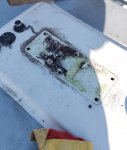
Recently removed the mast base from my Centaur to deal with the compression/rot under. There's no sign of any mastic on the coachroof*, but I noticed a sheet of something rubbery stuck to the mast base. Any idea as to what material it might be, or what would be a good modern alternative? Thanks
*black is just dirt, green is somehow algae (photosynthesing under the mast base? ?)
 

Attachments

  • IMG_20220306_145534 (2) (2).jpg
    IMG_20220306_145534 (2) (2).jpg
    111.1 KB · Views: 27
I was told to put something between the mast and base to stop the different metals eating each other... I used a bit of an old IKEA plastic chopping board cut to size... works well!
 
We’ve got to do the exact same job in next week or so and was wondering about sealant. Like others, we’re big fans of butyl tape for deck fittings, but my guess is that it is less well suited to the high loads/pressures of a mast foot? (Our mast is 15m!).

So it sounds like Sika (or equivalent), finger tight for an hour to start curing, then torque down?
 
A layer of Sikaflex sealant (or similar) will form a black rubber gasket if it’s not all squeezed out before it cures. Perhaps that’s what you found? Easy process to repeat…
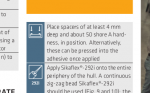
I wondered if the pressures were too high for sealant, even the mighty Sikaflex., even if you let it cure before tightening? I know that for 292i you're supposed to use spacers (pic).
I'd expect sealant like Sikaflex to stick to both parts when they were separated? (unless they prepped the gelcoat with a release agent to make a gasket effect? Unlikely I think though). The base is on the boat so can't check, but it's very neat , not like squuezed-out sealant, although it could have been trimmed. I'll have a good look later today.

I was told to put something between the mast and base to stop the different metals eating each other... I used a bit of an old IKEA plastic chopping board cut to size... works well!
Thanks, but this is between the alloy base & the gelcoat. I was thinking of using Duralac on the stainless screws countersinks, but I'm not sure how well that seals? There was some pale gunk on them, not as yellow as duralac, but might have been.

We’ve got to do the exact same job in next week or so and was wondering about sealant. Like others, we’re big fans of butyl tape for deck fittings, but my guess is that it is less well suited to the high loads/pressures of a mast foot? (Our mast is 15m!).

So it sounds like Sika (or equivalent), finger tight for an hour to start curing, then torque down?
Probably, the way ahead, I just wanted to see if the obvious route was the right one! Agree, butyl (favoured) would be squeezed out I suspect.

Thanks chaps
I wondered whether sealing the base area was fruitless due to pressure and flex etc and it's the bolt holes to which attention should be directed? Not sure what scope there is for that though with Duralac on the countersinks. Maybe a sausage of butyl round the screw shaft where it penetrates the substrate? I know to hold the screw stationary and tighten the nut, so any seal doesn't get destroyed.
 

Attachments

  • SikaSpacers.png
    SikaSpacers.png
    23.5 KB · Views: 3
Maybe a sausage of butyl round the screw shaft where it penetrates the substrate?
That is an idea… countersink around any fastener holes and just seal those with Butyl - accepting the rest of the mating surfaces will be under too much pressure.

I’d personally be wary of spacers. The gelcoat under ours was slightly deformed (the core is fine), suggesting the pressures involved. I’d worry spacers would either introduce movement or be pushed down into the GRP.

Maybe butyl around fasteners and a smear of Sika around the base itself ‘just because…’?
 
That is an idea… countersink around any fastener holes and just seal those with Butyl - accepting the rest of the mating surfaces will be under too much pressure.

I’d personally be wary of spacers. The gelcoat under ours was slightly deformed (the core is fine), suggesting the pressures involved. I’d worry spacers would either introduce movement or be pushed down into the GRP.

Maybe butyl around fasteners and a smear of Sika around the base itself ‘just because…’?
My fasteners are countersunk already.
Spacers need to be the same Shore hardness as the cured sealant. AFAICT, an excellent material for spacers would be the sealant itself. When I was rebedding my keels I considered this. Have two prepared boards (polythene or suitable release agent) and a couple of things the correct thickness (eg a 2 or 3 resin stirrers) then dispense sealant onto board 1 and put board 2 on top and leave to cure then cut to size with a razor. Not sure it's worth it for the mast base though.
The base fasteners aren't torqued crazily I'd imagine, so a bit of butyl around them shouldn't be squeezed out. I'll find out soon enough. Well, after I've rebuilt the coachroof, having replaced the structural plywood therein.
 
Revisiting this having almost finished the structural repairs. FWIW, the black I could see is actually the surface of the (underside) of the mast base smooth like anodising almost. There were however, some remains of a whitish sealant present, which peeled away fairly easily. I don't see what Sikaflex 291i offers over Puraflex 40 or Sabatack 720 or...or... but happy to use the best sealant for the job. Howevere, I'm currently feeling that I'll buy whatever I like the look of, as I've found nothing online specific to masts & highly compressed joints.
 
I put a layer of damp proof course under my mast base. I also inserted an additional stainless steel section to provide extra fastenings for deck hardware & to tighten up the rigging which had stretched too far to re tension enough. So I placed a layer of DPM between the aluminium base & the SS base as well.
 
Top