Marine GPS receiver V other?

Pkewish

Well-Known Member
Joined
14 Mar 2012
Messages
78
Location
Dorset
Visit site
SO, I get myself a lovely Raymarine GSP plotter on ebay. Lovely bit of kit for £75. It didn't come with any cables which shouldn't be too much of a problem. However, after some serious googling, I can't find any difference between the white marine GPS receivers and the ones you can use in cars (for example). They all seem to have the same number and coloured wires, they are the the same shape, they are both waterproof, they just come in black not white. does anyone know if there is a difference between other than the price?

http://www.ebay.co.uk/itm/Original-...Technology&hash=item3cc8feaed5#ht_2513wt_1163

http://www.ebay.co.uk/itm/Marine-GP...Technology&hash=item19c1f27eaf#ht_3976wt_1163
 
SO, I get myself a lovely Raymarine GSP plotter on ebay. Lovely bit of kit for £75. It didn't come with any cables which shouldn't be too much of a problem. However, after some serious googling, I can't find any difference between the white marine GPS receivers and the ones you can use in cars (for example). They all seem to have the same number and coloured wires, they are the the same shape, they are both waterproof, they just come in black not white. does anyone know if there is a difference between other than the price?

http://www.ebay.co.uk/itm/Original-...Technology&hash=item3cc8feaed5#ht_2513wt_1163

http://www.ebay.co.uk/itm/Marine-GP...Technology&hash=item19c1f27eaf#ht_3976wt_1163
The first is an antenna, the second is a GPS receiver. The first is of no use to you.
 
OK, I wasn't aware there was a difference between an antenna and a receiver, that would explain the price difference. by the way, the tatty old one on ebay was just an example and I would never have bought it.

Thanks for your help, it looks like I'll have to get the expensive one after all.
 
The marine one is described as using NMEA 0183. There is no reference to NMEA in the description of the GPS 16 which is understandable as NMEA is a marine standard, not normally used in car navigation systems.
 
The marine one is described as using NMEA 0183. There is no reference to NMEA in the description of the GPS 16 which is understandable as NMEA is a marine standard, not normally used in car navigation systems.

The Garmin GPS 16 was sold for the marine market and supports NMEA 0183. See the Technical Specs. The GPS 16 was replaced by the GPS 17, but that has now also been discontinued.
 
The marine one is described as using NMEA 0183. There is no reference to NMEA in the description of the GPS 16 which is understandable as NMEA is a marine standard, not normally used in car navigation systems.

If you have a gps receiver that connects serially, it will use NMEA regardless of the target market.

I have a Haicom 204s hardwired into my DSC radio...and it works just fine.
 
beware 'Pinning'

NMEA is used as the interface in virtually all GPS dongles, even those connecting via Bluetooth or USB, so a 'car' GPS dongle will work fine. I use one as the GPS feed for my PC chart program.

The GPS chip set will be the same in dongles, phones, in marine sets and in Tom-Toms, one of probably only a couple of makes (mostly Sirf/CSR or Broadcom). Indeed the chip-set in a phone or car is probably much more modern and high performance than that in a marine GPS set due to the rate people 'churn' phones compared to marine GPS sets.

HOWEVER, there is a problem using a GPS designed for a car. To stop a sequence of contradictory 'turn-around where possible', 'junction ahead' and other messages happening while the car is stopped at the lights, GPS sets for cars have a feature called 'Pinning' enabled.

Pinning is a mathematical constraint placed on the Kalman navigation filter. This filter's job is to convert from the (pseudo) ranges from each satellite to a position on (a model of) the earth's surface. The constraint imposed when pinning is enabled is to force velocity to be zero, and therefore the position not to change, when velocity is less than some value,which is usually around 5kph or 2.4kts.

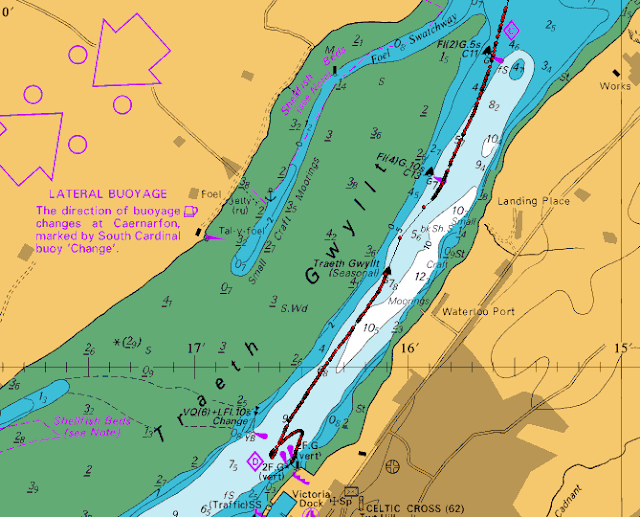
This is no problem to us when sailing along normally, but when creeping into an anchorage for instance it can be a nuisance. A plot showing the effect in action is shown here:
menai.PNG


The dark red dots are positions from a car GPS. The black lines are interpolations between them drawn by the cart plotter. I motored NE to Traeth Gwylit buoy and then turned off the engine despite light wind and contrary tide (we were doing the 3-peaks race, and this was the point at which engines had to be turned off after leaving Caernarfon). At this point we slowed right down to about 2 knots and you can see the fixes are not continuous - the position fixes remains frozen for 100m or so until jumping to the next position - until nearing C13 when the tide slackened and SoG increased.
 
Top