marine battery chargers are they worth the difference in price

currently i have a 100amp domestic , 80amp starting and i am adding a further 80 amp for domestic , the starter and domestic seem to charge fine on the m45 which is why i thought i would just charge the new one separately . is it a bad idea to use two chargers ?

I wouldn't bother adding the existing small charger to the engine bank just remove it. Does your car battery need help if left for a while? Why should a small yacht diesel be any different.

keep it simple, one decent sized charger straight to the house bank.
 
I've been on here for a lot longer than the join date above would indicate, pretty much since the beginning in fact, and back then it was much more about boaters helping each other. The OPs ignorance would have been met with helpful advice and a bit of useful education. Now it seems as if the place is rammed with self righteous know-it-alls who would rather belittle than help. Mixing up A and AH is quite common, almost normal, for non technical people when talking about battery sizes. It may be technically incorrect, but we all know what was meant and no boat is going to catch fire just because the wrong terminology is used in this instance.

What would be wrong with answering the question with some useful advice, if you really do know what you are talking about, and perhaps adding a bit of info about the correct way to talk about battery sizes?

The problem is sort out the lazy people from the completely clueless who need to be told to leave well alone lest they do real damage.
If you expect people to give quality advice that they are going to put some effort into and take care that it's safe and helpful, people need to put a bit of effort into asking the question to show as much understanding as they have.
 
There is some merit in avoid a house 'bank' of two different sized batteries, one of which is older than the other. For all we know they could be different brand and chemistry. So charging them separately might be a good idea. Especially long term float charging while unattended.
So I think some of the advice given in this thread is potentially poor.
Ctek chargers are good, but expensive per amp. May not be an issue if you don't need fast charging. I think Ctek chargers are a cut above the average for long term maintenance of batteries not used every day.
As ever , it all depends on how the boat is used and what the owner wants to achieve.
 
There is some merit in avoid a house 'bank' of two different sized batteries, one of which is older than the other. For all we know they could be different brand and chemistry.

What would those "merits" be ?


So I think some of the advice given in this thread is potentially poor.

At least the rest of us posted some advice, rather than insults.

Ctek chargers are good, but expensive per amp. May not be an issue if you don't need fast charging. I think Ctek chargers are a cut above the average for long term maintenance of batteries not used every day.

Nothing wrong with Ctek chargers, but they are nothing special for the money they cost. Sterling chargers will go into standby if there is nothing happening, Victron chargers go into maintenance mode, other quality chargers have similar features.
 
Different brand might be slightly different chemistry, antimony or calcium in the lead.
So charge and discharge won't be even, possibly resulting in short life for both.
Even if the batery is the same type, respected manufacturers like Trojan strongly advise not replacing one battery in a bank.

I'm not aware of any battery manufacturer advocating mixing capacities in a bank, or OKing mixing ages beyond a few months of storage or float. Let alone mixing brands, but of course one might expect battco to recommend having your whole bank made from their product.
Perhaps you can show us a respected battery manufacturer who says none of this is a potential problem?

For these reasons, large battery installations such as UPSs designed by actual professionals are often split into sub-banks charged separately, so that optimum life is extracted from each battery. It has other benefits of course, such as avoiding all the batteries needing replacement at the same time and less variation in useful capacity.
 
Different brand might be slightly different chemistry, antimony or calcium in the lead.

That could be the case with all batteries being the same brand.

So charge and discharge won't be even, possibly resulting in short life for both.
Even if the batery is the same type, respected manufacturers like Trojan strongly advise not replacing one battery in a bank.

I'm not aware of any battery manufacturer advocating mixing capacities in a bank, or OKing mixing ages beyond a few months of storage or float. Let alone mixing brands, but of course one might expect battco to recommend having your whole bank made from their product.
Perhaps you can show us a respected battery manufacturer who says none of this is a potential problem?

Perhaps you could show us a few boats where none of this happens ?

How about a bank of four T105s for domestics and a small lead acid battery for engine starting. What happens when the engine is started and the VSR closes ? All one big bank, being charged by the alternator.

There will be many combinations of battery banks on a boat, they will pretty much always get charged by the same charging source, even if the don't get paralleled by a VSR. I recently rewired the engine room of a large motor sailor, 2 banks of lead acid engine batteries, two banks of spiral wound AGMs and a very large bank of deep cycle batteries. They all have to be charged by the same alternators.

In a perfect World, the engine battery should be charged separately. That could be achieved by fitting some expensive charging electronics to the engine charging and shore power charging systems. We don't sail in a perfect World and the vast majority of us use the same systems for charging whatever batteries we have. If the engine battery last six months less than it would have done in a perfect World, do we give a toss ?

For these reasons, large battery installations such as UPSs designed by actual professionals are often split into sub-banks charged separately, so that optimum life is extracted from each battery. It has other benefits of course, such as avoiding all the batteries needing replacement at the same time and less variation in useful capacity.

Not seen anyone sailing a UPS recently. But, as an actual professional, i've seen a few boat battery installations :encouragement:
 
Different brand might be slightly different chemistry, antimony or calcium in the lead.
So charge and discharge won't be even, possibly resulting in short life for both.
Even if the batery is the same type, respected manufacturers like Trojan strongly advise not replacing one battery in a bank.

I'm not aware of any battery manufacturer advocating mixing capacities in a bank, or OKing mixing ages beyond a few months of storage or float. Let alone mixing brands, but of course one might expect battco to recommend having your whole bank made from their product.
Perhaps you can show us a respected battery manufacturer who says none of this is a potential problem?

For these reasons, large battery installations such as UPSs designed by actual professionals are often split into sub-banks charged separately, so that optimum life is extracted from each battery. It has other benefits of course, such as avoiding all the batteries needing replacement at the same time and less variation in useful capacity.

I have to agree with lw395, if you have two house batteries (Old 100AH and new 80AH) connected in parallel to provide 12 volts then you have an imbalance, as they are also different AmpHour ratings then one will be discharged quicker than the other and the chargers will be confused when trying to re-charge.

I suggest the OP has a look round this web site ..

https://batteryuniversity.com/learn/article/serial_and_parallel_battery_configurations

Mixing new and old batteries is a recipe for destroying one or both batteries in a relatively short space of time. The only way I can think of adding an 80AH to an existing 100AH domestic is if they are completely seperate from each other and run different loads - each battery also with it's own charger - any attempt to parallel up and 80AH and a 100AH would result in the new 80AH discharging more deeply than the 100AH (assuming they are both in good condition).

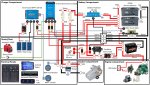
I really would recommend the OP does some research on creating a starter/house battery setup. I did a lot of research into my batteries when I added solar last year, PM if you want any detailed info. System looks like this ...

SolarAfter.JPG
 
I have to agree with lw395, if you have two house batteries (Old 100AH and new 80AH) connected in parallel to provide 12 volts then you have an imbalance, as they are also different AmpHour ratings then one will be discharged quicker than the other and the chargers will be confused when trying to re-charge.

So you wouldn't recommend connecting two 185ah and one 75ah battery in parallel ?
 
So you wouldn't recommend connecting two 185ah and one 75ah battery in parallel ?

No I wouldn't, not if they are driving loads ... the 75Ah is completely isolated from the 185Ah batteries and only has the starter motor as a load. The 185Ah batteries run all other loads. The Cyrix battery combiner is only closed when charging, and only when one side is fully charged - the SW monitors the voltage on each side and decides when to close, the other positive going from the 75Ah to the Shunt is a sense lead for the battery monitor for the starter battery voltage.

The starter battery is charged primarily by the alternator until it is fully charged. When fully charged, the Cyrix battery combiner will close and allow the alternator to charge the house batteries - as they are all the same chemistry this is fine as the charge voltages are all the same - technically they are in parallel, but only under certain conditions, and only when charging. The starter battery will be fully charged when the combiner closes, and it will draw little current - this method is recommended by Victron who supplied most of the components, it also works in reverse and charges the starter battery from the solar when the house batteries are full. The battery combiner replaces the old diode based isolator (and removes the voltage drop). The other advantage of the combiner is that there is a start-assist function which will combine starter and house batteries for 30secs on a button press should the starter battery be dead for some reason - then the engine can be started by the house batteries.

https://www.victronenergy.com/upload/documents/Datasheet-Cyrix-ct-120A-230A-EN.pdf

The alternator isn't the best charging method and I would have preferred to put a smart-charge system between the alternator and the batteries but cost was an issue so it looks like it does.

Both 185Ah batteries are the same age and capacity, lead lengths when paralleling the batteries are identical to ensure exactly the same voltage at the battery terminals, and they are connected correctly. This is just as important under load as when charging.

https://www.impactbattery.com/blog/tutorials/how-to-charge-marine-and-rv-batteries-in-parallel/

The Victron 30A charger has 3 independent charging circuits, I use 2 ... one for the starter and one for the house bank so they are charged seperately. I was worried about the combiner kicking in and confusing the charger but according to Victron this isn't an issue and so far, one year in, I have no problems at all.

Victron charger can be seen here charging 3 seperate batteries at the same time .... https://www.youtube.com/watch?v=nnvkyBSBT6E
 
Last edited:
So you wouldn't recommend connecting two 185ah and one 75ah battery in parallel ?

Depends what you mean by that.
In parallel 24/7? With various loads and whatever charging? In general, no.

In parallel for some loads, then charged separately? likely no problem.

In parallel for bulk charging, then floated separately? might not be optimum but probably no damage
 
That could be the case with all batteries being the same brand.


Perhaps you could show us a few boats where none of this happens ?

How about a bank of four T105s for domestics and a small lead acid battery for engine starting. What happens when the engine is started and the VSR closes ? All one big bank, being charged by the alternator.

There will be many combinations of battery banks on a boat, they will pretty much always get charged by the same charging source, even if the don't get paralleled by a VSR. I recently rewired the engine room of a large motor sailor, 2 banks of lead acid engine batteries, two banks of spiral wound AGMs and a very large bank of deep cycle batteries. They all have to be charged by the same alternators.

In a perfect World, the engine battery should be charged separately. That could be achieved by fitting some expensive charging electronics to the engine charging and shore power charging systems. We don't sail in a perfect World and the vast majority of us use the same systems for charging whatever batteries we have. If the engine battery last six months less than it would have done in a perfect World, do we give a toss ?


Not seen anyone sailing a UPS recently. But, as an actual professional, i've seen a few boat battery installations :encouragement:

I think in the world of electrical engineering, you're a tradesman rather than professional unless you're chartered or equivalent, which isn't the impression you give.
 
No I wouldn't, not if they are driving loads ... the 75Ah is completely isolated from the 185Ah batteries and only has the starter motor as a load. The 185Ah batteries run all other loads. The Cyrix battery combiner is only closed when charging, and only when one side is fully charged - the SW monitors the voltage on each side and decides when to close, the other positive going from the 75Ah to the Shunt is a sense lead for the battery monitor for the starter battery voltage.

The starter battery is charged primarily by the alternator until it is fully charged. When fully charged, the Cyrix battery combiner will close and allow the alternator to charge the house batteries - as they are all the same chemistry this is fine as the charge voltages are all the same - technically they are in parallel, but only under certain conditions, and only when charging. The starter battery will be fully charged when the combiner closes, and it will draw little current - this method is recommended by Victron who supplied most of the components, it also works in reverse and charges the starter battery from the solar when the house batteries are full. The battery combiner replaces the old diode based isolator (and removes the voltage drop). The other advantage of the combiner is that there is a start-assist function which will combine starter and house batteries for 30secs on a button press should the starter battery be dead for some reason - then the engine can be started by the house batteries.

https://www.victronenergy.com/upload/documents/Datasheet-Cyrix-ct-120A-230A-EN.pdf

The alternator isn't the best charging method and I would have preferred to put a smart-charge system between the alternator and the batteries but cost was an issue so it looks like it does.

Both 185Ah batteries are the same age and capacity, lead lengths when paralleling the batteries are identical to ensure exactly the same voltage at the battery terminals, and they are connected correctly. This is just as important under load as when charging.

https://www.impactbattery.com/blog/tutorials/how-to-charge-marine-and-rv-batteries-in-parallel/

The Victron 30A charger has 3 independent charging circuits, I use 2 ... one for the starter and one for the house bank so they are charged seperately. I was worried about the combiner kicking in and confusing the charger but according to Victron this isn't an issue and so far, one year in, I have no problems at all.

Victron charger can be seen here charging 3 seperate batteries at the same time .... https://www.youtube.com/watch?v=nnvkyBSBT6E

You have an incredibly poor understanding of how your own system works. It's late and i din't have time to correct everything you've posted, perhaps later in the week, if work permits.
 
The problem is sort out the lazy people from the completely clueless who need to be told to leave well alone lest they do real damage.

Oh dear, you're not making things any better.
Have you considered that there might be people who ask questions here who are neither lazy nor completely clueless?
 
I have to agree with lw395, if you have two house batteries (Old 100AH and new 80AH) connected in parallel to provide 12 volts then you have an imbalance, as they are also different AmpHour ratings then one will be discharged quicker than the other and the chargers will be confused when trying to re-charge.

Interesting comment, battery voltage is related to charge level, not capacity, to discharge one quicker will mean a lower voltage and different terminal voltages, but terminals are linked ?. On recharge the larger battery will take more amps, voltage will be the same and charger will see only one battery.

Charging via alternator and VSR is another story.

Brian
 
Oh dear, you're not making things any better.
Have you considered that there might be people who ask questions here who are neither lazy nor completely clueless?

Yes, they're the people who appreciate the difference between an amp and and amp-hour and make the effort to communicate that.
 
Interesting comment, battery voltage is related to charge level, not capacity, to discharge one quicker will mean a lower voltage and different terminal voltages, but terminals are linked ?. On recharge the larger battery will take more amps, voltage will be the same and charger will see only one battery.

....

Brian

Sorry that seems basically incoherent as well as wrong.
When any current is flowing, either charge or discharge, voltage will be a function of capacity as well as state of charge, since the characteristic curves of a lead -acid battery are pretty much a function of current/capacity. That's why you see graphs labelled c/10, c/20 etc etc.
 
Top