manual or electric bilge pump

My only experience of bailing any quantity was when helping someone empty a dinghy of about twelve feet. The owner was tired, and having used a sail to plug the centreboard box, I used a bucket. Although I only had to move the water over the dinghy gunwale, it took ages and I was exhausted at the end, even though I was in my 40s at the time. I later worked out that I had moved something like a ton of water.
 
Electric pumps only work at one speed, whereas Manual ones work faster the more scared you get.

...and then slower again as you get tired.

I don't see why the need to debate the relative merits anyway. A well-found boat would always have both.

(And I agree entirely with the point that a bilge pump is not for keeping up with a hole in the boat, it's for getting rid of the water once you've plugged the hole. Otherwise it's not a bilge pump you want but a "crash pump" or a "salvage pump", for example something with a 4 inch intake and a 10hp engine.)

Pete
 
My bro and his wife spent 19 hours pumping and bailing, about 12 miles off L'Abervrach. I bet he wished he had several electric pumps. And a better hand pump. "Oh you can't beat the old Whale gusher"....very old that is, the up and down variety.

Cracked frames in way of the mast partners, both sides, OK til he got in some weather.
 
(in emergencies) ...it's not a bilge pump you want but a "crash pump" or a "salvage pump", for example something with a 4 inch intake and a 10hp engine.

Is there any reason why this item isn't typically carried by offshore yachts? I doubt this Honda is any bigger, heavier (or costly) than many owners' coffee machines...

honda-pump-wb30xt3-600x600.jpg


...read the details, they're impressive...300 gals per minute! This site shows a US price, but I've found them under £370 new, here. http://powerequipment.honda.com/pumps/models/wb30
 
Is there any reason why this item isn't typically carried by offshore yachts? I doubt this Honda is any bigger, heavier (or costly) than many owners' coffee machines...

honda-pump-wb30xt3-600x600.jpg


...read the details, they're impressive...300 gals per minute! This site shows a US price, but I've found them under £370 new, here. http://powerequipment.honda.com/pumps/models/wb30

Could use that for propulsion, given a suitable nozzle.
 
1) The engine cooling inlet takes very little water.

My experience is different.
My engine (40 hp Yanmar) inlet has a T-valve plumbed in, one arm going to the seacock, the other arm to the bottom of the bilge with a strainer, exactly the same diameter pipe and strainer as the manual and electric bilge pumps. I use the emergency water inlet every winter when the boat is put ashore to flush the system. I put the emergency inlet in a bucket of water with a hose running and the engine in low rpm shifts more water than the hose can keep up with.
To me it is not a matter of either/or, I will always have all three: manual, electric and engine. And I hope I'll never have to use them in anger.
 
Is there any reason why this item isn't typically carried by offshore yachts?

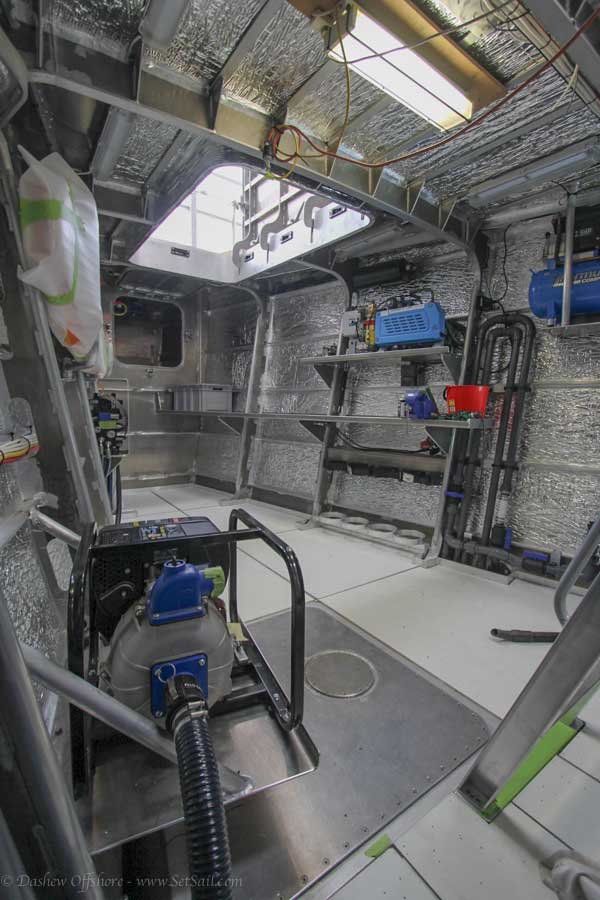
Space, presumably. But they're certainly not unknown among serious cruising boats - here's one in the capacious forepeak of Steve Dashew's latest design, still under construction:

FPB-78-2-Beam-3Forepeak.jpg


And at the other end of the fancy / scruffy scale, I know from this excellent book that the Mollymawks carry one too:

HNB-front-small-268x350.jpg


...and have used it to help salvage a neighbouring boat: http://www.yachtmollymawk.com/2011/02/the-fall-and-rise-of-duck/

Pete
 
500gph isn't very much - it's four standard two gallon buckets per minute. I wash down my decks at about that rate, and I have to dip the bucket with a lanyard.

Plus, "500gph" quoted on a centrifugal bilge pump is essentially a flat-out lie, the only consolation being that they all lie in the same way and therefore the numbers can be used to compare different pumps. But not to make calculations about how much water they will actually shift in practice.

Pete
 
For some reason the recommended size for a bilge pump is often given as small pump for small boat and converse for large boat. It should logically be the other way round as it takes less water to sink a small boat and a potential hole in a small boat is just as big. Realistically its only possible to fit a small one. Another point is that the quoted gph is often at zero head and drops as the square of the head.
I've got manual and electric pumps on the basis that the manual will always work. I wouldn't like to totally rely on electric.
 
Last edited:
For some reason the recommended size for a bilge pump is often given as small pump for small boat and converse for large boat. It should logically be the other way round as it takes less water to sink a small boat and a potential hole in a small boat is just as big. Realistically its only possible to fit a small one. Another point is that the quoted gph is often at zero head and drops as the square of the head.
I've got manual and electric pumps on the basis that the manual will always work. I wouldn't like to totally rely on electric.
The hole is the same size, but you find it quicker in a small boat, so less water to pump out?
 
This post is barely related to rest of the thread, but I reckon you gents know more about pumps than me.

I bought a Jabsco portable hand-pump for the dinghy last year. Finding it on board at the weekend, I tried its action, dry, and was surprised at the friction.

I reckon the labour of operating it ought to be the weight of sucking-up and squirting-out water...but if it's already a work-out when it's dry, how much harder might it get?

If I spray silicone lube (or some other type) inside, is it likely to reduce the pump's effectiveness? Thanks! :encouragement:
 
Manual pumps can get a bit stiff if unused for a while. I'm guessing its plastic construction so should ease up when its used a bit. A bit of light oil might make it freer and wouldn't harm it.
 
Top