
Making a windvane with auxiliary rudder

Akestor

Well-Known Member
Joined
12 May 2018
Messages
428
Location
Athens, Greece
www.youtube.com
Hello,
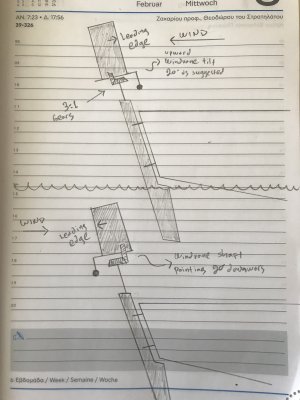
I ve studied John Letcher's book lately and thinking of trying making a dual axis windvane with auxiliary rudder. The windvane will sit on a horizontal axis with a 20 degrees upwards tilt for "in-built" rudder feedback as suggested by the writer. This way oversteering is avoided. Luckily, my stern has a 20 degrees tilt so the rudder will get this angle, and the windvane as well.
Obviously I will come along many difficulties, but one basic one is what the sketch shows. When rotating the windvane to change course, its axis will also change angle. If rotate it so far to the point of the leading edge pointing backwards, the vane shaft will now have a 20 degree slope down which is not desired.
In the case I make the rudder completely vertical which is also a choise, the windvane shaft will be completly horisontal resulting in oversteering.
Is there any obvious solution that I can't see? Unfortunately I dont have access to a boat with a windvane around to check in close and get ideas. Not close up pictures of mechanisms around internet either.
 

Attachments

  • 57F2909D-3394-463D-8C12-91B11E423FB5.jpeg
    57F2909D-3394-463D-8C12-91B11E423FB5.jpeg
    1.3 MB · Views: 25
The rudder needs to be on its own independent mounting with its own pivot/spindle. Then when you rotate it the spindle will always be at the correct angle. You then add a linkage to the auxiliary steering part which copes with any changes in angle etc.
In your design you are trying to remove this linkage which is the flaw in the design
 
The rudder needs to be on its own independent mounting with its own pivot/spindle. Then when you rotate it the spindle will always be at the correct angle. You then add a linkage to the auxiliary steering part which copes with any changes in angle etc.
In your design you are trying to remove this linkage which is the flaw in the design
I found the 45 degrees gears appealing, ( as there are no lines and pulleys involved) but seems there is no way to use them because as you say they do not create a linkage but make rudder and vane a sinlge part

Other thought is that windvane and rudder shafts are horizontal and vertical, and the vane blade only having an adjastable rake option
 
Last edited:
The vane should have an adjustable rake option anyway. This is for differing wind strengths. It is nothing to do with installed rake angles
My Aeries has gears but a linkage to the upper gear o separate it fom the rotating vane axle
My latest design which i am working on does not have gears & you can do it without
I have CAD drawings of part of the construction but it depends if you can open the files
 
I appreciate it's not an "auxiliary rudder design" but if you haven't already looked at it and are interested in trim trab windvanes then for about £30 you can download the plans and text for the "Wave Rover MK3":
https://www.etsy.com/uk/listing/1000498117/mk-3-trim-tab-wind-vane-diy-plans

I'm thinking about putting one on my Sadler 29, which has a transom hung rudder. If you have a transom hung rudder then a trim tab will almost certainly be the simplest and cheapest mechanical self-steering option.

The vast majority of the Wave Rover MK3 design is made from plywood and a bit of plastic sewage pipe, ie fairly straightforward DIY that you can do with hand tools (or cordless power tools). You will also need to get a couple of bits of stainless cut/welded. The plans and accompanying videos are such that a fairly non-technical person can understand them. Even if you don't go on to build this type it almost seems worth the money just to get a better understanding of the general concept, although the book previously mentioned would also do this.

It has also been pretty well tested, first on his Contessa 26 and then on his newer 22ft boat (which he also built himself from plywood), and has crossed several oceans (I think some of the Jester Challenge boats may have used them too). The windvane features in many of his videos, including about 40 seconds in on this one:

I have no commercial involvement with the product, just happen to think it's quite good!
 
How to sail oceans. Towards the end of the video it shows how he overcome the problem of a raked transom. If you look at some of his videos in one of them he tells you how to use bungee cords dampen over steer.

 
Last edited:
I appreciate it's not an "auxiliary rudder design" but if you haven't already looked at it and are interested in trim trab windvanes then for about £30 you can download the plans and text for the "Wave Rover MK3":
https://www.etsy.com/uk/listing/1000498117/mk-3-trim-tab-wind-vane-diy-plans

I'm thinking about putting one on my Sadler 29, which has a transom hung rudder. If you have a transom hung rudder then a trim tab will almost certainly be the simplest and cheapest mechanical self-steering option.

The vast majority of the Wave Rover MK3 design is made from plywood and a bit of plastic sewage pipe, ie fairly straightforward DIY that you can do with hand tools (or cordless power tools). You will also need to get a couple of bits of stainless cut/welded. The plans and accompanying videos are such that a fairly non-technical person can understand them. Even if you don't go on to build this type it almost seems worth the money just to get a better understanding of the general concept, although the book previously mentioned would also do this.

It has also been pretty well tested, first on his Contessa 26 and then on his newer 22ft boat (which he also built himself from plywood), and has crossed several oceans (I think some of the Jester Challenge boats may have used them too). The windvane features in many of his videos, including about 40 seconds in on this one:

I have no commercial involvement with the product, just happen to think it's quite good!
I ve seen Waver Rover videos nice channel. Trim tab is great if you have a primary outboard rudder but in my case it is a fixed skeg rudder, and would benefit more from a servo pendulum option, but its complicated and I have slack in the system that is impossible to overcome ( warm gear system with lot of moving parts). so even this would not work properly.
Leaving as single option the auxiliary rudder windvane system. Thanks for the input!
 
I have a montor wind vane that I added and auxiliary rubber to

The monitor has bevel gears that ore a 2:1 ratio that gives the correct feedback between the wind vain and the pendulum rubber.

the auxiliary rudder is then driven off the pendulum rudder with a simple linkage between the pendulum and the auxiliary rubbers


Shear pin hinge to protect pendulum and auxiliary rudders


Auxiliary rubber in rib before plating
 
Last edited:
I have a montor wind vane that I added and auxiliary rubber to

The monitor has bevel gears that ore a 2:1 ratio that gives the correct feedback between the wind vain and the pendulum rubber.

the auxiliary rudder is then driven off the pendulum rudder with a simple linkage between the pendulum and the auxiliary rubbers


Shear pin hinge to protect pendulum and auxiliary rudders


Auxiliary rubber in rib before plating
looks like a bomb proof construction! Why you add an auxiliary rudder and not driving the primary rudder directly?
 
looks like a bomb proof construction! Why you add an auxiliary rudder and not driving the primary rudder directly?

I went for an auxiliary rudder as my main rudder is hydraulically operated with twin wheels and auto pilot so to connect to the wheel would allow for create in the hydraulics than having to constantly adjust the self-steering gear to keep the course correct
 
Top