

Greenheart
Well-Known Member
Wow, so much useful knowledge and experience! Thanks to all. I'll probably reply intermittently to suggestions as I re-read them.
It occurred to me as I read, that while rowing the Osprey, I found the boat had a tendency to roll a great deal in small waves, making the business of keeping the oar-blades in the water, much more difficult than I had anticipated. If there was a short-shaft outboard mounted on the gunwale, I think it would resemble a weed-whacker quite a lot of the time. But I haven't given up on that idea.
The weakness of the aft-deck and transom glassfibre, isn't easy to convey to anyone who doubts it. The rearmost, topmost edge of the transom feels firm, but below and forward of that one inch of material, everything bends easily under pressure. That never mattered before because it never received any pressure in the boat's normal use.
This pre-bulkhead photo from six years back doesn't help much, but it does show the aft end is just a light glassfibre box.
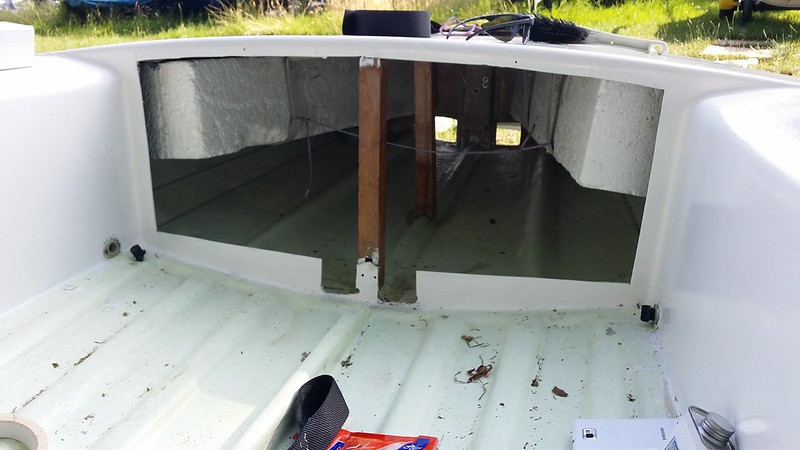
Given that I don't want to open up the rear-deck/tank to add reinforcement to this thin glassfibre, I still believe that the only two extensive solid bits - the hefty gunwale-overhangs - offer a solution, if I can use them to 'bridge' the lightweight decking under the sweep of the tiller. It's appealing not to have to risk (or reinforce) relatively fragile sections, by only using proven tough bits.
As to the boat's behaviour under outboard, I should stress that it isn't a heavy engine at 13kg, and that the Osprey at 17ft 6" and probably 150kg+, has a lot of weight, well spread. I'm content that the idea of the boat pitching back under the engine's weight or thrust, doesn't apply.
The engine certainly doesn't have reverse gear. My use of it would be to shave hours off calms or arduous windward legs. So I don't regard rapid access to the controls as vital. Obviously there's a kill-cord so the prop could be stopped instantly if necessary. I don't know if 'vectoring' the thrust of an auxiliary is better than relying on the boat's main rudder because I've never done it. But super-responsive steering isn't at the top of my priorities, just an option, and one which might help prevent, as Owl put it, the propeller chewing up the rudder blade. So linking the engine's little tiller to the boat's, does sound clever.
As to whether the propeller will breath air in waves, I'll have to wait and see. I haven't observed the stern while sailing of course, but I never had any sense that it lifts far out of the water. Heavy old boat, despite its reputation for performance.
I encountered unnaturally short, steep waves from a tanker a few years ago...my mate in a much smaller dinghy was rolling wildly, while the Osprey was so steady, I was easily able to video with my unprotected, not waterproof phone as I steered. My stern is just about visible in the resulting short video, and I don't see it rising out of the briny, much.
It occurred to me as I read, that while rowing the Osprey, I found the boat had a tendency to roll a great deal in small waves, making the business of keeping the oar-blades in the water, much more difficult than I had anticipated. If there was a short-shaft outboard mounted on the gunwale, I think it would resemble a weed-whacker quite a lot of the time. But I haven't given up on that idea.
The weakness of the aft-deck and transom glassfibre, isn't easy to convey to anyone who doubts it. The rearmost, topmost edge of the transom feels firm, but below and forward of that one inch of material, everything bends easily under pressure. That never mattered before because it never received any pressure in the boat's normal use.
This pre-bulkhead photo from six years back doesn't help much, but it does show the aft end is just a light glassfibre box.
Given that I don't want to open up the rear-deck/tank to add reinforcement to this thin glassfibre, I still believe that the only two extensive solid bits - the hefty gunwale-overhangs - offer a solution, if I can use them to 'bridge' the lightweight decking under the sweep of the tiller. It's appealing not to have to risk (or reinforce) relatively fragile sections, by only using proven tough bits.
As to the boat's behaviour under outboard, I should stress that it isn't a heavy engine at 13kg, and that the Osprey at 17ft 6" and probably 150kg+, has a lot of weight, well spread. I'm content that the idea of the boat pitching back under the engine's weight or thrust, doesn't apply.
The engine certainly doesn't have reverse gear. My use of it would be to shave hours off calms or arduous windward legs. So I don't regard rapid access to the controls as vital. Obviously there's a kill-cord so the prop could be stopped instantly if necessary. I don't know if 'vectoring' the thrust of an auxiliary is better than relying on the boat's main rudder because I've never done it. But super-responsive steering isn't at the top of my priorities, just an option, and one which might help prevent, as Owl put it, the propeller chewing up the rudder blade. So linking the engine's little tiller to the boat's, does sound clever.
As to whether the propeller will breath air in waves, I'll have to wait and see. I haven't observed the stern while sailing of course, but I never had any sense that it lifts far out of the water. Heavy old boat, despite its reputation for performance.
I encountered unnaturally short, steep waves from a tanker a few years ago...my mate in a much smaller dinghy was rolling wildly, while the Osprey was so steady, I was easily able to video with my unprotected, not waterproof phone as I steered. My stern is just about visible in the resulting short video, and I don't see it rising out of the briny, much.
Last edited: