Major shear pin design fail

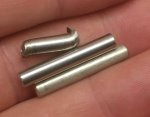
I hit the prop on my Tohatsu 3.5 two stroke last night and sheared the pin. No problem I thought, a few seconds to pop a new one in. No chance!! Some idiot decided to bevel the hole on the shaft so the pin can bend into it both sides before shearing making it impossible to remove the pin with the usual tools I expect most of us have in a dinghy. I've sheared pins on every outboard I've owned and never had any trouble before.

I'm now wondering what to do about this. Carry a hammer and punch? Use smaller pins so even when its bent i can still push it through? Ideally find more brittle metal pins that do nothing but shear... where from? Maybe I need to heat and quench some pins? But then will that make them too hard?? And do I have to hit something deliberately to test that I can get it out before using it again? I guess I should. How do I create that scenario in my wheelie bin?? ? I was incredibly lucky with where it happened, if it had earlier in the day would have been a major inconvenience. Adding this to the long list of "nothing bloody works right anymore these days"

View attachment 137966
That’s not a genuine Tohatsu/Mariner shear pin - they break fairly easily. You’ll probably find this has been replaced with a “universal” pin from a chandlery or marine supplier.

It shouldn’t make a difference, but always seems like OEM are made to a higher tolerance.
 
So I found some brass rod locally but didn't get the specs until I went to the manufacturers website. The specs are "Alloy 260, 1/4 Hard, Mill Finish (ASTM B134)" According to this its the most ductile so least ideal. Speedy Metals Information for 260 Brass Sheet and Plate

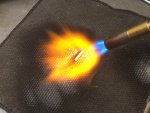
Still for my £2.99 I deserved to have a play. I tried heating and slowly cooling a piece, allegedly thats how to harden brass, to compare to untreated.

IMG_0072.jpg

It made f all difference. I tried more bending force and less shearing. And then shearing. No good.

I phoned a local outboard dealer to see if he had some genuine pins. He said he's familiar with the problem, often has to drill out the pins! Said the countersinking of the holes was Tohatsu responding to complaints that pins sheared too easily by people who rev up and slam into gear and complain instead of learning not to do it. So now they don't shear at all. The idiots are dragging us all down with them once again.

I can't leave this issue unresolved so I need some correct brass to try. Does anyone know which of these is the most suitable: Brass Alloys | Brass Suppliers | Brass Stockist (smithmetal.com)

I can learn not to slam it into gear so the most brittle and least strong 4mm bar is probably the best for me. They mention when one is good for cold forming but its harder to figure out which is the worst for it.
 
That’s not a genuine Tohatsu/Mariner shear pin - they break fairly easily. You’ll probably find this has been replaced with a “universal” pin from a chandlery or marine supplier.

It shouldn’t make a difference, but always seems like OEM are made to a higher tolerance.
I would generally buy OEM with that assumption. I'm going to try brass on the basis that it'll be easier to remove on the water if it rounds off and some rounding off seems inevitable due to the countersinking. Contemplating tig welding the top of the holes and redrilling to get rid of that countersink but worried in case I deform the shaft. Could try putting a heat sink on it... but I don't know the exact metal its made from to match the rods. What a bloody faff. I can't believe this really but its a huge problem as I use this on the sea not just for a tender in a river.
 
I would generally buy OEM with that assumption. I'm going to try brass on the basis that it'll be easier to remove on the water if it rounds off and some rounding off seems inevitable due to the countersinking. Contemplating tig welding the top of the holes and redrilling to get rid of that countersink but worried in case I deform the shaft. Could try putting a heat sink on it... but I don't know the exact metal its made from to match the rods. What a bloody faff. I can't believe this really but its a huge problem as I use this on the sea not just for a tender in a river.
To be honest, I’d just replace with an OEM pin. I’ve seen brass pins shear under very light impact, and just from someone putting it in reverse at higher revs than it should be.
If you struggle removing that, use a hacksaw and the prop shaft as guide, pair of pliers and it should come out with ease.
 
It just sheared or you hit something?
I didn't hit anything or slam it into gear ,guess fatigue? Was a long row back against the wind and tide. Decided oem was far to weak so made a stainless one.
The spark plug failed very prematurely too. Other than that it's been a good outboard.
 
To be honest, I’d just replace with an OEM pin. I’ve seen brass pins shear under very light impact, and just from someone putting it in reverse at higher revs than it should be.
If you struggle removing that, use a hacksaw and the prop shaft as guide, pair of pliers and it should come out with ease.
I made a mistake using the dremel and bur to get the bent pin metal off from around the hole. I should have used the lowest tech thing that I can easily carry first. A folding jab saw with a sawzall blade might have done it. One of these Milwaukee 48220305 Folding Jab saw (sgs-engineering.com) Trouble is though that damn countersunk recess makes it hard to get off all the metal thats bigger than the pin hole diameter. The more remaining the bigger the hammer I need to carry. Without the countersunk part if it was all proud of the surface as you say I could cut across the hole with a flat blade and pull out from the other side. Honestly with that recess full of metal like a countersunk screws head it wasn't pushing through the hole with ease.
 
I made a mistake using the dremel and bur to get the bent pin metal off from around the hole. I should have used the lowest tech thing that I can easily carry first. A folding jab saw with a sawzall blade might have done it. One of these Milwaukee 48220305 Folding Jab saw (sgs-engineering.com) Trouble is though that damn countersunk recess makes it hard to get off all the metal thats bigger than the pin hole diameter. The more remaining the bigger the hammer I need to carry. Without the countersunk part if it was all proud of the surface as you say I could cut across the hole with a flat blade and pull out from the other side. Honestly with that recess full of metal like a countersunk screws head it wasn't pushing through the hole with ease.
I'm not sure your 'shearing' experiments give a true indication of the brass bars performance really. Might be better to drill a hole through two steel blocks, fit a sample pin and hold one block in a vice while drifting the other block........you could even replicate the chamfer! If all else were equal then the brass/alloy pin would be easier to punch out for a variety of reasons. If you have welding access then making a small vee block type clamp with a screw down 'drift' to suit the shaft hole would be good so you don't need to keep beating the unsupported shaft...!
 
I'm not sure your 'shearing' experiments give a true indication of the brass bars performance really. Might be better to drill a hole through two steel blocks, fit a sample pin and hold one block in a vice while drifting the other block........you could even replicate the chamfer! If all else were equal then the brass/alloy pin would be easier to punch out for a variety of reasons.
It could well be different in a hole where it has nowhere to go in terms of place to bend into but with a plastic prop thats just what happened as you can see. I was thinking that part of what makes a pin specific for the task was brittleness not softness so I expected it wouldn't cut and bend like it did but snap and for that the test I did would have given a reasonable idea woudn't it as it showed no brittleness at all. But are these supposed to be brittle?
If you have welding access then making a small vee block type clamp with a screw down 'drift' to suit the shaft hole would be good so you don't need to keep beating the unsupported shaft...!
I do and thats a great idea thanks. Though I doubt even that would have gotten this pin out without first removing the metal that was outside the hole diameter, that it was rounded over wouldn't have helped as the drift would slide away from the right alignment. Will give that some thought though
 
Last edited:
This is what I carry for my 3.3 Mariner 2T:
View attachment 137971
Note the red handled punch.
Rather than spend £5 on a new shear pin I got a 1m length of 3mm brass from B&Q for less. The one time the brass sheared it was quite easy tap out the remains of the old pin.
I think if you have a metal prop you need a stainless pin but brass is correct for the plastic prop.

This is what I carried for my old outboard, (A reliable Seagull):
 

Attachments

  • 2 paddles.jpg
    2 paddles.jpg
    14.2 KB · Views: 0
Just to follow up I'm now sure the pin that didn't shear was NOT a genuine Tohatsu. I had 2 spares and noticed they didn't look the same. Ordered a few genuine ones from 2 different reputable dealers and the genuine ones and one of my spares have a dull finish and probably more significantly a slightly different colour, while the other spare and the one that didn't shear looks more like regular stainless rod. The difference is more obvious in reality than in the picture. I would guess they could be significantly different in some way to make them more suitable. Probably not long to wait to find out if it works better or if the countersink still creates a problem.

IMG_0133.jpg
 
Just to follow up I'm now sure the pin that didn't shear was NOT a genuine Tohatsu. I had 2 spares and noticed they didn't look the same. Ordered a few genuine ones from 2 different reputable dealers and the genuine ones and one of my spares have a dull finish and probably more significantly a slightly different colour, while the other spare and the one that didn't shear looks more like regular stainless rod. The difference is more obvious in reality than in the picture. I would guess they could be significantly different in some way to make them more suitable. Probably not long to wait to find out if it works better or if the countersink still creates a problem.

View attachment 138526
As I wrote a long time ago I am pretty sure the correct item is manufactured by sintering (powdered metal) to give it the desired low ductility fracture characteristics.
 
As I wrote a long time ago I am pretty sure the correct item is manufactured by sintering (powdered metal) to give it the desired low ductility fracture characteristics.
What a little known serious menace are the fake ones made of regular stainless! I realise the primary purpose is to protect the other components which it did other than chewing up the inside of the plastic prop, but aren't we all working with the assumption its easy to pop another pin in and carry on? It could have seriously messed up my day if it had happened earlier.
 
Top