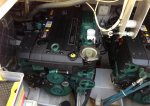
Maintenance books ?

iapetus

Active Member
Joined
24 Sep 2016
Messages
53
Location
Monaco
Visit site
I was just given my yearly quote for maintenance of my twin-D4 open. Once I got past the usual hiccups, I decided to do part of the works myself, excluding everything that needs special tools (I'll especially leave the dreaded DPH sterndrives to my beloved Volvo service center).

Problem is, I don't have hands-on experience in mechanics, especially marine engines. I did numerous motorbikes, but it was quite simpler (and more accessible) that the labyrinthine system living in the bilge.

I know there are valuable training courses for the passagemaker-inclined, but not in my area as far as I know. So a book it is, for starters. The first I found is Nigel Calder's classic "Marine Diesel Engines", now a bit old (last revision was in 2006) and, it seems, really focusing on small engines with few mentions of anything else. Are there any other more general good books on the market ?

Thanks
 
What about the owners manual ?
When I had a VP KAD 300/ DPG boat. Bit like you I left the leg bit to VP authorised service , never let me down .
About 1/2 way into the ownership experience I started to do the engine annual .
Think about it — ideally @ sea you supposed to be able to change a belt , check / change the impeller , replace filters .
That does not leave much else like oil and compressor oil ( if you have one ) and airfilters .

We even one year drained the coolant and replaced - anitcorosive issues ?

So to all the above in a cool calculated controlled way at the dock or in a yard is pretty easy .

Utube is your friend indeed there’s some good vids re VP stuff on the MBY site .
You also ideally need a mate ,kinda helpa , pass me this , pass me that , etc

To start with try it in a yard or vicinity of a engine shop .

When confidence increased we changed the elbows , and thermostat s — not tricky .
 
Last edited:
Marine engines are basically just big Diesel engines with added bits for water cooling. On the whole they are pretty straight forward. Often the hardest part is working out how to get at something. There is also lots of stuff on YouTube.
BUT.......
There is quite a lot of subtlety in how some of the bits and pieces work, and getting that wrong could leave you with a serious bill. I have had the misfortune to see what ex-lorry/construction machinery fitters have done to boat engines because they didn't understand properly.

It's well worth finding a good marine diesel course even if you have to travel quite a way and overnight. I did a two day course with Mermaid Marine in Poole - it was a real eye opener and I had previously rebuilt a few car engines already.
You will see a typical engine on a bench and really be able to get at it easily. There after when you do your own servicing etc (lots of us do) you may spot the beginnings of any small fault that you can readily sort before it gets serious.
And when you are out and about on the sea, not be worried that a simple issue is going to ruin your trip.
 
As suggested by petem, I think it's a good idea if you can get someone to show you on your own boat. About 20 years ago my boat had Mermaid engines and I had one of their mechanics spend 2 days on the boat teaching me what to do. Being on your own boat gives the mechanic the opportunity to spot anything untoward or that needs attention, which wouldn't happen in a 'school room' environment.
 
What about the owners manual ?
<snip>

The Volvo manual is full of scary "don't you dare" warnings, with little information, more like a users manual... I know the VP workshop manual is really comprehensive but I confess it's far too advanced for me.

The parts you mentioned are indeed what I intend to do: filters, oil, be able to replace a belt or impeller should it break at sea, and the common security check before starting the day. For now, apart from the possible bilge water presence or oil leak, I don't feel comfortable with anything else, for fear of my messing it up!

Elbows and exchangers were done last year by the VP guy, so at least I escaped that trap for a couple years...

Could you pay the local VP guy to show you how to do all the stuff that Porto mentions?
As suggested by petem, I think it's a good idea if you can get someone to show you on your own boat.
I know I should, but I'm not sure the rock-star VP guy would agree on spending valuable hours with such a d*mn newbie (neither would I, to be honest). Even paid for.

BUT.......
There is quite a lot of subtlety in how some of the bits and pieces work, and getting that wrong could leave you with a serious bill. I have had the misfortune to see what ex-lorry/construction machinery fitters have done to boat engines because they didn't understand properly.

It's well worth finding a good marine diesel course even if you have to travel quite a way and overnight. I did a two day course with Mermaid Marine in Poole - it was a real eye opener and I had previously rebuilt a few car engines already.

And when you are out and about on the sea, not be worried that a simple issue is going to ruin your trip.

Exactly my goal. And the subtlety of marine contraptions is also a concern, given what I faced when rebuilding a seemingly simple bike engine: I know I'll need practical experience sooner or later.
If someone knows a serious marine diesel course in SoF (English, French or Italian-speaking accepted), please shoot.
 
Seastart offer a one day diesel course, which shows most of the basics for not just maintenance but how to deal with certain breakdowns at sea, and for ~ £110 well worth it.
 
Spent a couple hours watching instructional videos on YouTube (the MBY ones were especially instructive), things are now becoming a little clearer.

I'd have a question regarding the change of impeller:
- Jon (Mendez) shows a curious ad-hoc torture device (aka "impeller puller" I guess) that allows pulling the impeller out of its chamber with ease. I also saw other examples where the mech was even more menacing (using two screwdrivers, or even a pair of pliers to lever up the impeller axis, and a Colson ring to put the replacement). Are the latter techniques applicable on motorboat engines ? (the impeller for a small D1 or a Yanmar 3Y being quite small compared to the stiff ones found in larger engines).
- lubrication is obviously essential in order to put the d*mn thing back in: silicone grease seems the way to go, or glycerin. Some say washing-up liquid works just fine in an emergency, is that safe?
 
Spent a couple hours watching instructional videos on YouTube (the MBY ones were especially instructive), things are now becoming a little clearer.

I'd have a question regarding the change of impeller:
- Jon (Mendez) shows a curious ad-hoc torture device (aka "impeller puller" I guess) that allows pulling the impeller out of its chamber with ease. I also saw other examples where the mech was even more menacing (using two screwdrivers, or even a pair of pliers to lever up the impeller axis, and a Colson ring to put the replacement). Are the latter techniques applicable on motorboat engines ? (the impeller for a small D1 or a Yanmar 3Y being quite small compared to the stiff ones found in larger engines).
- lubrication is obviously essential in order to put the d*mn thing back in: silicone grease seems the way to go, or glycerin. Some say washing-up liquid works just fine in an emergency, is that safe?

A puller is the easiest way, but I have normally done it the hard way with screwdrivers or pliers. Getting them in can be tricky - I once used this method to get a tough one in - compress the vanes in the right direction using a cable tie which I snipped after the first part was in the housing. Probably a right 'cowboy' maneuver, but it worked!
 
The Vp impellers come out pretty easy as MarkC says ^^^ .I bought a puller , but found the twin screwdriver way better .
The issues I had was reseating and re sealing the face plate , remember it’s position and put it back the same way .
Also the original brass plate retaining screws shear off ,
The replacement a bag of 12 are peanuts and stainless I think .Get a pack B4 starting .
If they fracture When the plate is off a pair of pointed nose pliers / WD 40 and you can recover them easily - the stud .
Be careful aligning the paper gasket ,

Worth doing diy .
Don,t forget to open the strainer to prime with water before firing up .Add some fairy liquid to see / confirm by looking at the stern that water flows too - better than waiting for an alarm imho
 
Keep all the receipts for anything you buy ... for your servicing file ... :encouragement:

I will. I know future buyers would prefer an official, expensive Volvo invoice listing parts AND labour each year, but hopefully receipts for the VP parts will do.

Another practical question regarding impellers (as well as filter clean up) : because of stern drives, there are no seacocks. What are the best practices to avoid ending up at the bottom of the harbour ? The raw water pump is well below the waterline (but the filters should be above as far I can see).
 
Bilge pump in the ER - make sure it works - test the float switch often as they are notorious for packing up .
Shore power - to charge up the bats to power the bilge pump(s) —- make sure it’s on when unattended.
Everyone in the Med scene in a marina leaves the charger on .

Your pump face plate may weep , but it’s not a sinker scenario, your strainer lids should be tight , theses days they are a good thread and don,t pop off —- punters tested in the field I,am afraid and VP made modifications- so don,t worry about that .
But yup your basic concept of a pipe below the waterline leaking is correct , in all boats .
In a shaft we can close the main seacocks if unattended-
You can,t do that with outdrives and there’s one of the bellows I think it’s the drive shaft not sure ? / could be the other depends ? - if that splits - then potentially it’s a sinker .
If the drive shaft leaks ,a bit it’s normally just a knackered universal joint or more if waters found its way in to the top of the upper unit ,
Hence the change every 2 years —- and new clips / jubilee s - as often these rust and snap - loads of dodgy ones , bad batches about ,
Lifting your leg up every 5 mins for what ever reason naturally is gonna test the “ rip abilities “ of the bellows more than a neighbour who only just moves them when trimming .
They get caked up in those worm casts - abrasive accretions in the Med .
So yup a nice fat file of blue logo headed invoice s will definitely hook a buyer when it’s time to sell .
The only thing imho that’s OK to shop around is the oil - as long as it’s VP spec - which most after market are labled .
Change it every year as well btw .

You may find from an actuarial pov outdrives boats are approx 2x or more even to insure than equivalent same size shaft drive .
There’s a reason
 
Last edited:
I will. I know future buyers would prefer an official, expensive Volvo invoice listing parts AND labour each year, but hopefully receipts for the VP parts will do.

Another practical question regarding impellers (as well as filter clean up) : because of stern drives, there are no seacocks. What are the best practices to avoid ending up at the bottom of the harbour ? The raw water pump is well below the waterline (but the filters should be above as far I can see).

Do you mean raw water strainers? If so, these are at the top of the engines so well above the waterline (checking these should be part of your daily checks routine).
 
Do you mean raw water strainers? If so, these are at the top of the engines so well above the waterline (checking these should be part of your daily checks routine).

Yes exactly. They are on top of the whole engine apparatus so should be well above the water (but with these low Med open designs, you never know). Little bits of seaweed and other soft things in there end of season, but nothing much.
IMG_2277.jpg
 
Bilge pump in the ER - make sure it works - test the float switch often as they are notorious for packing up .
Shore power - to charge up the bats to power the bilge pump(s) —- make sure it’s on when unattended.
Everyone in the Med scene in a marina leaves the charger on .

Your pump face plate may weep , but it’s not a sinker scenario, your strainer lids should be tight , theses days they are a good thread and don,t pop off —- punters tested in the field I,am afraid and VP made modifications- so don,t worry about that .
But yup your basic concept of a pipe below the waterline leaking is correct , in all boats .
In a shaft we can close the main seacocks if unattended-
You can,t do that with outdrives and there’s one of the bellows I think it’s the drive shaft not sure ? / could be the other depends ? - if that splits - then potentially it’s a sinker .

I indeed have the revised strainer lids (the previous owner told me the plastic swimming pool-like ones VP used to fit would simply pop out under pressure! Customers as beta-testers...).

And indeed the auto switch seems to be dead in the ER (just checked, so thanks @pf for pointing it out. The fore and midship bilge pumps switch on just fine, though - time to visit the nearest shipchandler...). And shore power and charger are always on ("when in Rome, do as the Romans do". However I just can't resolve to the old lorry tyre shock absorber).

As for the legs, I ensure the VP guy changes the bellows every year when he services the drives (some told me may be overkill but everyone says it's too dangerous a situation... not to mention the ridiculous price of said legs should they break). I will definitely leave the sterndrives servicing to a professional.
 
So I spent half day fiddling with dead bilge switches while cleaning things up and starting limited maintenance works.

As for the raw water strainers, they are definitely above sea level, so I could open and clean them (seaweed and... lots of barnacles stuck in the filter holes. These things really encrust everything, everywhere).

But the impeller housing is also definitely below the waterline. Once I (carefully) started opening the pump, I also started a serious water ingress, so I immediately stopped before the kraken unleashed its aqueous breath.

How would you guys manage a simple impeller change, if not on the dry of course ?

I wonder if fitting a stop valve between the sterndrive and the engine would be worth the cost.
 
What could happen if, say, the impellor is installed with the wrong direction of 'slant'? Where do I find out whether I have done it correctly?
 
What could happen if, say, the impellor is installed with the wrong direction of 'slant'? Where do I find out whether I have done it correctly?
The impellor blades will flick into the correct orientation as soon as the pump rotates. Don't worry which way the blades are set when you insert it, just grease the splines with waterproof grease, and use either the supplied lubricant or some washing up liquid to get it all the way in. If it's a big impellor and/or hard to get at put a cable tie around it to fold the blades over to help get started.

If you want to get an impellor out use a proper extractor. Makes it all a LOT easier.
 
Top