Mainsheet doubling

In the picture of that boat with the spinnaker the boom is being held by the windward mainsheet. The leeward one is slack. That suggests that he is not using that one to assist the vang. So in that situation, one might ask what is the point of the arrangement?
 
Last edited:
In the picture of that boat with the spinnaker the boom is being held by the windward mainsheet. The leeward one is slack. That suggests that he is not using that one to assist the vang. So in that situation, one might ask what is the point of the arrangement?

The point is sheeting from a more windward point in the cockpit without a traveller. Also being able to use the leeward sheet to apply plenty of leach tension when required, which generally isn't with the kite up.
It doesn't fully replace the vang (apart from close hauled), any more than a short traveller does.
It looks like a lot of heavy string and blocks to me, but I appreciate that travellers are expensive (so are blocks) and not always reliable.

I'd guess it works better or less well depending on exactly where the boom needs to be, which will depend on lots of things including how much genoa overlap you have.

It might be handy for a storm trysail too? If the sheeting points in the cockpit were in the right place...
 
For deep sea use, it seems much better, because you can stop the boom from moving.

Inshore, not so much.

I lash something together on the mooring which works in a very similar way, to keep the boom still.
I think more gooseneck wear happens on the mooring than when sailing.
 
Not if it's a continuous sheet, so no bitter ends.
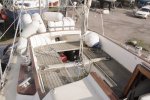
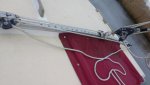
I'm thinking of doing it on my main which is on a traveler on the coach roof. I have made the traveler sheets continuous which works well. I would like to remove the traveler block and anchor two main sheets at the ends of the traveler track. The only thing that's stopping me is the cost of the extra blocks.

Do you have a drawing/photo of your traveler setup? Sounds interesting.
 
The owner/skipper of MalMut, the R36 in the OP, is Jean-Luc van den Heede. He's certainly one of the most experienced long-distance skippers around.

https://goldengloberace.com/skipper/2018/jean-luc-van-den-heede-13/

His preparations for the GGR were detailed and meticulous - contrasted with that of some others - and he has evidently exercised his judgement on fitting a double mainsheet tackle as shown. He suffered a severe knockdown, his much-reinforced mast was damaged at the lowers' attachment point - but survived - and he nursed the rig all the way back from SW of Chile to stay ahead and win the race. Both he and Tony Curphey have such a setup. I'd like to understand their rationale.....
 
I went for this arrangement on Snow Leopard. One key factor was that with the solid boom arrangement there was no need for a downward pull to flatten the sail so it only needed enough power to rotate the boom. By setting the sheeting points well apart so they were always pulling sideways instead of down, I was able to control a 600 sq ft main with only 3-part tackles. On a conventional rig you would need a powerful kicker to get the same effect.

When close hauled I used the weather sheet and broad off I switched to the leeward sheet.

Gybing in strong winds was done by winching in on one sheet and easing the other so the boom was unable to swing and do damage.
 
I went for this arrangement on Snow Leopard. One key factor was that with the solid boom arrangement there was no need for a downward pull to flatten the sail so it only needed enough power to rotate the boom. By setting the sheeting points well apart so they were always pulling sideways instead of down, I was able to control a 600 sq ft main with only 3-part tackles. On a conventional rig you would need a powerful kicker to get the same effect.

When close hauled I used the weather sheet and broad off I switched to the leeward sheet.

Gybing in strong winds was done by winching in on one sheet and easing the other so the boom was unable to swing and do damage.

That's very a interesting explanation. I can see the advantages of the system now.

Did you find it slow in operation, especially when short-tacking in a narrow channel?
 
I went for this arrangement on Snow Leopard. One key factor was that with the solid boom arrangement there was no need for a downward pull to flatten the sail so it only needed enough power to rotate the boom. By setting the sheeting points well apart so they were always pulling sideways instead of down, I was able to control a 600 sq ft main with only 3-part tackles. On a conventional rig you would need a powerful kicker to get the same effect.

When close hauled I used the weather sheet and broad off I switched to the leeward sheet.

Gybing in strong winds was done by winching in on one sheet and easing the other so the boom was unable to swing and do damage.

Thank you. We have 510 sq ft with a 4:1 purchase and a 42:1 winch. Since I have a pair of 4:1 tackles available I’ll give this a try, because to be honest the mainsheet winch only gets used to harden the sail down.
 
Interesing discussion. I have been considering switching to this sort of system myself on our CC Moody. The current arrangement has the sheet going from a fiddle block on the traveller, up to the boom, and then straight to a central turning block and winch. This means that the pull on the boom is always at least 50% coming from the centreline, so the effective width of the traveller is greatly reduced.
My reasoning for switching to a dual-tackle system would be that it would solve the immediate problem, be more reliable and simpler, and free up some deck space aft of the cockpit. It would also allow the boom to be locked in place, and negate the need for a kicker.
I'm not sure whether to dispense with the winch, or to keep it and have less powerful tackles.
 
I got to wondering whether to use a quad sheave block on the boom or two doubles. I decided that a quad sheave block is out as it would twist depending on direction of pull, but two doubles would be a tight fit to the boom.
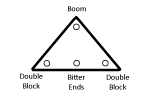
I have decided that the two doubles would need to attach to the boom via a twin tail strop, but wire or dyneema, or maybe a triangular stainless plate would be better?
Your thoughts please.

After thought - If I used a plate like this, to make my sheet continuous I could attach the bitter ends to the centre hole on the plate, saving money on buying double blocks with beckets.
Boom Block Bracket.pngWould the bitter ends get in the way of the blocks?
 
Last edited:
I got to wondering whether to use a quad sheave block on the boom or two doubles. I decided that a quad sheave block is out as it would twist depending on direction of pull, but two doubles would be a tight fit to the boom.
I have decided that the two doubles would need to attach to the boom via a twin tail strop, but wire or dyneema, or maybe a triangular stainless plate would be better?
Your thoughts please.

After thought - If I used a plate like this, to make my sheet continuous I could attach the bitter ends to the centre hole on the plate, saving money on buying double blocks with beckets.
View attachment 82067Would the bitter ends get in the way of the blocks?

Unless I'm entirely getting the wrong end of the stick, what is the difference between tying off the "bitter ends" to a plate and having two stopper knots? Surely "continuous" means that there are no ends, just a splice somewhere that runs through all the blocks equally and gets lost? (Which, since I don't think I have encountered such, I suppose means cutting it to, for instance, replace one of the blocks?)

Mike.
 
On a recent long passage I experimented with something similar in concept on my genoa. My Jib cars are the old type, held in place by a pin with no way to adjust from the cockpit and they have seen better days so occasionally needed percussion adjustment with a winch handle. I got round the need to leave the cockpit by using two sheets. One to the car in the fully forward position and a second straight back to the spinnaker block then across the aft deck to the windward block and up to the opposite winch.

With this arrangement I could adjust the tension in 2D without bothering with car adjustment at all. The only downside was when changing tack I had to re-rig it all on the opposite side. As that was once or twice a day it was no problem.
 
Unless I'm entirely getting the wrong end of the stick, what is the difference between tying off the "bitter ends" to a plate and having two stopper knots? Surely "continuous" means that there are no ends, just a splice somewhere that runs through all the blocks equally and gets lost? (Which, since I don't think I have encountered such, I suppose means cutting it to, for instance, replace one of the blocks?)

Mike.
Apart from a splice enlarging the thickness of the rope, the rope ends have to be eye spliced to either block becets which increases the cost of the blocks attached to the boom or you could use a plate attached to the boom then attach two ordinary blocks to the bottom of the plate along with the two bitter ends. Just a way of saving a few quid! Assuming that you can DIY the plate.
 
Top