Mains electricity & corrosion (dumb question)

beancounter

Well-Known Member
Joined
28 Feb 2003
Messages
1,334
Location
Cambridge
Visit site
Sorry for a (probably) dumb question.

Normally, when we leave the boat in the marina, if we've used the shorepower connection, we unplug it. So no connection to the shore.

We're going to leave the boat in the water this winter (certainly until after Xmas), so we'd like to run the dehumidifier/tubular heater combo to keep the boat aired.

I'm sure I've read something about risks associated with leaving the mains connected - galvanic corrosion or somesuch. I've never really got my head around this topic, so can someone explain any issues to me?

(Keep it basic lads, I'm just a simple beancounter)
 
Its perfectly safe to do so..... some profess the importance of a galvanic isolator, some don't.....

Just plug your stuff in, stop worrying about it, and check your anodes every few weeks by peering under the bottom of the boat!

Do you have a shore power battery charger? becuase if you don't then you almost certainly have no possible connection between the shore power and boat bits (engine, shaft etc etc), so have no physical way for a galvanic circuit to be set up... if you do, then the most common advice seems to be to bond the earths of the 12V and 240V systems (eg join 'em together), and then fit a galvanic isolator... a job of but a few minutes.
 
Neil,

we do have a shore power charger. IIRC it's on a seperate breaker on the RCD panel. So if I leave that off, but the ring to the sockets on, I should be OK (if I've understood you correctly) ?
 
[ QUOTE ]
the most common advice seems to be to bond the earths of the 12V and 240V systems (eg join 'em together), and then fit a galvanic isolator

[/ QUOTE ] Uh, hold on. I started a thread here the other day where I asked:
"the cameras ground shares a connection with the BNC co-ax ground which runs to the AC powered TV and via that is connected to the on-shore earth. Oops! There go my anodes...
"Would fitting a galvanic isolater cure this?"[ QUOTE ]
A galvanic isolator may (will, if your concerns are correct) not help because your earth connection via the BNC connector will by pass or short circuit the isolator.

[/ QUOTE ] Did I misunderstand that? /forums/images/graemlins/confused.gif
 
Yes. But possibly no!...if your 240V and 12V earths are bonded then you probably ought to break that connection too. (note: - NOT breaking the 240V earth!!!!!!!)

If they aren't bonded then yes, flicking that breaker off would remove any possibility of your shore power causing a problem.
 
Why so? Wouldn't connecting the ground of one appliance to the earth of another be the same as the connection you advocate above?

Or, and maybe the penny's dropping here, do you mean the bypass is potentially happening within the TV's electronics? Though I don't understand that.
 
[ QUOTE ]
if you do, then the most common advice seems to be to bond the earths of the 12V and 240V systems (eg join 'em together), and then fit a galvanic isolator... a job of but a few minutes.

[/ QUOTE ]

Hmm... Taking this slowly - so if the 12v and 240v are earthed in different spots, they should be joined by suitable cable... where does the galvanic isolater fit into the circuit?

Told you explaining this to me would be hard work...
 
The Galvanic isolator sits in the 240V earth path. Yes, bonding the 12V and 240V earth really looks like taking a connection from the negative side of the battery circuit to the earth of the 240V system somewhere. It doesn't affect how the isolator is fitted, it just makes it more important that it is fitted. Its worth noting that there are opposing views that state that an isolator isn't neccessary.

On Magna Carter, I bonded the system direct from the battery to the 240V earth in the shore power breaker unit, but (with safety in mind) it can be anywhere in the circuit.
 
[ QUOTE ]
it can be anywhere in the circuit

[/ QUOTE ] ...with the exception of the common earth/ground wiring of a 12V camera plugged into a 240V TV set....? But why is that?

If they were joined elsewhere as well then a common connection like the one I've inadvertently set up wouldn't make any difference. Would it? /forums/images/graemlins/confused.gif
 
[ QUOTE ]
Sorry for a (probably) dumb question.


[/ QUOTE ] If your shore-power earth is connected to the anodes and under water fittings (and current recommendations say it should be) then these items are at risk of accelerated corrosion if the shore power lead is left plugged in. In these circumstances a galvanic isolator should be fitted to reduce and hopefully eliminate the problem. Nobody can for sure say how great the risk is but the more boats there are in the vicinity with shore-power connected the greater the risk.
 
Re: Mains electricity & corrosion (dumb question)

If you are worried about this get a Galvanic Isolator ( about £70 or £45 from Ebay - they appear to be thesame) fitting is easy to understand and it it was something you were fitting in your house would take 30 minutes, but cos it's a boat adn access is always difficult allow 2 hours !! There speaks someone who did the same job last Saturday and that's how long it took in total.

Regards
 
[ QUOTE ]
I've got a water tank meter that doesn't work, and is rather inaccessible, and I didn't want to try fixing it and ending up instead with a leaking water tank! But I had a spare security camera, so I thought I'd do something clever and mount it down below where it could 'see' the water tank. It's 12V so it runs off the accessories circuit with it's own isolating switch and fuse.

However the camera's ground (common to it's power lead and video output) is connected via the AC powered TV to the on-shore earth. (There is a connection between the TV's 'video in' ground and the earth pin - I've tested it).

Currently the camera's unplugged till I get this sorted.

Would fitting a galvanic isolater (which I was about to do anyway) cure this (the threat to my anodes)?

[/ QUOTE ]

I was told it wouldn't, but your post seems to contradict that. Maybe I'm failing to understand something.

If it is ok, then I'll put a more substantial connection in elsewhere (between ground and earth after the isolator) to minimise potentially damaging stray currents running through the TV.

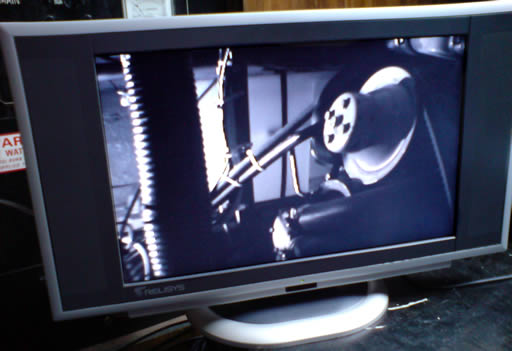
And here's what the camera sees (since you're bound to be curious /forums/images/graemlins/grin.gif ):

DOWN_BELOW.jpg


The half full water tank is in the background. /forums/images/graemlins/smile.gif
 
Re: Mains electricity & corrosion (dumb question)

[ QUOTE ]
If you are worried about this get a Galvanic Isolator ( about £70

[/ QUOTE ]

Right - better look into sourcing one.

"Darling, we just need to spend a few more pounds on something for the boat...." /forums/images/graemlins/ooo.gif
 
Re: Mains electricity & corrosion (dumb question)

Many thanks Stargazer.

Sorry Morgana to hijack your thread a bit.

Do please post here what you may find by way of an isolator. The best I've found is this one direct from the manufacturers
http://www.safeshoremarine.com/buyitnow.htm

The one at top even has a couple of LEDs to tell you if there's a break in the earth connection.
 
Re: Mains electricity & corrosion (dumb question)

I would suggest that if it is allow wattage heater you wish to leave running 24/7 then you try to isolate all of the heater and wiring from the boat earth. This may mean ignoring your 240v permanent wiring and running a power flex straight from the marina connection to the heater.

This will mean there is no RCD (earth laekage detector) protection but especially if is an all plastic heater with no metal it probably has only a 2 wire flex with no earth connection. There will be no connection marina earth top ship earth so hopefully no galvanic corrosion.

Let me try to explain galvanic isolators.

The first question is whether the marina earth (mains earth) should be connected to the ships earth. This depends a bit on the complexity of the system and the ship. You might find the ship very unsafe if you have the body of a mains appliance connected to the marina earth while there are pieces of ship (eg the sink or stove) connected to the ship earth and water. If there is a fault in the marina that increases the voltage on the earth line while you are connected to the ships earth you could get a shock. Likewise if the appliance body becomes live through a fault and it is not earthed properly you could get a shock. If it is an all plastic appliance there is no danger.
So especially with metal bodied appliances it is good to earth the mains earth to the ship and water.

In some cases a mains battery charger actually connects the metal case to mains earth and the negative output. (which is connected to the ships earth. This is bad.

If we connect either deliberately or accidentally (via a camera cable) the mains earth to the ships earth then any small DC current from anywhere in the marina can find its way to water via your ships earth and your bronze fitting props etc.

If you don't have any connection to the ships earth from the mains (marina) earth but you think you should have a connection for safety (people from shock) then you can use a galvanic isolator to make this connection.

This is a device which will provide a connection for any voltage over about 2 volts but for any voltage under 2 volts it has no connection.
It uses back to back diodes in series (total 4). Diodes have this characteristic that they take about .7 to one volt before they will conduct.

Obviously the isolator is useless if it is bypassed in any way by existing wiring connecting the mains earth to the ships earth.

Yes the whole subject of earthing is confusing. good luck olewill
 
Top