Main-sheet traveller advice please

Pkewish

Well-Known Member
Joined
14 Mar 2012
Messages
78
Location
Dorset
Visit site
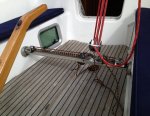
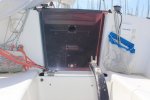
I am having trouble trimming the mainsheet as it doesn't currently have any way of moving the block to P or S as the the block is attached to an eye on the cockpit floor. I have been looking at a number of solution and have attached pics of them. The cockpit is quite small (20" across on the floor) and the access to the companion way is also quite restricted. Because of the shape of the mouldings of the seats, it's not possible to fit a wider traveller either. I cannot run a system at the back of the boom via the transom either as the distances are too great and I would end up being garrotted at the helm.

So my options are
1. Across the top of the companionway step but making access to the cabin even harder. Best travel but most inconvenient
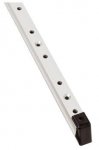
2. Across the floor with a Barton i-beam type setup. Medium travel, medium inconvenience, lowest cost.
3. Across the cockpit with a removable setup up, but with less travel and low inconvenience and highest cost.

My question is, which system will give me the most benefit verses inconvenience of location? There is about £100 between the option which I'm not that bothered about.
OR have I missed a trick to which one of you can advice please.

Thanks

PeteIMG_6970.jpgBarton Liftout.jpgbartin iBeam.jpg
 
Which is least inconvenient for the people/person sheeting the genoa?
People have to do that during a tack or gybe, they don't have to access the cabin at those times.

Many boats would extend the traveller across the cockpit seats.
If your boat has a strong boom, you might be able to use the kicker to give more of the leech tension and sheet with a bridle system instead of a tracked traveller.
 
20 inches of travel is in my opinion not worth worrying about, so I don't like any of your suggestions.

A traveller across port and starboard cockpit seats would give you control, but would restrict movement around the cockpit, which is always the trade off.

Plank
 
20 inches of travel is in my opinion not worth worrying about, so I don't like any of your suggestions.

A traveller across port and starboard cockpit seats would give you control, but would restrict movement around the cockpit, which is always the trade off.

Plank

I agree. Not worth the trouble and inconvenience
 
20 inches of travel is in my opinion not worth worrying about, so I don't like any of your suggestions.

A traveller across port and starboard cockpit seats would give you control, but would restrict movement around the cockpit, which is always the trade off.

Plank


This is where my boat's is located (near the companion way) but the OP's seating appears to be curved and not able to take the traveller across fully - better not to bother then.
 
This is how it is done on our Sadler. But the seats are level, making it easier. It is possible to bend these tracks, there are some types that are strong enough to be unsupported in the centre section but others need additional structure. It doesn't make entry to the saloon appreciably more difficult.
CockpitGoes1-1.jpg


One alternative is to use two mainsheet blocks on eyes each side of the cockpit or on the coach roof, I think the Spring 25 (and some others) does so. It is then possible to adjust the boom position to almost wherever required.
 
20 inches of travel is in my opinion not worth worrying about, so I don't like any of your suggestions.

A traveller across port and starboard cockpit seats would give you control, but would restrict movement around the cockpit, which is always the trade off.

Plank
Depends on the length of the boom.
And whether there is an issue with the main setting well.
When I had my Impala, letting the traveller down a few inches made a huge difference.
Likewise bringing it up to weather in light air.
A bit of one design racing will show you these things.

A longer traveller is nice, but only really comes into its own when fetching or basically overpowered in the gusts.

At least a short traveller can have a decent 4:1 tackle on it, so you can play it in gusts, without having miles of string.
 
004_zps0fc53ad9.jpg


This is what I have on my Centurion 32. If your seats are higher than the central part, could you not build this part up to be level with the seats?

Access to the companionway is only a slight problem when the lower mainsheet block is placed upwind so as to bring the boom past the centreline; otherwise, for 'normal sailing' it is just beyond the opening whatever the tack.

I have never liked the idea of a beam across the cockpit because of damage to my shins...I mostly sail single-handed. It also interferes with my access to the genoa winches.
 
I have a track across the cockpit in my HR34. It looks a bit odd, and only gives moderate travel, but rarely gets in the way and is something I use to brace myself when hauling on halyards. On the other hand, it's not something I would instal if other options were better. A track near the companionway worked well in our Sadler 29. It is a convenient place for adjustments and very seldom got in the way of entering or leaving the cabin.
 
If you want a traveller to go across the seats then make a template and shape so hardwood to give the flat across the width. So long as you bolt through the track to under the seats. I did the same to mount an outboard bracket on a curved transom. Do you have room so it does not foul the tiller, allows the helm to sit in a comfortable position and leave room for the crew. If it's not at the stern or by the companionway you could find it quite intrusive.
 
If you want a traveller to go across the seats then make a template and shape so hardwood to give the flat across the width. So long as you bolt through the track to under the seats. I did the same to mount an outboard bracket on a curved transom. Do you have room so it does not foul the tiller, allows the helm to sit in a comfortable position and leave room for the crew. If it's not at the stern or by the companionway you could find it quite intrusive.

I'm in the process of doing this - I made a mahogany beam to go across the whole width of the cockpit - the seats weren't quite level so did a bit of profiling to get the top surface flat and level. I've yet to fit the beam and track - looking for bolts, penny washers etc at the moment, also 25mm blanking plugs to cover the holes on the inside of the boat. I need to test drill the seats to get the depth for the bolts, first though.
 
We use our main traveller mostly to bring the sheet to weather on the beat. It does not need to travel very far so the gap between the seats may well give enough adjustment. If using a track on the floor I think you will need to have a corded adjustment system, to cam cleats fixed vertically on the locker sides. Adjusting nasty metal stops at floor level will possibly mean you don't use the traveller often. I don't know if you have a sprayhood but if you mount the traveller on the bridgedeck you would have to keep it far enough aft to avoid a clash. Ours is against the bulkhead and this is definitely an issue.
Picture is of trial sail, pre fitting out.
 
Last edited:
As lw395 said earlier, an alternative is to beef up the kicker and use that to control twist rather than the traveller. As he also mentioned, make sure your boom is strong enough to handle it.
 
Faced with the same problem - but the advantage of doing it from new - I had a SS tube bent to shape (large diameter, so expensive) to go up from cabinroof/cockpit bulkhead each side, aft of, across and above companionway allowing access below.
This takes two mainsheets, one to each side, giving complete control of position and shape of sail.
It also takes ends of high-level jackstays, sprayhood and supplies a very robust hand grip when standing in cockpit.
This leaves cockpit clear, but is in reach of helm and crew.
Years ago I was trapped by a mainsheet after an accidental gybe and unable to breathe, I resolved never to have a low-level sliding mainsheet across the cockpit.
Ken
 
Top