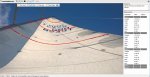
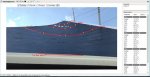
Main sail luff curve.

I do know that a mast should have a degree of curve and I did try a long time back.
I ended up with more mast rake but no curve.
I think the forward lower shrouds are maybe not enough forward and I end up with a crazy amount of tension on the forward shrouds, much more than some boats could take.
The boat does sail to windward amazingly well !
I do need to address the rake one day. Being a long keel it's extremely forgiving .
 
I suggest that you try to get hold of a copy of "Make your own sails" by R.M.Bowker and S. A. Budd. It's an old book so well out of print. I bought the 'revised edition' in 1980. ISBN 0 333 17906 4 pub Macmillan
It gives instructions for calculating the shape of the luff and broad seams along with everything else to build a range of sails.
Originally written for cotton it has a short chapter on Terylene which basically says to ignore the stretch ratios given for cotton cloths.
 
I suggest that you try to get hold of a copy of "Make your own sails" by R.M.Bowker and S. A. Budd. It's an old book so well out of print. I bought the 'revised edition' in 1980. ISBN 0 333 17906 4 pub Macmillan
It gives instructions for calculating the shape of the luff and broad seams along with everything else to build a range of sails.
Originally written for cotton it has a short chapter on Terylene which basically says to ignore the stretch ratios given for cotton cloths.
I first tried with 'Racing Dinghy Sails' by Jeremy Howard-Williams (1971) and didn't get a good result. The book I referenced above is far more comprehensive and deals with synthetic and natural fibres. But more recent at 1994
Not familiar with B&B's book but we did use their sails a while back.
The SMA's also covers more modern cuts for synthetics, like radials..
 
there are things that im great at being a tradesman myself and other things where its best for me to pay someone as they do the job in a fraction of the time and far better.
sailmaking is one of those things i would leave to a sailmaker. a few adjustments and repair i would happily tackle.
 
My previous mainsail was very badly stretched. This one came from a storage unit clear out, is a little shorter and will certainly do for a while until I find a better one.

Why did you go and buy a sail that obviously isn't intended for your boat and doesn't fit?

Maybe it's time to bite the bullet and go and buy one that is made to fit and perform properly without being bodged. Your boat will know the difference, it will sail properly and you will enjoy the sailing more.
 
Why did you go and buy a sail that obviously isn't intended for your boat and doesn't fit?

I paid £160 for 75m of immaculate 10mm chain, 20 litres of international antifoul, a bag full of rope and a mainsail that is only a couple of feet shorter than the terrible one I had.
I've had a lot of cheap boats that I've been given or bought crazy cheap ,done a little work and sold on and have bought and sold around 30 sails over the years (cheap boats often don't have their sails) .
This mainsail is the first one I've come across with a large luff curve and up until now was not really aware, or gave no thought to sails being like this.
My boat sails perfectly fine often reaching max hull speed under genoa alone .
Putting the mainsail up is often not worth the hassle.
Why not make do with what I have now , buying me lots of time to source another.
Maybe this one will work out fine.
Why do you think it will be bodged?
 
Every sailmaker and sail design programme shapes sails in different ways. Some have lots of luff curve and very little seam shaping which make a sail very adjustable while others have lots of seam shaping and low amounts of luff curve giving a much more stable shape but with less range of adjustment.

I have certain luff curve percentages that I use as a baseline depending on the rig type and sailing style, but for re-cutting these have to be used in conjunction with how much bend your mast has, how much adjustment you have to that bend and then how the sail sets and its age and batten layout. Another thing to always check is the position of your luff reef attachments on the sail, it must remain at the correct distance from the luff so that when reefed the load is taken correctly (this can define how much you can re-cut without re-patching)

I would always advise going sailing and taking photos of the flying shape before a re-cut. Its fairly simple to photograph. Find a day with medium wind conditions (10-15 knots). Mark the mid point on the boom and take a photo of the sail ensuring to get the boom and as much of the sail in as possible. When home input the photo into this free programme SailPack-Vision see the attached photos to get an idea. The white dacron sail is much too deep and either needs more mast bend put in or luff curve taken out while the black 3DI sails is setup nicely.

How long is your luff and what is your rig configuration (masthead or fractional)
 

Attachments

  • Mainsail upwind 2.jpg
    Mainsail upwind 2.jpg
    336.2 KB · Views: 20
  • Mainsail 3.jpg
    Mainsail 3.jpg
    296 KB · Views: 20
Current luff is 11.4m . Foot is 4m. Masthead rig. Mast is a very heavy section kemp, ex mod nicholson 42.
The sail sets beautifully across all of it, fore to aft, top to bottom, no creases or baggy areas but-
Top 1/4 of sail is fine, bottom 1/4 is also spot on( leech to luff) , the middle half right on the luff extending no more than 300 mm back is slack. It's that bit I want to tighten up.
Hopefully my sketch may help. The dots show were sail should be, but the extra luff curve and nearly full length battons create this small loose tight curve.
I did draw it straight but camera has added mast curve ?
Batton representation may also be incorrect
 

Attachments

  • 1587990323195-356557835.jpg
    1587990323195-356557835.jpg
    219.1 KB · Views: 19
  • 15879907797041460266996.jpg
    15879907797041460266996.jpg
    293.3 KB · Views: 19
Last edited:
Current luff is 11.4m . Foot is 4m. Masthead rig. Mast is a very heavy section kemp, ex mod nicholson 42.
The sail sets beautifully across all of it, fore to aft, top to bottom, no creases or baggy areas but-
Top 1/4 of sail is fine, bottom 1/4 is also spot on( leech to luff) , the middle half right on the luff extending no more than 300 mm back is slack. It's that bit I want to tighten up.
Hopefully my sketch may help. The dots show were sail should be, but the extra luff curve and nearly full length battons create this small loose tight curve.
I did draw it straight but camera has added mast curve ?
Batton representation may also be incorrect

How have you measured the current luff curve? It needs to be done with the sail pulled out, a flake put in the luff and the sail properly spiked out tight. If you just pull the sail out tight without a flake you will end with a luff curve number that is affected by the seam shaping and is generally a higher amount then there actually is.

Again to do any re-cut will require the above done and the full luff refaired, only doing part of the luff will end up a unfair curve.

For a small sailmaker in the Solent area there are plenty, GP Sails at Warsash is a family run business and Grant has a wealth of knowledge, he will be able to do a very good job and properly asses the sail.
 
I intended to do the whole luff, not part of it.
Im not understanding how one can spike the sail out tight but get a flake in the luff?
It's not the easiest describing things via text.
The information I'm getting here is really good ?.
 
I intended to do the whole luff, not part of it.
Im not understanding how one can spike the sail out tight but get a flake in the luff?
It's not the easiest describing things via text.
The information I'm getting here is really good ?.
See the attached photo for how a sail should have a flake in the luff and be spiked out. The photo is of a dayboat jibs leech so it hollowed but the principal is the same
 

Attachments

  • 20200327_094137.jpg
    20200327_094137.jpg
    978.9 KB · Views: 15
After reading all the helpfull advice I went with my original plan as the advice seemed to tally with my original guestimate.
I tried flaking and pegging down the sail but the luff could easily be moved one way or the other whereas sail just laid on flat surface gave me a straight line from top to bottom eye that fell in the same place each time I tried it.
I measured between my line and the luff along the length of the sail and removed 2/3.
Sewed it all back together, put it up on the boat and it sets so much better as I no longer have the loose area directly behind the luff.
Cost £26 for new eyes and killed a bit of lockdown time.
 

Attachments

  • 15902276053691818458651.jpg
    15902276053691818458651.jpg
    703.9 KB · Views: 10
Top