
Macwester 32 rig tension help (Westerly and other views welcome too)

yodave

Well-Known Member
Joined
31 Dec 2010
Messages
400
Location
up North
Visit site
rigtensioner_01.jpg


Hi, I'm not happy with the tension on our Macwester Malin's rigging. It seems to me that there's a balance between ensuring that your mast stays upright and driving it down through the coach roof. We don't race, so don't want to have the mast set-up for racing. We cruise and our number one aim is to ensure that the mast is tensioned properly to avoid fatigue and failure.

Does anyone know what sort of tension I should aim to achieve on a Macwester Malin or Wight ketch? Failing that any views on a similar setup perhaps on an older Westerly?

Any tips on how best to spread the load across the rigging and achieve balance?

All views/input welcome. Thanks in advance for any input.
 
Hi, I'm not happy with the tension on our Macwester Malin's rigging. ......

All views/input welcome. Thanks in advance for any input.

The advice on setting up the rigging on the Selden masts website is well worth reading. It should answer many of your questions ..... but may raise others.

You obviously have a gauge but otherwise there is a method of adjustment describe based on the stretch of the wire, Also a useful hint about under what sailing conditions the leeward shrouds should just start to go slack.

I hope one of these links works . (Selden seem to have changed their website since I last looked at it)

http://www.seldenmast.com/resources/hints_and_advices.html
or
http://www.seldenmast.com/products/pdfview/__file_595-540-E-1-88.pdf.html


.
 
Last edited:
Most owners don't set rigging tension anywhere near high enough, and vibration/movement due to insufficient tension can cause rig failures.

It would be worth paying a rigger to set yours up properly (wouldn't cost much), then you can measure the various tensions and be able to repeat the settings yourself in future.
.
 
As said above you need to put far more tension in than you might think. I can't think of a good argument for paying a rigger to tension the rig as it's such a simple job. The Selden guide is excellent - just follow the section for masthead rigs.
 
I can't think of a good argument for paying a rigger to tension the rig as it's such a simple job.

It might not be so simple to set up the OP's ketch rig, and boatowners are usually scared of winding the correct amount of tension on. Once it's been properly done by a rigger, the OP can measure the various tensions and note them for future use.
 
It might not be so simple to set up the OP's ketch rig, and boatowners are usually scared of winding the correct amount of tension on. Once it's been properly done by a rigger, the OP can measure the various tensions and note them for future use.

Fair enough I may have been a bit flippant there :). I know what I am doing in a Bermudan sloop situation but have never tuned a ketch.

I assume it's a matter of treating each mast separately as if it was a masthead rig (lateral alignment, rake, tension / prebend) and then gently taking up any slack in the triatic?
 
Last edited:
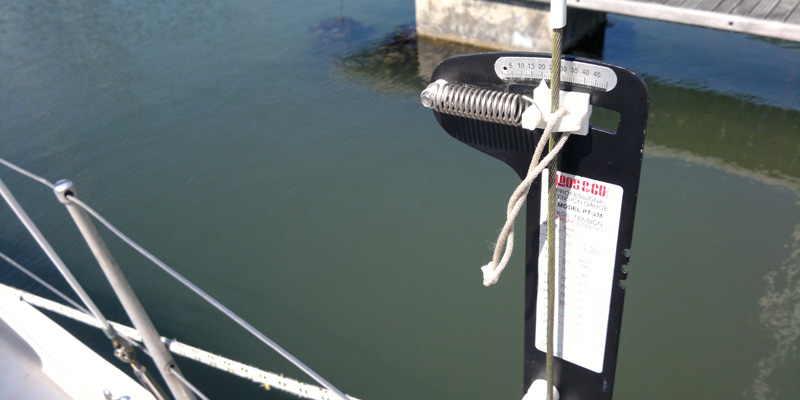
I tuned my friend's Macwester Wight ketch last year. Unfortunately I don't recall the exact figures we used but it was a good deal tighter when we'd finished! The figure of 15% rings a bell for the fore and back stays with something less for the shrouds. I used a borrowed Loos professional gauge which was so much easier to use than the tape measure method so I would recommend you get hold of one if you can.
The two masts are independently stayed so are treated as separate entities.
The triatic stay between the two masts was just tightened so it didn't sag but I don't know whether this is correct.
Subsequent sea trials were a bit inconclusive but it did seem to perform a bit better.
 
You should have something between 10 and 15% of the breaking load of the wire.The way to check is by measuring stretch . Tape a one meter length of a tape measure to the stay and mark at the lower end with insulating tape.Wind up the rigging screws until you've achieved the desired stretch knowing that one millimeter equals 5% of the breaking load of the wire regardless of it's diameter.Start with 10% and go sailing in about 15 knots of wind.If the rig is still too slack increase the tension to a maximum of 15% of the BL of the wire.If the tension doesn't increase with winding up of the rigging screws there's a structural problem.
This applies to masthead rigs.Fractionals take much higher loadings.
 
You should have something between 10 and 15% of the breaking load of the wire.The way to check is by measuring stretch . Tape a one meter length of a tape measure to the stay and mark at the lower end with insulating tape.Wind up the rigging screws until you've achieved the desired stretch knowing that one millimeter equals 5% of the breaking load of the wire regardless of it's diameter.Start with 10% and go sailing in about 15 knots of wind.If the rig is still too slack increase the tension to a maximum of 15% of the BL of the wire.If the tension doesn't increase with winding up of the rigging screws there's a structural problem.
This applies to masthead rigs.Fractionals take much higher loadings.
Agree with the % of breaking load but would again stress the ease of using a Loos gauge if you can borrow one.
 
Agree with the % of breaking load but would again stress the ease of using a Loos gauge if you can borrow one.
As it happens I own one and use it.It's much easier.The stretch method is helpful if one doesn't know what tension to aim for although this is easily arrived at.
 
Well I am like the OP still confused about rig tension. Perhaps not so much confused as just refusing to believe the words. I have raced my little fractional rig for 30 years through 4 masts and several rig replacements. All rigged and set up myself. yes I understand the concept of stretching the wire to reduce fatigue problems but I just can not get the hull being part of the load path to understand what is needed. or put another way I always have slack lee stays.
So I write it off in my mind that Selden might understand rigging and so suggest 15% of max working wire strength but they just don't understand fibre glass hulls and the inherent flexibility between the mast compression post the hull and the chain plates. Is my boat just pathetically flexible or is everyone just agreeing with Selden cos tey are experts.
I do like the advice saying for one boat type tighten the rigging till the loo door won't close then back off a bit.
I have no trouble understanding how the rig is set up with relative tensions giving different shape results but it is the overall tension that worries me. meanwhile I will just keep replacing the wire every 10 years or so as I have done. olewill
 
Well I am like the OP still confused about rig tension. Perhaps not so much confused as just refusing to believe the words. I have raced my little fractional rig for 30 years through 4 masts and several rig replacements. All rigged and set up myself. yes I understand the concept of stretching the wire to reduce fatigue problems but I just can not get the hull being part of the load path to understand what is needed. or put another way I always have slack lee stays.
So I write it off in my mind that Selden might understand rigging and so suggest 15% of max working wire strength but they just don't understand fibre glass hulls and the inherent flexibility between the mast compression post the hull and the chain plates. Is my boat just pathetically flexible or is everyone just agreeing with Selden cos tey are experts.
I do like the advice saying for one boat type tighten the rigging till the loo door won't close then back off a bit.
I have no trouble understanding how the rig is set up with relative tensions giving different shape results but it is the overall tension that worries me. meanwhile I will just keep replacing the wire every 10 years or so as I have done. olewill
I tension my caps to 20% of the breaking load and the boat so far has been taking it well.I now have a stiffer mast but my previous mast had a much smaller section(although the walls were thicker) and required tensioning to 25% of the breaking load of the wire.Anything less than 20% now and I get slack leeward caps and lowers.Boat is a Westerly Fulmar.
 
Many thanks to everyone who has replied. Thanks to VicS & Salty John for the links which I'll study. Reading the comments there seems to be a consensus that 15% is about right. GhostlyMoron has experience with a Macwester Wight and suggested 15% for the forestay & backstay with less for the shrouds. 30boat suggests a max of 15%, and has a Westerly Fulmar (which I think has a replacement mast) that is tensioned to 20%.

This is all very useful input. Thank you again. As I mentioned, I'll look at the links and then may come back with more questions. A bit like William_H, I feel that getting the balance right is a complicated issue that requires a tailored solution for each boat. Bringing in a professional as pvb suggests might be the way ahead; but then of course I'd be relying on them being knowledgeable about older yachts ...and as we all know there are good and bad tradesmen out there.

Thanks once again to everyone who replied including paul-essex, nickrobinson & mrming.
 
Last edited:
I tension my caps to 20% of the breaking load and the boat so far has been taking it well.I now have a stiffer mast but my previous mast had a much smaller section(although the walls were thicker) and required tensioning to 25% of the breaking load of the wire.Anything less than 20% now and I get slack leeward caps and lowers.Boat is a Westerly Fulmar.

But doesn't the Fulmar have a fractional rig with aft swept spreaders. That's a different kettle of fish to set compared to the OP's Macwester.

I dont know if it applies to the Fulmar but IIRC some such rigs require the shrouds to be tensioned so that they do not go slack.

Selden IIRC suggest that the cap shrouds of a conventional masthead rig should only just go slack when sailed to windward in a force 4 when the heel reaches about 20 degrees
 
Last edited:
Top